
Heating System Maintenance: Save Money All Year Long
Discover how heating system maintenance saves money by lowering energy bills and preventing costly repairs. Start saving today!
Heating System Maintenance: Save Money All Year Long
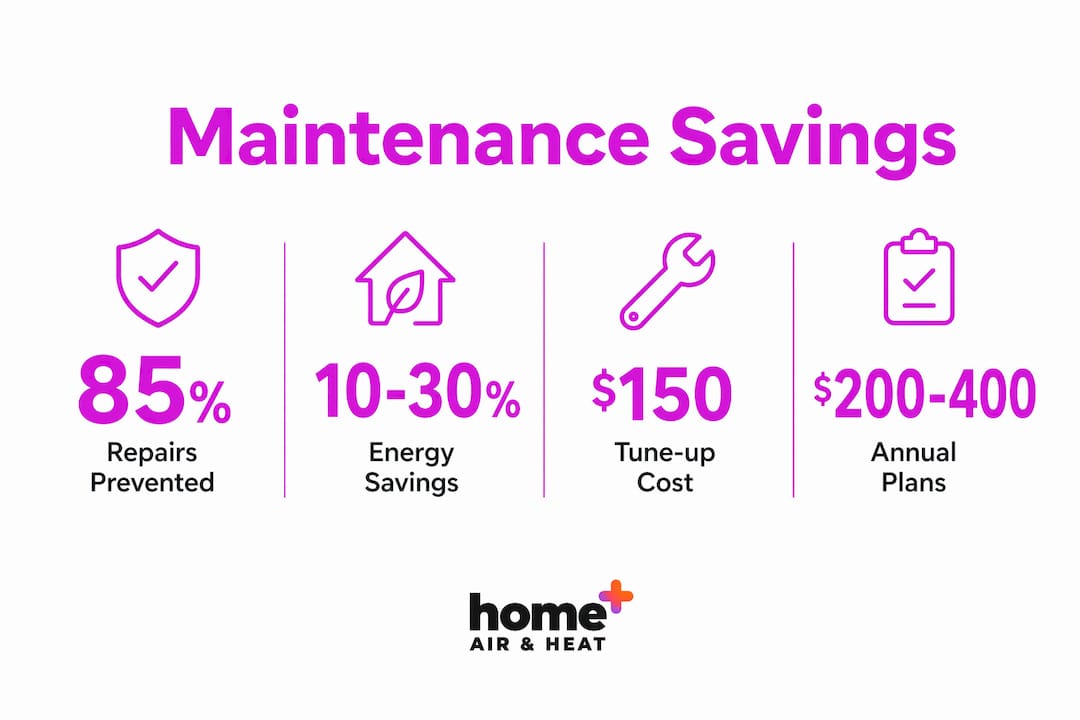
Routine heating system maintenance is the single most cost-effective action a homeowner can take to reduce energy bills and avoid expensive repairs. Energy bills drop 10%–30% with regular professional service. A professional tune-up runs $80–$300, while emergency repairs cost $800–$2,500. Skipping annual service does not save money. It delays a small expense and creates a much larger one. This article breaks down exactly how heating system maintenance saves money, what tasks matter most, and how to choose a plan that fits your budget.
Why does heating system maintenance reduce repair costs?
85% of HVAC repairs are preventable with routine maintenance. That number means most homeowners paying for emergency service calls could have avoided the bill entirely with a scheduled tune-up.
The financial logic is straightforward. A technician catching a weak capacitor or a dirty burner during a $150 tune-up prevents those components from causing short-cycling. Short-cycling stresses unrelated parts and triggers cascading failures that push repair bills past $1,000. One ignored warning sign becomes three broken components.
Emergency repairs also carry a price premium. Emergency service costs 50%–100% more than scheduled maintenance. A repair that costs $400 during a booked appointment can cost $700 on a Saturday night in january when your heat stops working.
Warranty protection adds another financial layer. Most manufacturers require documented annual service to keep warranty coverage active. Skipping a single year can void the warranty and leave you paying full price for a part the manufacturer would have covered.
- Weak capacitors cause motor failures if left unchecked
- Dirty burners lead to overheating and heat exchanger cracks
- Clogged condensate drains cause water damage and shutdowns
- Low refrigerant stresses the compressor until it fails completely
- Cracked heat exchangers create carbon monoxide risks and require full replacement
Pro Tip: Keep a maintenance log with dates, technician names, and work performed. Manufacturers and home insurers both ask for this documentation when a warranty or damage claim is filed.
How does maintenance lower your heating bills?
Heating accounts for approximately 29% of a home’s utility costs. That makes it the single largest controllable expense in most households. Maintenance directly attacks that number.
A dirty air filter forces the blower motor to work harder to push air through the system. Changing filters every 1–3 months lowers monthly energy costs by a measurable amount. Clogged ducts compound the problem by trapping heat before it reaches living spaces. Duct repairs alone improve efficiency by up to 20%, which translates directly into lower bills.
Professional tune-ups go further. A technician calibrates the fuel-to-air ratio in a furnace during a tune-up. When that ratio drifts, combustion inefficiency adds up to 10% to gas bills without any visible sign of a problem. You pay more every month and never know why.
Here is a practical example. If your annual heating bill is $1,800, a 15% efficiency gain from a tune-up saves $270 per year. A $150 tune-up pays for itself in under seven months and keeps saving money every month after that.
- Replace air filters every 1–3 months with a MERV 8–11 rated filter
- Clear supply and return vents of furniture, rugs, and debris
- Check thermostat settings and switch to a programmable or smart thermostat
- Seal visible duct gaps with mastic sealant or metal tape
- Schedule a professional tune-up each fall before the heating season starts
Combining maintenance with air sealing and thermostat management produces the best long-term savings. Each strategy reinforces the others.
What tools and steps do homeowners need for heating maintenance?
Effective heating system upkeep splits into two categories: tasks you handle yourself and tasks that require a licensed technician. Knowing the difference saves time and prevents accidental damage.
DIY tasks homeowners can do
You need a flashlight, a screwdriver, a vacuum with a brush attachment, and replacement filters in the correct size for your system. With those tools, you can replace filters, vacuum around the furnace cabinet, clear debris from outdoor units, and check that vents are open and unblocked. These tasks take under 30 minutes and cost nothing beyond the filter price.
Pro Tip: Write the filter replacement date on the filter frame with a marker when you install it. You will never guess whether it has been one month or four months again.
What a professional tune-up covers
| Task | DIY | Professional |
|---|---|---|
| Filter replacement | Yes | Yes (included) |
| Thermostat calibration | Basic | Full calibration |
| Burner cleaning | No | Yes |
| Heat exchanger inspection | No | Yes |
| Flue and venting check | No | Yes |
| Electrical connections check | No | Yes |
| Combustion efficiency test | No | Yes |
| Refrigerant level check | No | Yes |
A NATE-certified technician covers every item in the professional column during a standard tune-up. The best time to book is in september or october, before peak demand drives up wait times and prices. Waiting until december means longer delays and potentially no heat during the coldest nights.
For homeowners with ductless heating systems, the checklist differs slightly. Filter cleaning, coil inspection, and refrigerant checks replace duct-related tasks, but the scheduling logic stays the same.
How to choose the right maintenance plan and maximize your savings
Maintenance plans typically cost $200–$400 per year and include two visits, priority scheduling, and parts discounts. For most homeowners, the math favors a plan over paying per visit.
| Option | Annual cost | What you get |
|---|---|---|
| Single tune-up | $80–$300 | One visit, no priority status |
| Maintenance plan | $200–$400 | Two visits, priority response, parts discounts |
| No service | $0 upfront | Higher bills, repair risk, voided warranty |
Priority scheduling is worth more than it looks on paper. Priority response status in a maintenance plan guarantees faster service during peak heating season. That means you avoid the emergency premium when your system fails on the coldest night of the year.
Regional pricing varies. Labor rates in California run 20%–30% higher than the national average. Long Island homeowners face similar coastal market pricing, which makes locking in a plan rate before the heating season a practical move.
- Ask whether the plan covers both heating and cooling visits
- Confirm that parts discounts apply to the components most likely to fail on your system’s age
- Check whether the plan transfers if you sell the home, since maintenance contracts can boost property value
- Verify that the plan includes a written service record for warranty purposes
Common maintenance mistakes and how to avoid them
The most expensive maintenance mistake is skipping a year because the system seems to be running fine. Skipping a single maintenance year costs more than the tune-up price avoided once efficiency losses and emergency repair risk are factored in. Systems do not announce problems. They degrade quietly until something fails.
Ignoring air filter replacement is the second most common error. A clogged filter does not just reduce airflow. It forces the blower motor to overheat, shortens its lifespan, and raises your monthly bill every single day it stays in place.
Delaying action on warning signs is the third mistake. A furnace that short-cycles, makes a new noise, or takes longer to reach temperature is signaling a problem. Waiting costs more than acting. A cracked heat exchanger from a neglected burner is not just expensive. It is a carbon monoxide risk.
- Do not skip fall tune-ups because summer bills were low
- Do not use the cheapest fiberglass filters if your system requires higher filtration
- Do not ignore a yellow or flickering burner flame on a gas furnace
- Do not block return air vents with furniture to “redirect” heat
Pro Tip: Set a recurring calendar reminder for the first week of september to schedule your heating tune-up. Booking early avoids the october and november rush and often gets you a better appointment window.
Pairing your tune-up with effective maintenance scheduling turns reactive repairs into planned, predictable costs. That shift alone changes how much you spend on your home each year.
Key takeaways
Regular heating system maintenance is the most direct way to cut energy costs, prevent expensive repairs, and extend the life of your equipment by 5–8 years.
| Point | Details |
|---|---|
| Maintenance cuts energy bills | Professional tune-ups reduce annual heating costs by 10%–30% through combustion and airflow improvements. |
| Repairs cost far more than tune-ups | Emergency repairs run $800–$2,500 versus $80–$300 for scheduled service, a difference of 50%–100%. |
| Filter changes matter every month | Replacing filters every 1–3 months prevents blower strain and keeps monthly bills from climbing. |
| Maintenance plans offer the best value | Plans at $200–$400 per year include priority service, two visits, and parts discounts for older systems. |
| Skipping service voids warranties | Most manufacturers require documented annual service to honor warranty claims on parts and equipment. |
What I have learned from watching homeowners skip maintenance
The pattern I see most often is this: a homeowner skips the fall tune-up, the system runs through winter without obvious problems, and they feel like they saved $150. Then in february, the furnace locks out at 11 p.m. The emergency call costs $600. The part that failed would have been caught and cleaned during the skipped tune-up.
What surprises most homeowners is that the savings from maintenance are not just about avoiding repairs. A well-maintained furnace uses less fuel every single day it runs. Over a full heating season, that adds up to real money. The efficiency gain is invisible, which is exactly why people underestimate it.
The other thing I would push back on is the idea that newer systems do not need service. A two-year-old furnace still accumulates dust on the burners, still drifts on its fuel-to-air ratio, and still needs its heat exchanger inspected. Age matters less than consistency. The homeowners I have seen get 20-plus years from a furnace are the ones who never missed a fall tune-up.
My honest advice: treat the annual tune-up like a car oil change. You do not wait for the engine to knock before you service it. The same logic applies to the system that heats your home.
— Blake
Hometsair makes heating maintenance simple on Long Island
Hometsair serves Long Island homeowners with NATE-certified technicians who understand the specific demands of coastal climates, including salt-air corrosion and homes without traditional ductwork. Every visit comes with transparent pricing, zero overtime fees, and a 90% first-visit fix rate.
If you want to stop paying emergency repair premiums and start saving on heating costs, a scheduled tune-up is the place to start. Hometsair’s furnace tune-up service is priced at $199 for Nassau County homeowners and includes a full inspection, combustion efficiency test, and written service record. For homeowners across Long Island, local HVAC service is available with same-day response and no surprise fees.
FAQ
How much does heating system maintenance save per year?
Regular maintenance reduces annual heating bills by 10%–30%, according to Energy.gov. On a $1,800 annual heating bill, that equals $180–$540 in savings each year.
How often should a furnace be serviced?
A furnace should be professionally serviced once per year, ideally in the fall before the heating season begins. Annual service keeps warranties active and catches problems before they become expensive repairs.
What happens if you skip annual heating maintenance?
Skipping a tune-up leads to efficiency losses, a higher risk of emergency breakdowns, and potential warranty voidance. Emergency repairs cost 50%–100% more than scheduled service, making the skipped tune-up far more expensive in the long run.
Does a maintenance plan save more money than a single tune-up?
For most homeowners, yes. Plans at $200–$400 per year include two visits, priority scheduling, and parts discounts, which reduce both repair costs and emergency service premiums compared to paying per visit.
Can dirty air filters really raise my heating bill?
A clogged filter forces the blower motor to work harder, raising energy use and shortening motor life. Replacing filters every 1–3 months is one of the simplest and most cost-effective heating system care tips available.