
How to Find Budget Heating Repair Services That Last
Learn how to find budget heating repair services that last, keeping your home comfortable without breaking the bank. Get expert tips now!
How to Find Budget Heating Repair Services That Last
Affordable heating repair is defined as professional HVAC service that restores your system to safe, working condition at a price you can plan for. When your furnace fails in January, the cost of doing nothing is always higher than the cost of a repair. Minor heating repairs run $150–$600, while complex jobs like blower motor replacements can reach $900. Knowing how to find budget heating repair services before a breakdown happens puts you in control of both your comfort and your wallet. This guide walks you through exactly how to do that, from locating the right contractor to deciding when repair no longer makes financial sense.
How to find budget heating repair services near you
The fastest way to locate affordable heating repair is to search licensed HVAC contractors through Yelp, the Better Business Bureau, or Google’s Local Services Ads, then filter by verified reviews and licensing status. These platforms show you real customer feedback and flag contractors who carry proper liability insurance. A contractor without insurance puts you on the hook for any damage that happens during the job.

Once you have a short list, call each one and ask three specific questions: Do you charge a diagnostic fee? Do you offer flat-rate pricing? Do you provide a written quote before starting work? Flat-rate pricing means you pay for the job, not the hour. That protects you from a two-hour job becoming a six-hour bill.
Here is what to look for when evaluating contractors:
- Licensing and insurance: Verify credentials through your state’s contractor licensing board.
- Written estimates: Never approve work without a signed, itemized quote.
- 24/7 availability: Emergency heating repair options matter when temperatures drop overnight.
- Maintenance memberships: Many providers offer annual plans that include discounts on repairs and priority scheduling.
- Experience with your brand: Contractors familiar with Lennox, Carrier, or Trane systems diagnose problems faster.
Pro Tip: Search for HVAC contractors who are NATE-certified. The North American Technician Excellence certification is the industry’s most recognized credential, and certified techs typically diagnose problems correctly on the first visit.
Homeowner maintenance plans are one of the most underused tools for keeping repair costs low. Maintenance plans provide priority scheduling during peak winter periods and member discounts that reduce total out-of-pocket costs. If you call a contractor cold in February, you may wait days. Plan members often get same-day service.
What does heating repair actually cost?
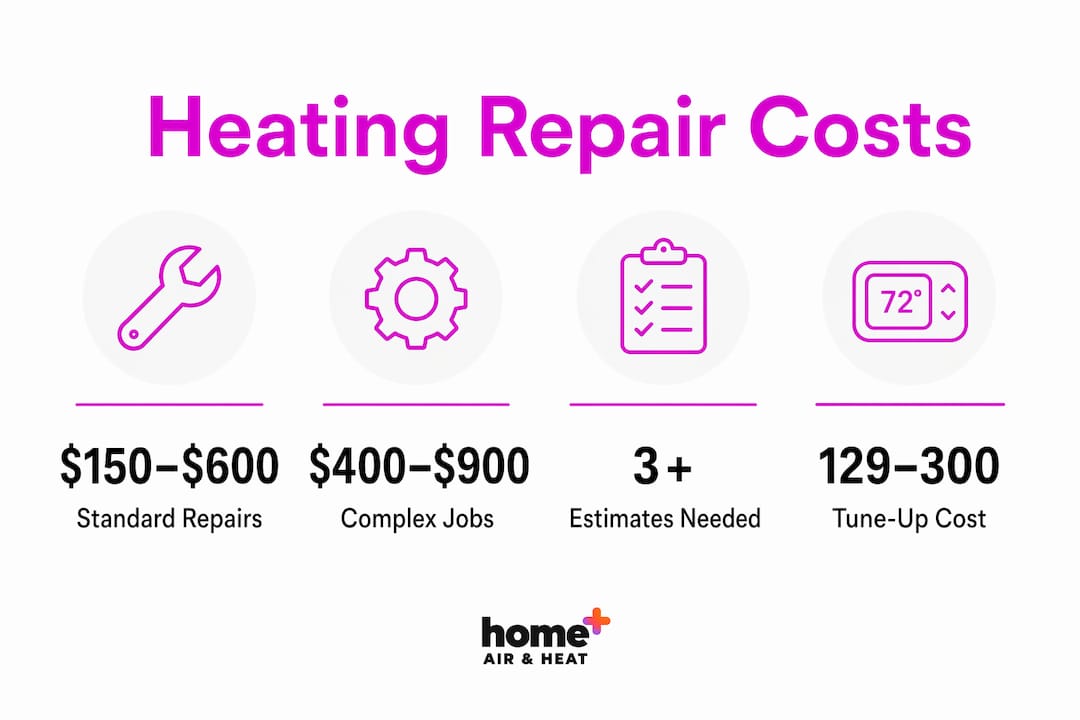
Standard heating repairs range from $150 to $600 for most common issues, with more complex jobs running $400–$900. Understanding where your repair falls in that range helps you spot a fair quote and walk away from an inflated one.
| Repair Type | Typical Cost Range |
|---|---|
| Flame sensor replacement | $150–$300 |
| Igniter replacement | $150–$250 |
| Thermostat replacement | $150–$300 |
| Blower motor replacement | $400–$900 |
| Heat exchanger repair | $500–$1,500+ |
| Emergency after-hours call | Add $100–$200 |
A few cost factors that most homeowners miss:
- Diagnostic fees: Some contractors charge $75–$150 just to show up and assess the problem. Ask upfront whether that fee applies toward the repair cost.
- After-hours premiums: Emergency heating repair options are available around the clock from many providers, but weekend and overnight calls often carry surcharges.
- Parts availability: Older systems from discontinued product lines can have hard-to-source parts, which drives up both cost and wait time.
Getting multiple written estimates is the single most effective way to benchmark pricing. Call at least three contractors before approving any repair over $300. The spread between the lowest and highest quote on the same job is often $200 or more.
Pro Tip: Ask each contractor to break out parts cost from labor cost in their written estimate. This lets you verify whether the parts markup is reasonable by checking retail prices on sites like RepairClinic or Grainger.
Legitimate HVAC repairs require onsite diagnostics. Any contractor who gives you a firm price over the phone without seeing the system is guessing. That guess usually costs you more in the end, either through unnecessary parts or a misdiagnosed problem that comes back within weeks.
Should you repair or replace your heating system?
The 50% rule is the standard industry benchmark: if the cost of a repair exceeds 50% of what a new system would cost, replacement is the smarter financial decision. Systems older than 15 years that need expensive repairs should be evaluated for replacement, not just patched.
Age and repair cost are the two primary factors, but they are not the only ones. Consider these signals that point toward replacement:
- Repeated breakdowns: If you have called a technician three or more times in two years, the system is failing systemically, not just in one component.
- Rising energy bills: An aging furnace loses efficiency every year. A system running at 70% efficiency costs significantly more to operate than a modern unit running at 95%.
- Carbon monoxide risk: A cracked heat exchanger is a safety emergency, not a repair option. A cracked heat exchanger can leak carbon monoxide into your living space. Trustworthy technicians will show you photographic evidence of the crack before recommending replacement.
- Refrigerant or parts obsolescence: Systems using discontinued refrigerants or discontinued parts lines become increasingly expensive to maintain.
A written assessment from your technician is non-negotiable before any replacement decision. Reputable contractors provide documented findings, not verbal pressure. If a tech tells you that you need a new system without showing you the evidence, get a second opinion.
When replacement is the right call, look at heat pump installation contractors as an alternative to a straight furnace swap. Modern heat pumps deliver both heating and cooling from one system, which changes the long-term cost math significantly.
How preventive maintenance cuts your repair costs
Annual furnace tune-ups are the most cost-effective investment a homeowner can make in their heating system. Tune-ups typically cost $129–$300 and prevent emergency repairs that routinely run $800–$2,500 or more. That is a return on investment that most financial decisions cannot match.
Here is what a standard annual tune-up covers:
- Cleaning the burners and heat exchanger: Removes buildup that reduces efficiency and creates safety risks.
- Testing the igniter and flame sensor: Catches the two most common causes of no-heat calls before they strand you in the cold.
- Inspecting the flue and venting: Confirms that combustion gases are exiting the home safely.
- Checking refrigerant levels and electrical connections: Prevents component failures that develop silently over months.
- Measuring system efficiency: Gives you a baseline to track performance year over year.
Modern high-efficiency furnaces require precise maintenance to avoid early component failure. A 96% AFUE furnace that skips annual service for three years can drop to the performance level of a 15-year-old unit. You paid for efficiency. Maintenance is how you keep it.
Schedule your tune-up in early fall, before the first cold snap. Contractors are less busy in September and October, which means faster appointments and sometimes lower rates. Waiting until December means competing with every other homeowner whose heat just stopped working.
Pro Tip: Ask your contractor about an annual maintenance schedule that covers your full home, not just the HVAC system. Bundled maintenance programs often cost less per service than booking each one separately.
Key takeaways
Affordable heating repair comes down to three things: finding the right contractor before an emergency, understanding what fair pricing looks like, and maintaining your system so emergencies happen less often.
| Point | Details |
|---|---|
| Use verified directories | Search Yelp and the BBB for licensed, insured HVAC contractors with documented reviews. |
| Get written flat-rate quotes | Always secure a written estimate before approving any repair to avoid billing surprises. |
| Know the 50% rule | Replace rather than repair when costs exceed half the price of a new system, especially on older units. |
| Schedule fall tune-ups | Annual maintenance costing $129–$300 prevents emergency repairs that run $800–$2,500 or more. |
| Join a maintenance plan | Membership plans deliver priority scheduling and repair discounts that reduce total annual costs. |
What I have learned from years of watching homeowners get burned on heating bills
The most common mistake I see is homeowners treating a phone quote as a real number. A contractor who quotes you $250 over the phone has not seen your system, has not tested your components, and is giving you a number designed to get you to say yes. Onsite diagnostics are the only way to get an accurate repair cost. I have watched homeowners approve phone quotes, then face a bill that was double the estimate because the tech found additional problems on arrival.
The second mistake is skipping the written estimate. Verbal agreements in home services are worth nothing. A written, itemized quote is your only protection if the final bill does not match what you were told.
Transparent, upfront pricing is the clearest signal of a trustworthy contractor. Contractors who provide no-pressure repair versus replace guidance and show you the evidence behind their recommendation are the ones worth calling back. The ones who push replacement without documentation are the ones to avoid.
My honest advice: join a maintenance plan with a contractor you trust before you need emergency service. The discounts are real, the priority scheduling is real, and the peace of mind is worth more than the membership fee. Cheap HVAC repair found in a panic at midnight costs far more than low-cost furnace service booked through a provider who already knows your system.
— Blake
Why Hometsair is built for budget-conscious Long Island homeowners
Hometsair operates as Home+ Air and Heat on Long Island, and the service model is designed specifically for homeowners who need reliable repairs without surprise costs. NATE-certified technicians arrive with the parts and tools to handle most repairs on the first visit. The company reports a 90% first-visit fix rate, which means fewer callbacks and lower total costs for you. Hometsair charges zero overtime fees and offers 24-hour HVAC service with upfront flat-rate pricing on every job. Maintenance memberships are available for homeowners who want priority scheduling and ongoing discounts. Contact Hometsair for a written estimate and find out what budget-friendly heating repair actually looks like when the contractor shows up prepared.
FAQ
What is the average cost of a heating repair in 2026?
Standard heating repairs cost $150–$600 for most common issues, with complex repairs like blower motor replacements reaching $900. Emergency after-hours calls typically add $100–$200 to the base repair cost.
How do I know if a heating repair quote is fair?
Get at least three written estimates from licensed contractors and compare the parts and labor costs separately. Any quote given over the phone without an onsite inspection is not a reliable number.
When does it make more sense to replace than repair a furnace?
Replace your furnace when repair costs exceed 50% of the replacement price, especially if the system is older than 15 years. A cracked heat exchanger is an immediate safety reason to replace rather than repair.
How much does a furnace tune-up cost, and is it worth it?
Annual tune-ups cost $129–$300 and prevent emergency repairs that typically run $800–$2,500 or more. For most homeowners, the math strongly favors annual maintenance.
What should I look for in a budget-friendly HVAC contractor?
Look for NATE certification, verified licensing and insurance, flat-rate written quotes, and a documented track record of first-visit repairs. Contractors who offer maintenance memberships with repair discounts deliver the best long-term value.