
HVAC Heating Upgrade ROI Explained for Homeowners
Discover how HVAC heating upgrade ROI explained can lead to significant energy savings, increased home value, and tax incentives. Learn more!

HVAC Heating Upgrade ROI Explained for Homeowners
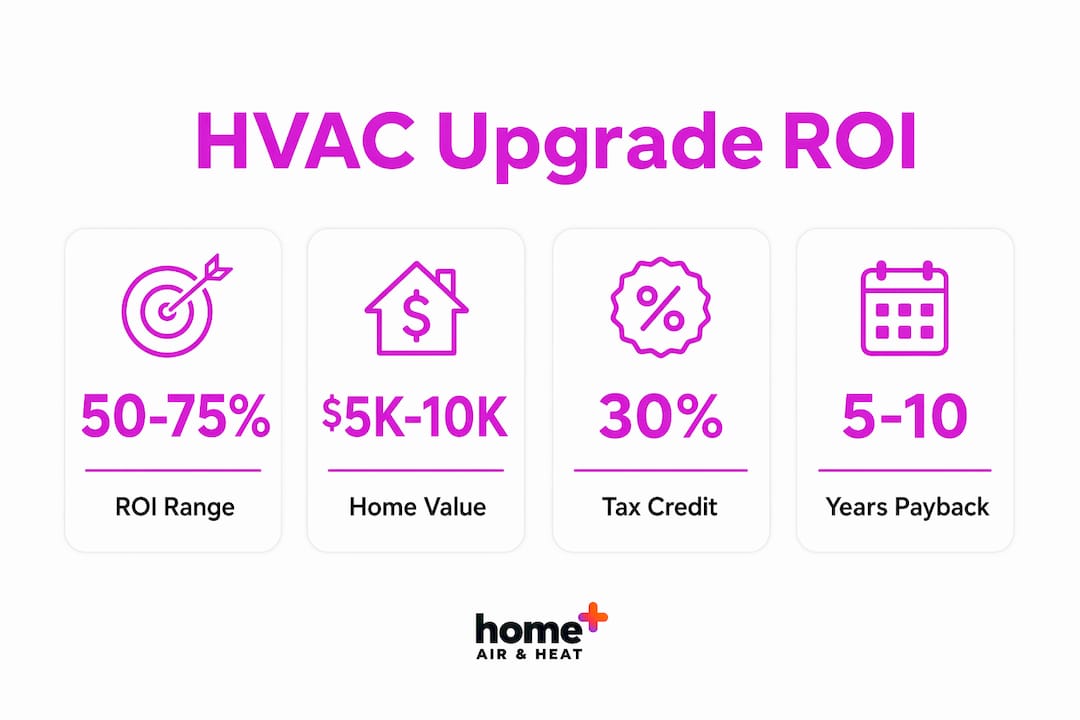
HVAC heating upgrade ROI is the financial return measured by reduced energy bills, increased home resale value, and tax credits compared against the upfront installation cost. Homeowners and property managers can expect a 50% to 75% ROI on high-efficiency HVAC replacements, with energy bill savings ranging between 20% and 40%. The payback period typically runs 5–10 years when you factor in energy savings, avoided repairs, and federal incentives. Three forces drive that return: monthly utility savings, the bump in appraised home value, and credits from the Inflation Reduction Act. Understanding each one separately lets you build a realistic projection before you spend a dollar.
How do energy savings contribute to HVAC heating upgrade ROI?
Energy savings are the most immediate and measurable component of return on investment for HVAC upgrades. A modern high-efficiency system cuts monthly utility costs from day one, while an aging unit continues to drain money every billing cycle.
The efficiency gains are concrete. Upgrading from a 10-SEER to an 18-SEER2 system can reduce cooling costs by approximately 44%. On a $200 monthly cooling bill, that translates to $880 saved in a single summer. The payback period on the efficiency premium alone runs 4–7 years.
Heating efficiency follows the same logic. Heat pumps deliver up to three times the efficiency of electric resistance heating. Homes currently running electric resistance heat could save $1,530 per year by switching to a heat pump, adding up to nearly $23,000 over 15 years.
Several variables determine how much you actually save:
- System sizing: An oversized unit short-cycles, running in brief bursts that waste energy and wear out components faster.
- Local utility rates: Higher rates per kilowatt-hour accelerate payback. Long Island homeowners, for example, pay among the highest electricity rates in the country.
- Climate zone: Heating-dominated climates extract more value from high-HSPF2 rated equipment than mild ones.
- Ductwork condition: Leaky ducts can bleed 20%–30% of conditioned air before it reaches living spaces.
Pro Tip: Multiply your current annual heating and cooling bill by the efficiency gain percentage of your new system. Then subtract that number from your total installation cost each year to estimate your personal payback timeline.
What is the effect of HVAC upgrades on home resale value?
A new HVAC system raises appraised home value and shortens time on market. Buyers treat a recently installed system as a risk reduction, not just a comfort feature.
The numbers back this up. A new HVAC system can increase home appraised value by $5,000 to $10,000, representing a 5%–10% boost on many mid-range homes. Homes with HVAC upgrades also sell 10%–15% faster than comparable listings with older systems. That speed matters for property managers and landlords who lose rental income during vacancy.
Heat pump installations carry an additional advantage. Homes with high-efficiency HVAC systems attract environmentally conscious buyers and command stronger offers in competitive markets. That buyer pool has grown significantly as energy costs have risen.
A few factors shape how much value you actually capture:
- Documentation: Keep all permits, installation records, and equipment specs. Appraisers and buyers both ask for them.
- Local market conditions: In high-demand areas like Nassau County, a new system can push a listing above asking. In slower markets, it primarily prevents price reductions.
- System age at time of sale: A system installed two years before listing carries more value than one installed eight years prior.
- Brand and efficiency rating: Equipment from recognized manufacturers with high SEER2 and HSPF2 ratings appraises better than budget alternatives.
The resale value contribution alone can account for a meaningful share of total ROI, particularly for homeowners planning to sell within 5–7 years of upgrading.
How do federal and local incentives impact HVAC upgrade ROI?
Tax credits and rebates reduce the net cost of your upgrade, which directly shortens the payback period. They do not change how efficient your system is. They change how much you actually spend to get there.
The Inflation Reduction Act is the most significant federal program currently available. Qualifying HVAC upgrades receive a 30% federal tax credit on installed cost. On a $10,000 heat pump installation, that credit returns $3,000 at tax time. Combined with local utility rebates, the effective out-of-pocket cost drops further.
Here is how to stack incentives effectively:
- Confirm equipment eligibility first. Not every heat pump or furnace qualifies. The ENERGY STAR certification and specific efficiency thresholds determine eligibility under the Inflation Reduction Act.
- Check your utility’s rebate program. PSEG Long Island, for example, offers rebates on qualifying heat pump installations. These rebates apply at the point of purchase, reducing upfront cost before the federal credit even arrives.
- Understand annual caps. The federal credit caps at $2,000 per year for heat pumps and $600 for other HVAC equipment. Homeowners doing phased upgrades can spread projects across tax years to maximize total credits.
- File IRS Form 5695. This is the required form for claiming residential energy credits. Your tax preparer needs the equipment’s efficiency certification and the total installed cost.
Pro Tip: Ask your contractor for the Manufacturer’s Certification Statement before installation. This document confirms your equipment qualifies for the federal credit and protects your claim if the IRS questions it.
What installation factors determine whether you actually get the ROI you expect?
Installation quality determines whether your new system delivers its rated efficiency or falls short by 20%–30%. Equipment ratings are measured in lab conditions. Your home is not a lab.
Over 65% of HVAC systems are improperly installed, causing 20%–30% excess energy use. That figure means most homeowners with new systems are not getting what they paid for. The root cause is almost always skipped load calculations and poor ductwork.
“Correct load calculation and professional installation are the most critical factors to securing ROI, more than just equipment efficiency ratings.” — U.S. Department of Energy
Manual J, Manual S, and Manual D calculations are the industry standard for sizing equipment and designing duct systems. Manual J determines how much heating and cooling your home actually needs. Manual S selects the right equipment for that load. Manual D sizes the ductwork to deliver conditioned air efficiently. Contractors who skip these steps and simply swap out old equipment for new units of the same size often leave significant savings on the table.
High SEER2 and HSPF2 ratings alone will not guarantee expected savings if the system is mismatched to your home’s load or the ductwork is not optimized. A box-swap replacement without proper system design consistently produces lower ROI than a fully engineered installation.
One more factor that homeowners underestimate: the shift to SEER2 and HSPF2 metrics reduces apparent efficiency compared to older SEER and HSPF ratings by 4.7%–15%. When comparing a new system to your old one, adjust for this metric change or you will overestimate your savings.
Pairing your HVAC upgrade with whole-home efficiency improvements like air sealing and added insulation produces the best combined ROI. A tighter building envelope means your new system runs less often to maintain temperature, compounding the energy savings.
Which heating system type offers the best ROI for your situation?
The right system depends on your climate, existing infrastructure, and energy costs. No single option wins in every scenario.
| System type | Best climate fit | Typical installed cost | Annual energy savings | Payback period |
|---|---|---|---|---|
| Heat pump (air-source) | Moderate to mild winters | $5,000–$12,000 | $500–$1,530/year | 5–10 years |
| Gas furnace | Cold climates, existing gas lines | $3,000–$7,000 | $200–$600/year | 6–12 years |
| Dual-fuel system | Mixed climates, variable winters | $7,000–$15,000 | $600–$1,200/year | 7–12 years |
| Ductless mini-split | Homes without ductwork | $3,000–$10,000 | $400–$1,000/year | 5–9 years |
Heat pumps consolidate heating and cooling into one unit, which eliminates the need for separate systems and reduces total maintenance costs. For Long Island homeowners replacing electric resistance baseboard heat, the savings case is particularly strong. Ductless systems like mini-splits work well in older homes without existing ductwork, a common situation in many Long Island housing stock built before central air became standard. You can read more about ductless heating options if your home lacks existing duct infrastructure.
Gas furnaces still make sense in regions with very cold winters where heat pumps lose efficiency, though modern cold-climate heat pumps now operate effectively down to 0°F. Dual-fuel systems pair a heat pump with a gas furnace backup, switching automatically based on outdoor temperature. They capture heat pump efficiency in mild weather and gas furnace power in extreme cold.
When calculating HVAC ROI, include avoided emergency repairs alongside energy savings. An aging system that costs $800–$1,500 per year in repairs adds that amount directly to your annual return once you replace it.
Key Takeaways
The return on investment for an HVAC heating upgrade depends on energy savings, resale value gains, and incentives working together, but only when the system is correctly sized and professionally installed.
| Point | Details |
|---|---|
| ROI range for upgrades | Homeowners can expect 50%–75% ROI with energy savings of 20%–40% on high-efficiency systems. |
| Federal tax credits | The Inflation Reduction Act covers 30% of installed cost for qualifying equipment, capped at $2,000 for heat pumps. |
| Resale value boost | A new HVAC system adds $5,000–$10,000 in appraised value and helps homes sell 10%–15% faster. |
| Installation quality matters | Over 65% of systems are improperly installed; Manual J/S/D calculations are required to realize rated savings. |
| System type drives payback | Heat pumps offer the strongest ROI in moderate climates; dual-fuel systems suit mixed-climate zones. |
What I’ve learned about HVAC ROI that most articles get wrong
Most homeowners focus entirely on the equipment efficiency rating when evaluating an upgrade. That number matters, but it is the second or third most important factor, not the first.
The single biggest determinant of whether you hit your projected ROI is the quality of the installation and the accuracy of the load calculation. I have seen homeowners install $14,000 heat pump systems and end up with higher bills because the contractor oversized the unit and left the ductwork untouched. The equipment was excellent. The installation was not.
The second thing most articles skip is the repair cost savings. If your current system is costing you $900 in repairs annually, that $900 is part of your annual return from the new system. Add it to your energy savings when you calculate payback. Most people do not, which means they underestimate how fast the new system pays for itself.
My honest recommendation: before you sign any contract, ask the contractor to show you their Manual J calculation. If they cannot produce one, or if they say sizing is based on the old unit, find a different contractor. That one question filters out the majority of installations that will underperform. Hometsair’s NATE-certified technicians perform proper load calculations as standard practice, which is exactly the kind of due diligence that protects your investment.
The third misconception is that ROI is purely financial. A system that keeps your home at a consistent temperature, runs quietly, and never breaks down in january has real value that does not show up in a spreadsheet. Factor in comfort and reliability when you make your decision.
— Blake
Get a professional HVAC assessment from Hometsair
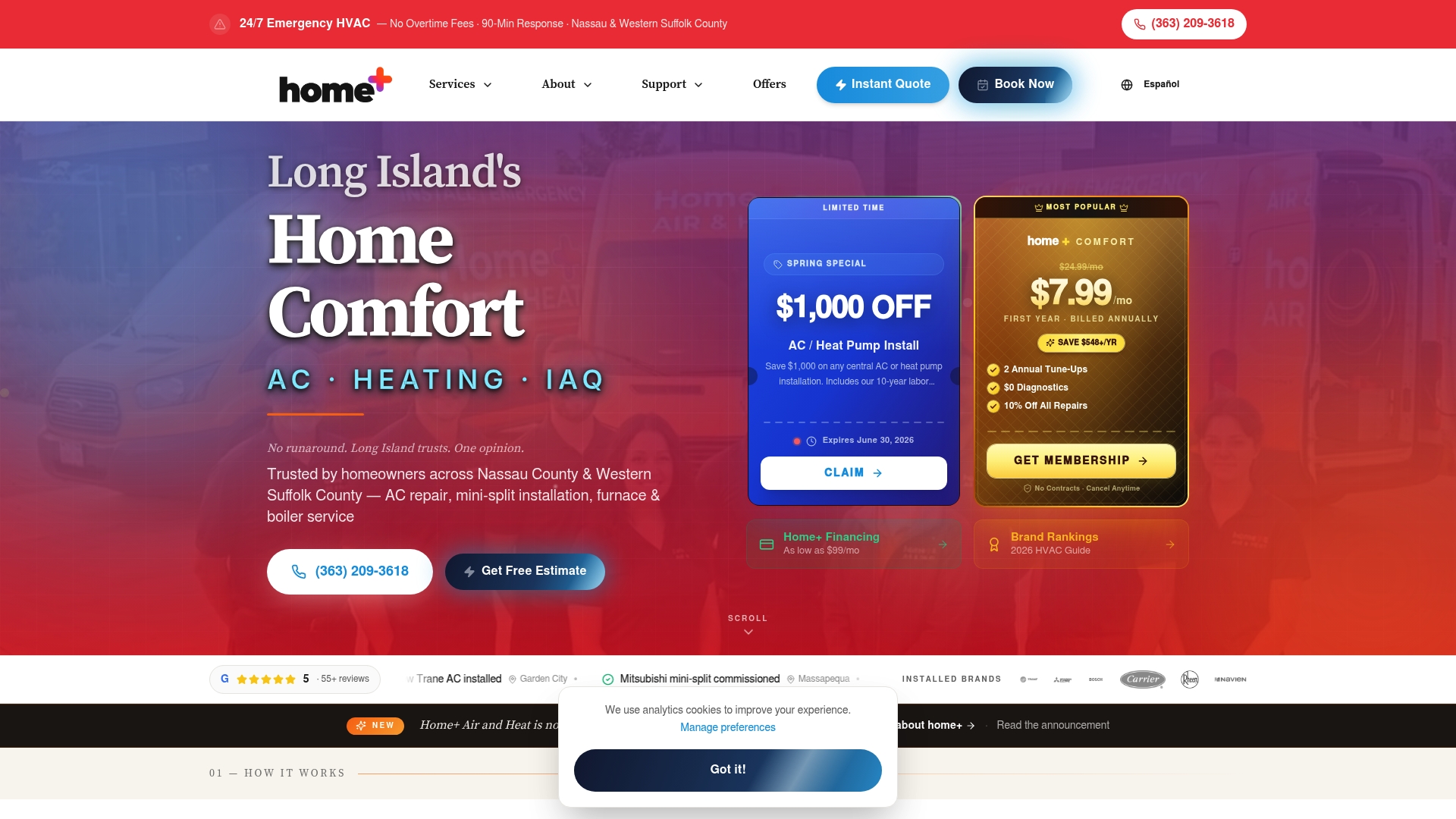
Hometsair serves Long Island homeowners with NATE-certified technicians who perform proper load calculations on every installation. The team specializes in the coastal climate challenges specific to Nassau County, including salt-air corrosion and homes without existing ductwork. Hometsair currently offers $1,000 off AC installations, and charges zero overtime fees regardless of when you call. Their HVAC installation services cover heat pumps, ductless systems, and full system replacements with same-day response. If you want to know exactly what your upgrade will cost and what return to expect, request a free quote and get a clear answer before you commit.
FAQ
What is a realistic payback period for an HVAC heating upgrade?
Most homeowners see a payback period of 5–10 years, factoring in energy savings, avoided repairs, and federal tax credits. Stacking local utility rebates with the Inflation Reduction Act credit can shorten that window by several years.
Does a new HVAC system increase home resale value?
A new HVAC system adds $5,000–$10,000 to appraised home value and helps homes sell 10%–15% faster. Keeping installation records and permits strengthens the value claim during appraisal.
What federal tax credit is available for HVAC upgrades in 2026?
The Inflation Reduction Act provides a 30% federal tax credit on qualifying HVAC installations, capped at $2,000 per year for heat pumps. Equipment must meet specific ENERGY STAR efficiency thresholds to qualify.
Why does installation quality affect HVAC ROI so much?
Over 65% of HVAC systems are improperly installed, leading to 20%–30% excess energy use that erases projected savings. Manual J load calculations and proper ductwork design are required to achieve the efficiency ratings shown on the equipment label.
Are heat pumps worth the investment in colder climates?
Modern cold-climate heat pumps operate effectively down to 0°F and can save households switching from electric resistance heat up to $1,530 per year. In very cold regions, a dual-fuel system pairing a heat pump with a gas furnace backup captures efficiency gains while maintaining heating capacity on the coldest days.