
Key Takeaways
- Quick estimate: multiply room square footage by 25 BTU for a Long Island room with average insulation, average ceiling height, and one exterior wall
- Adjust up for west-facing rooms with afternoon sun (+10%), high ceilings over 9 feet (+15%), and kitchens (+1,000 BTU for cooking heat)
- Oversize slightly (10-15%) rather than undersize — a slightly oversized inverter mini split runs on low fan, while an undersized unit runs on high fan all summer and is louder, less efficient, and dehumidifies worse
- Skip any contractor who sizes by square footage alone — a real Manual J load calculation factors in insulation R-values, window U-factors, and orientation, and is the only way to size a whole-home ductless system correctly
01Quick Answer: BTU per Square Foot for Long Island Rooms
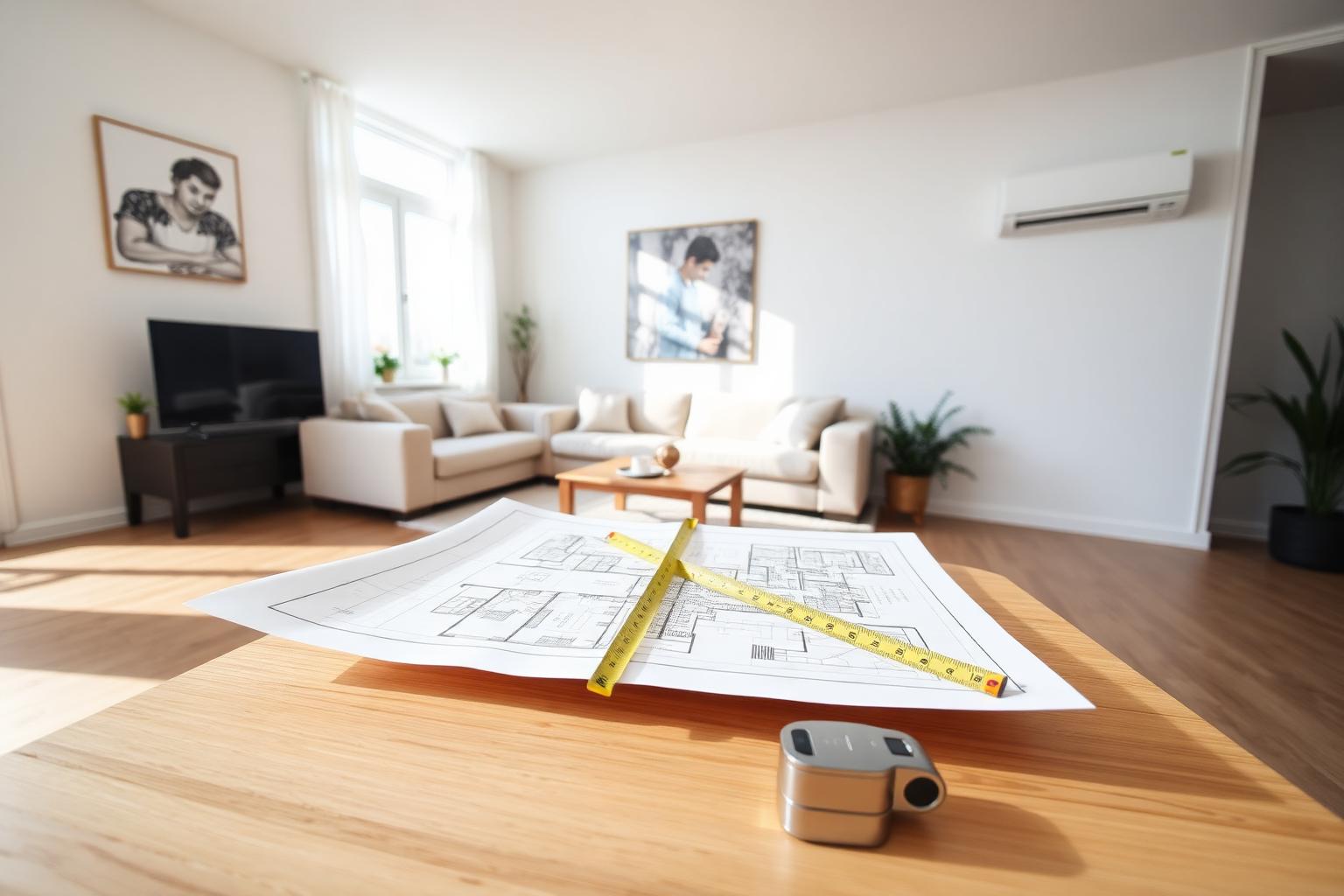
If you just need a ballpark to sanity-check a contractor's recommendation, use this baseline for Long Island (Climate Zone 4A):
- 150-250 sqft bedroom or office: 6,000 BTU (½ ton)
- 250-400 sqft living room: 9,000 BTU (¾ ton)
- 400-550 sqft open kitchen + living: 12,000 BTU (1 ton)
- 550-800 sqft great room: 18,000 BTU (1.5 ton)
- 800-1,200 sqft open-plan first floor: 24,000 BTU (2 ton)
These ranges assume average insulation (R-13 walls, R-30 attic), 8-foot ceilings, two-pane vinyl windows, and one exterior wall. Adjust from there using the multipliers below.
02Sizing Adjustments — Don't Skip These
Every variable below changes the BTU number from the baseline. They add up faster than you'd expect:
| Condition | Adjustment |
|---|---|
| West-facing room with afternoon sun | +10% |
| East-facing room with morning sun | +5% |
| Ceiling height > 9 feet | +15% per extra foot |
| Two or more exterior walls | +10% |
| Single-pane or old aluminum windows | +15-25% |
| Poor or no wall insulation (pre-1980 home) | +20% |
| Kitchen (cooking + appliance heat) | +1,000-2,000 BTU |
| More than 2 occupants regularly | +600 BTU per extra person |
| Open to adjacent unconditioned space | +15-20% |
Example: a 300 sqft west-facing primary bedroom in a 1950s Levittown cape with original walls and replacement vinyl windows starts at 7,500 BTU (300 × 25), plus 10% for west exposure, plus 20% for poor wall insulation = ~9,750 BTU. A 9,000 BTU head is borderline; a 12,000 BTU head is the safer pick.
Need professional help?
Nassau County service · Written scope and pricing · Scheduling confirmed by dispatch
03Why Oversizing (Slightly) Beats Undersizing
Old-school HVAC advice says "never oversize, you'll lose dehumidification." That was true for single-stage central AC. It is not true for modern inverter mini splits, and the math has reversed.
Here's why slight oversizing wins for ductless:
- Inverter compressors throttle down. A 12k BTU mini split running on low can output 3,000-4,000 BTU continuously. It's not all-or-nothing like a single-stage system.
- Low-fan operation is quieter. The dBA ratings in our quietest mini splits ranking are all measured on low fan. An oversized unit stays there; an undersized unit ramps to high constantly.
- Long runtime dehumidifies better. A right-sized or 10-15% oversized inverter unit runs longer at lower output, pulling more moisture per kWh than an undersized unit cycling between high and off.
- Cold-climate capacity drops in winter. Even a true cold-climate head loses some capacity below 5°F. Sizing slightly above the cooling load gives you headroom for January heating without backup strip.
Our rule: round up to the nearest available BTU size, not down. If the math says 7,500 BTU, install a 9k head — never a 6k.
04What Manual J Actually Does (And Why It Matters)
A Manual J load calculation is the industry-standard room-by-room heating and cooling load calculation published by ACCA (Air Conditioning Contractors of America). For a whole-home ductless install or any system over 18k BTU, a real Manual J is required by code in most New York jurisdictions.
A real Manual J factors in:
- Wall, ceiling, and floor R-values (room by room)
- Window U-factor, SHGC, area, and orientation
- Infiltration rate (blower door test or equivalent estimate)
- Occupant count and internal heat gains (appliances, lighting)
- Long Island-specific design temperatures (88°F summer, 11°F winter)
It takes 1-2 hours per house to do correctly and produces a heating and cooling load number for every room. If a contractor walks through your house in 10 minutes and quotes a ductless system, they did not do a Manual J — they did a square-footage estimate, which is the #1 cause of oversized/undersized mini split installs on Long Island.
Ask any prospective installer for a written Manual J report before signing. Reputable contractors will provide it.
Get a Quick Callback
No email required — we'll call you.
05Multi-Zone Systems Need Different Math
When you connect multiple indoor heads to one outdoor condenser (a multi-zone system), the outdoor unit is rated for the total simultaneous load, not the sum of indoor head sizes. You can — and usually should — connect more indoor BTU than the outdoor rating, because not all rooms will hit peak load at the same time.
Typical multi-zone diversity factor: connect up to 130% of outdoor rated capacity in indoor heads, assuming bedrooms (used at night) share the same condenser as a living room (used during the day). This keeps the outdoor unit operating in its efficient mid-range most of the time.
Our ductless installation page covers our standard multi-zone design workflow. Long Island multi-zone installs are typically 2-zone (master suite + main living area) or 3-zone (master + two secondary bedrooms), with a 24k or 36k BTU outdoor unit.
Get Ready for Winter ❄️
Call to confirm the current furnace-maintenance scope, price and appointment window.
(516) 259-119106Right-Sized Ductless Installs on Long Island
Home+ Air and Heat performs a written Manual J on every ductless install over 18k BTU and on every multi-zone system regardless of size. Sizing is the single highest-leverage decision in a ductless project — get it right and the system is silent, efficient, and lasts 15-20 years. Get it wrong and no brand or model can save you.
We serve Garden City, Manhasset, Great Neck, Huntington, and surrounding Nassau and Western Suffolk communities.
Frequently Asked Questions
Home+ Air and Heat Team
Home+ Air and Heat editorial team
Service articles are reviewed against current company pricing, coverage and scheduling terms. Technician credentials are confirmed for the person and work assigned to each appointment.
Continue Reading
Best Cold-Climate Mini Splits for Long Island Winters (2026)
Long Island winters routinely drop to 5°F and occasionally below 0°F. We rank the cold-climate ductless heat pumps that actually keep their rated capacity in single-digit weather — Mitsubishi Hyper-Heat, Bosch IDS, Mitsubishi Intelli-HEAT, Fujitsu XLTH, and more.
Best Looking Mini Splits 2026: 7 Designer Units That Don't Ruin a Room
We ranked the most attractive ductless mini splits of 2026 on profile depth, finish quality, and how cleanly each head integrates into a finished room. Bosch leads — here's why, plus six runners-up from LG, Mitsubishi, Daikin, Samsung, Fujitsu, and Carrier.
Quietest Mini Splits 2026: Ranked by Decibels (Bedroom Edition)
We ranked the quietest ductless mini splits of 2026 by published indoor sound rating (dBA), with a bedroom-first lens — including the units that drop below 19 dBA on low fan. Mitsubishi, Bosch, Daikin, Fujitsu, LG, and Carrier compared.
Need help with the next HVAC step?
Call to confirm service-area fit, equipment capability, written terms and current scheduling.
5.0 Google rating · 94 reviews