
01
Where the ice is visible
Note whether frost appears on exposed tubing, the indoor cabinet, the coil area or another accessible location. A photo taken without opening panels can help document the condition.
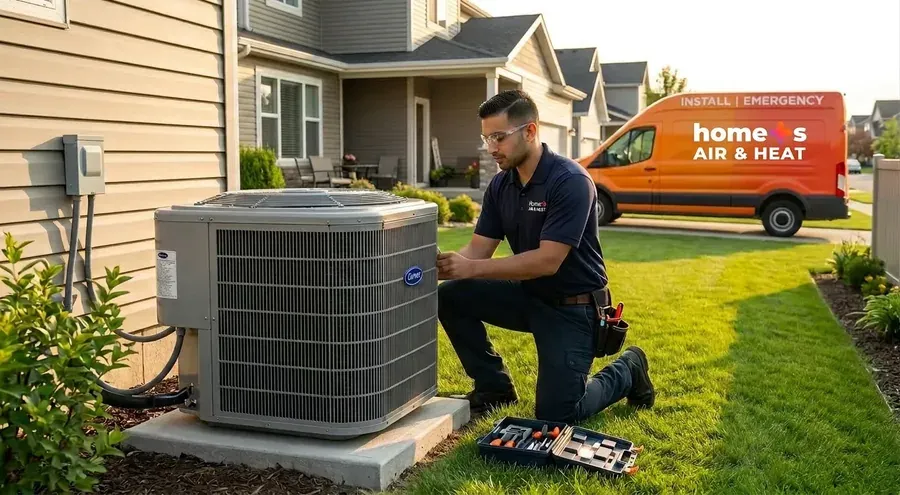
Visible-ice guidance and cooling diagnosis
Stop normal cooling operation when ice is visible and do not chip, scrape or heat it. A loaded filter, restricted airflow, control condition, coil problem or refrigerant-circuit condition can contribute, so the ice alone does not establish the repair.
Nassau County service · Diagnosis before repair · Written option before approved work
Smoke, fire, sparking or a burning odor? Leave the area and call 911.
An HVAC appointment does not replace emergency response, medical care or electrical safety.
Leave the area and call 911. Do not wait for an HVAC appointment, open equipment panels or repeatedly reset a breaker.
Stop normal cooling operation. Do not chip, scrape or heat the ice. Note where it appears so the airflow, controls, coil and refrigerant circuit can be evaluated.
Keep people and pets away from the wet area and electrical equipment. Call 911 first if there is an active fire or electrical hazard.
REPORT WHAT YOU OBSERVE
Visible ice can result from different airflow, control, coil or refrigerant-circuit conditions; its location and timing help guide testing.
Note whether frost appears on exposed tubing, the indoor cabinet, the coil area or another accessible location. A photo taken without opening panels can help document the condition.
Report whether airflow became weak before the ice appeared, whether every vent is affected and whether the filter is visibly loaded or incorrectly seated.
Watch for water approaching electrical equipment or finished surfaces. Keep people away from energized wet areas and report the water location.
Share prior repairs, refrigerant service, filter changes, recent thermostat changes and whether the ice returned after a previous thaw or service visit.
BEFORE THE APPOINTMENT
These observations are not a substitute for diagnosis and do not require opening equipment.
Check that the system is set to cooling, note the setpoint and room temperature, and report whether the display or equipment shows an error code.
If you can reach it safely, compare the filter with the equipment’s specified type and note whether it is visibly loaded. Do not run the system without its required filter.
Note whether airflow is weak or absent, which rooms are affected, whether the outdoor unit runs, and whether you see ice or water. Do not remove panels.
Do not attach gauges, add refrigerant, bypass safeties or keep resetting a tripping breaker. Share the observations with dispatch or the technician.
DIAGNOSIS-LED SERVICE
Thawing removes the visible ice but does not identify why it formed. The technician evaluates airflow, filter and blower conditions, controls, coil condition, temperature change, drainage and the refrigerant circuit as the installed system requires.
01
The visit begins with the thermostat request, operating sequence, indoor conditions and the specific symptom you observed.
02
Accessible controls, electrical components, airflow, temperature change, coils, drainage, outdoor equipment and refrigerant circuit are evaluated as the symptom requires.
03
Testing—not the symptom alone—determines whether the next step involves airflow, controls, cleaning, drainage, electrical work, refrigerant work or another component.
04
Home+ provides the proposed scope and price before authorized work. Parts and first-visit completion are not guaranteed.
DIAGNOSIS BEFORE REPAIR
Dispatch confirms appointment-specific and after-hours terms. Diagnosis, access, parts, refrigerant requirements, equipment condition and authorized scope determine the written repair price.
Residential non-member diagnostic
$199
There is no standing arrival-time or first-visit completion guarantee.
Diagnostics are free for all Home+ membership plans.
The U.S. Department of Energy identifies filters, coils, drainage and refrigerant as cooling-system considerations. Restricted airflow can contribute to icing, but visible ice does not identify the underlying repair by itself.
Do not rely on an uncertain HVAC arrival time to protect someone from heat illness. CDC advises using air conditioning or finding an air-conditioned location and using fans only when indoor temperatures are below 90°F.
Stop normal cooling operation and do not chip, scrape or heat the ice. Keep water away from energized equipment as it melts. Record where the ice is visible and contact dispatch for equipment-specific guidance and current appointment options.
No. A refrigerant-circuit condition can contribute, but restricted airflow, a loaded filter, blower or control problems, coil conditions and other faults can also be involved. Testing is needed before recommending refrigerant work.
A visibly loaded or incorrect filter can restrict airflow, so the accessible filter is a useful observation. Replacing it with the equipment-specified type does not prove the cause is resolved. Do not resume normal cooling while ice remains, and seek diagnosis if freezing recurs or cooling remains weak.
There is no reliable universal thaw time. Ice amount, equipment, airflow, indoor conditions and the underlying fault all matter. Avoid forcing the process with tools or heat; dispatch or the technician can provide guidance for the actual system.
The current residential diagnostic is $199 and is credited toward an approved repair. Dispatch confirms appointment-specific terms. Testing, access, diagnosis, parts, refrigerant requirements, equipment condition and authorized scope determine the written repair price.
Home+ is based at 55 Jericho Tpke, Suite 203, Jericho, NY 11753. Dispatch confirms the exact address, equipment capability and current appointment window before scheduling.
HOME+ AIR & HEAT
Book through the registered production scheduler or call to confirm service-area fit, equipment capability and current availability.