
Key Takeaways
- Schedule your AC tune-up in April or early May — before Nassau County's humidity-driven demand backlog locks up the calendar
- A proper spring service is a 12-point inspection covering filter, condenser, evaporator, refrigerant, drain, thermostat, blower, electrical, capacitor, contactor, temperature split, and full-cycle test
- Hicksville and Levittown homes built between 1947–1975 often have undersized returns and aging ductwork that put extra load on cooling equipment
- A Home+ à-la-carte tune-up is $299 (Standard) or $449 (Premium); Home+ Comfort members get two tune-ups (AC + furnace) plus 10% off repairs for $11.99/mo, paid up front as $143.88 for Year 1, then $299/yr
- Refrigerant handling, capacitor testing, and electrical work belong with a trained HVAC technician — refrigerant work legally requires EPA Section 608 certification
- Skipping annual maintenance can cut system life by 3–7 years and voids most manufacturer warranties from Trane, Carrier, Lennox, and Rheem
Long Island AC Maintenance — Real Pricing (Spring 2026)
| Service | Cost Range | Notes |
|---|---|---|
| DIY filter change (homeowner) |
$10–$30
|
Every 30–90 days during cooling season |
| Standard 12-point spring tune-up |
$299–$299
|
April–May booking, à-la-carte |
| Premium 38-point inspection |
$449–$449
|
Includes coil deep-clean + CO test |
| Home+ Comfort Membership (annual) |
$144–$299
|
Year 1 $143.88 / renewal $299 — 2 tune-ups + $0 member diagnostic + 10% off repairs |
| Emergency July diagnostic + repair |
$199–$1,200
|
Peak-season rates after first heat wave |
| Compressor replacement (skipped maintenance) |
$1,800–$3,500
|
Common 4–6 yr outcome of neglect |
Pricing reflects Nassau County, Suffolk County and the five NYC boroughs service area as of June 2026. Membership pricing assumes annual billing. Emergency repair ranges depend on parts availability and after-hours surcharges.
01Quick Answer — When to Book Your Spring AC Tune-Up
Schedule your AC maintenance in Hicksville, NY between mid-April and the first week of May. Booking in this window gives an EPA 608-certified technician time to inspect the system, order any parts, and complete the 12-point service before Long Island's first 85°F day — which historically triggers a 48–72 hour scheduling backlog across every HVAC company in Nassau County.
If your AC struggled at all last summer — uneven cooling, longer run times, water around the air handler — that's your signal to book this week, not next month.
02The Long Island Climate Reality Your AC Faces
Long Island isn't just hot in summer — it's hot, humid, and salty, and that combination is uniquely brutal on cooling equipment. Three climate facts shape every maintenance decision you'll make:
- Average July relative humidity in Nassau County: 72–80%. Your AC isn't just cooling air — it's pulling roughly 10–20 pints of water out of it every day. That load doubles the workload on the evaporator coil and drain system.
- Cooling-degree days in Hicksville average 1,050+ per year. That's 25–30% more cooling demand than inland New England towns and translates to 1,200–1,800 compressor run-hours every summer.
- Salt-air corrosion affects coastal communities from Long Beach and Massapequa to Oyster Bay and Glen Cove. Aluminum condenser fins corrode 2–3× faster within 5 miles of the South Shore — making annual coil inspection non-negotiable for those zip codes.
A tune-up that's "good enough" in Dallas or Atlanta isn't good enough here. Long Island AC service has to account for marine air, late-spring pollen, and a brutally compressed cooling season that runs hard from late June through mid-September.
Need professional help?
Nassau County service · Written scope and pricing · Scheduling confirmed by dispatch
03Why Hicksville & Levittown Homes Stress AC Systems Hard
Hicksville sits at the heart of the post-war Levittown construction belt, and the housing stock here has three characteristics that punish central AC systems:
- Tight, undersized ductwork. Many homes built between 1947 and 1975 were retrofitted with central AC decades after construction. The ducts were sized for a furnace, not a 2.5–4 ton condenser, which causes high static pressure, premature blower wear, and frozen evaporator coils.
- Attic air handlers in unconditioned space. Attic temperatures in July can hit 130°F, forcing the air handler to fight ambient heat soak. Insulation gaps on supply ducts can lose 15–25% of cooling capacity before air ever reaches a register.
- Original 60-amp electrical service. Some Levittown homes still run on undersized panels that brown out the compressor on startup — a problem only a capacitor and amp-draw test will catch.
If you live in a 1950s Cape Cod or ranch in Hicksville, Levittown, Plainview, Jericho, or Massapequa, your spring tune-up should include a duct-pressure check and a hard look at the return-air path. We cover the same checklist (with installation context) on our Levittown AC installation page and the Long Island HVAC contractor guide.
04The 12-Point Spring AC Tune-Up Checklist
A thorough spring service isn't a 20-minute filter change. Here's the full 12-point inspection EPA 608-certified Home+ technicians work through on every visit — the same checklist we apply whether you're a one-off service customer or a Comfort member.
1. Thermostat Calibration & Programming Check
We verify the thermostat reads within ±1°F of actual room temperature, confirm programmed schedules survived the winter, and check communication with the control board. A miscalibrated thermostat alone can waste 5–10% on your PSEG-LI cooling bill.
2. Air Filter Inspection & Replacement
The single most common cause of preventable AC failure on Long Island. Filters should be checked every 30–90 days; spring pollen in Nassau County accelerates loading. We replace a standard 1" filter as part of every tune-up and recommend MERV ratings appropriate to your equipment.
3. Outdoor Condenser Coil Cleaning
Winter debris, cottonwood fluff, grass clippings, and salt residue all reduce heat-rejection capacity. A dirty condenser coil can drop efficiency by 30% and force the compressor to run hot. We rinse from the inside out so debris exits the way it came.
4. Evaporator Coil Inspection
Indoor coil is checked for dirt buildup, biological growth, and frost patterns. Dirty evaporator coils restrict airflow, cause ice formation, and dramatically reduce dehumidification — which matters a lot in Nassau County humidity.
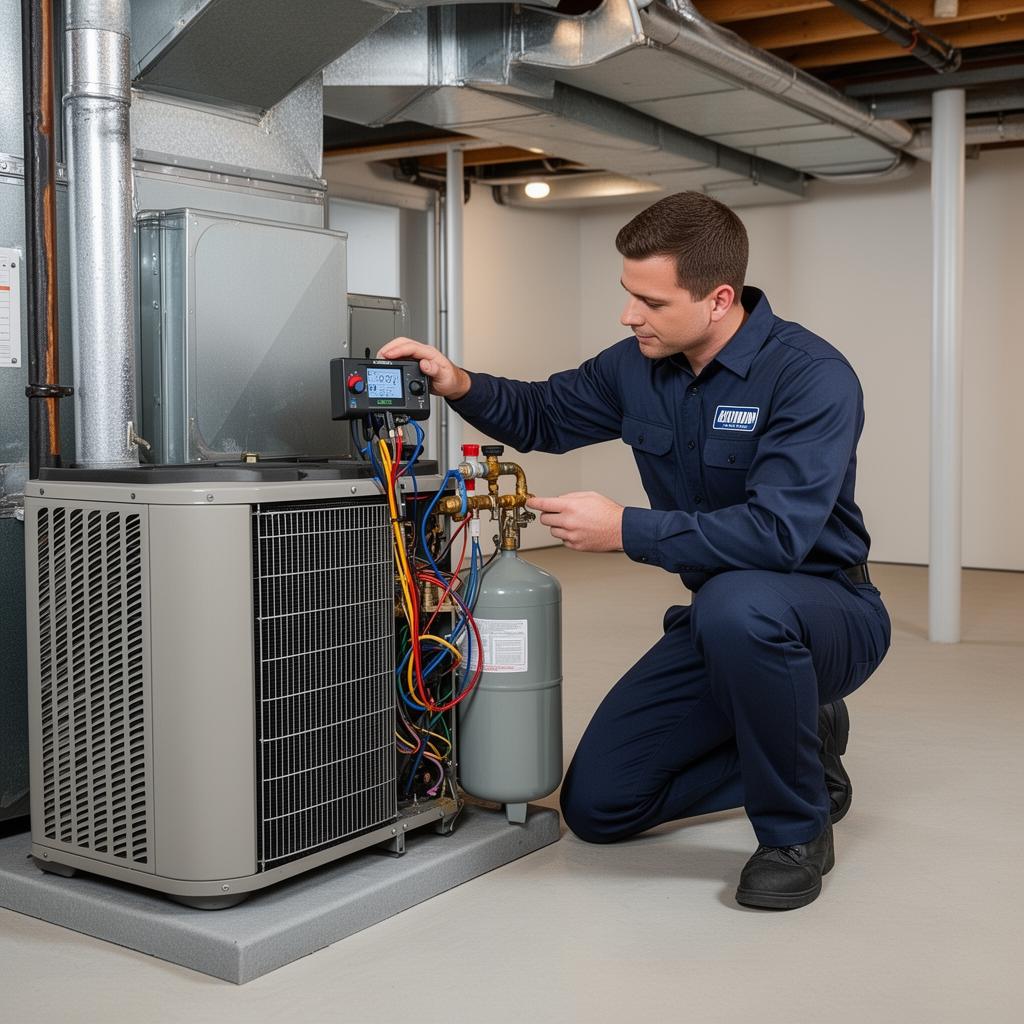
5. Refrigerant Pressure & Charge Verification
System suction and head pressures are measured against manufacturer specs. Low refrigerant indicates a leak that must be repaired, not "topped off" — EPA rules and good practice both require finding and fixing the source. R-410A and the new R-454B both require an EPA Section 608 certified technician.
6. Capacitor & Contactor Testing
The start/run capacitors are tested with a multimeter against rated microfarads. A weak capacitor is the #1 cause of mid-July compressor failures — and a $25 part replaced in April prevents a $1,800 compressor in July. The contactor is checked for pitting and coil resistance.
7. Compressor Amp Draw & Electrical Inspection
We measure compressor amperage at startup and steady-state, then compare to nameplate specs. Elevated draw signals mechanical wear or refrigerant problems. All electrical terminals are inspected for corrosion, loose connections, and heat damage — a major fire-risk source.
8. Blower Motor & Wheel Inspection
Blower amp draw, bearing condition, and wheel cleanliness all affect airflow. A dirty blower wheel can reduce airflow by 25%, causing the same symptoms as a refrigerant problem. We clean as needed and report bearing wear before it becomes a motor replacement.
9. Condensate Drain Line Flush & Treatment
The condensate drain is flushed, vacuumed, and treated to prevent algae blockages — the #1 cause of summer water damage on Long Island. Cracked or improperly sloped drain pans are flagged before they ruin a Hicksville bedroom ceiling.
10. Ductwork Visual & Return-Air Path Check
Accessible ductwork is checked for disconnections, crushed sections, and visible leaks. Return-air pathways are verified clear — blocked returns are the cause of icing, short cycling, and compressor damage in many older Long Island homes.
11. Temperature Split Testing
We measure the temperature difference between return and supply air with the system running. A healthy split is 15–20°F. Anything lower means restricted airflow, low refrigerant, or coil contamination — and the diagnostic continues from there.
12. Full Cooling Cycle & Safety Controls Test
The system is run through a complete cooling cycle while we monitor pressures, temperatures, electrical draw, and the operation of every safety switch and limit control. You receive a written report with photos, findings, and any honest recommendations — no upsell pressure.
Get a Quick Callback
No email required — we'll call you.
05How Long Does a Proper Spring Tune-Up Take?
A real 12-point tune-up takes 45–90 minutes, depending on system condition, location, and accessibility. Here's the breakdown:
- Standard split system, ground-level condenser: 45–60 minutes
- Attic air handler (most Hicksville Capes): 60–75 minutes
- Older system requiring extra cleaning or amp-draw diagnostics: 75–90 minutes
- Premium 38-point inspection with CO testing: 90–120 minutes
Be skeptical of any "$59 spring tune-up" that takes 20 minutes — that's a sales-call visual inspection, not a tune-up. A proper service requires manifold gauges, electrical test meters, coil-cleaning chemicals, and time to evaluate every component under load.
Get Ready for Winter ❄️
Call to confirm the current furnace-maintenance scope, price and appointment window.
(516) 259-119106DIY vs. Professional — What You Can (and Can't) Do Yourself
Homeowners can safely handle a handful of maintenance tasks between professional visits. Everything else belongs with a trained HVAC technician — and refrigerant work legally requires EPA Section 608 certification.
Safe DIY tasks (do these monthly during cooling season)
- Replace the air filter every 30–90 days. Set a phone reminder.
- Keep 2+ feet of clearance around the outdoor condenser — no plantings, no patio furniture, no mulch piles against the fins.
- Rinse the outdoor unit gently with a garden hose from the inside out (power off at the disconnect first).
- Check thermostat batteries annually, ideally in spring.
- Listen for new noises — clicking, grinding, or screeching are early warnings worth reporting to a technician.
Pro-only tasks (do not attempt)
- Refrigerant handling — legally requires EPA Section 608 certification. Improper charge damages the compressor.
- Capacitor replacement — capacitors store lethal voltage even when power is off.
- Electrical testing or wiring repair — high-voltage diagnosis is not a YouTube project.
- Coil acid cleaning — chemical sprays can deform fins and void warranties if misapplied.
Think of DIY maintenance like brushing your teeth — necessary daily, but not a substitute for the dentist. The 12-point professional service catches problems your eyes can't see and your hands can't safely test.
07Spring vs. Summer Pricing — What You're Actually Paying For
Long Island HVAC pricing follows a brutal seasonal curve. The same diagnostic that costs about $200 in April can cost $400+ in July because of overtime rates, parts availability, and emergency-priority scheduling.
Here's the math on a typical Nassau County homeowner with one central AC:
- April à-la-carte tune-up: $299 — full 12-point inspection with a written report.
- July emergency diagnostic: $199 diagnostic + $400–$1,200 in repairs that a spring tune-up would have caught for free.
- August compressor replacement (skipped maintenance): $1,800–$3,500 — and you wait 3–10 days for parts in the middle of a heat wave.
For most homeowners, the smart move is a Home+ Comfort Membership at $11.99/mo, paid up front as $143.88 for Year 1, then $299/yr. You get two annual tune-ups (one AC, one furnace), $0 member diagnostics year-round, 10% off any repairs, and priority scheduling that bumps you ahead of non-members during peak season.
For a full breakdown of what membership covers vs. à-la-carte, see our Central AC Tune-Up Checklist post.
🔧 Do You Need AC Repair?
Answer 5 quick questions
Is your AC blowing warm air?
08What Happens if You Skip Spring Maintenance — Year by Year
Neglecting maintenance doesn't cause immediate failure — it causes gradual degradation that compounds. Here's the typical trajectory we see on Long Island systems:
- Year 1 without maintenance: Efficiency drops 5–10%. PSEG bill creeps up. System still cools — you'd never know.
- Year 2: Efficiency down 15–20%. Coils visibly dirty, capacitor showing wear, drain partially clogged. One room runs warmer than the rest.
- Year 3: Down 25–30%. Slow refrigerant leak, noisy blower bearings, longer run-times. System fights to keep up on 90°F days.
- Year 4+: Compressor failure, motor burnout, or major refrigerant leak becomes likely. What would have been a $249 tune-up is now $1,800–$3,500 or a full system replacement at $7,500–$15,000.
Annual maintenance interrupts this cycle and resets your equipment to peak condition every spring. It also keeps your manufacturer warranty intact — Trane, Carrier, Lennox, American Standard, and Rheem all require documented annual professional maintenance, and a denied warranty claim on a $2,500 compressor is the most expensive "tune-up" you'll ever skip.
If you're already past the 4-year warning sign, start with our AC replacement cost guide for Long Island to understand your options before committing to repairs.
09Schedule Your Hicksville Spring Tune-Up Today
Home+ Air and Heat serves Hicksville, Levittown, Jericho, Plainview, Garden City, Massapequa, Long Beach, and the rest of Nassau County, Suffolk County and the five NYC boroughs from our base in Jericho. Every spring tune-up is performed by an insured, EPA 608-certified technician using the full 12-point checklist above — and every visit ends with a written report and honest recommendations, not a high-pressure sales pitch.
Three ways to book:
- Call (516) 259-1191 — book early; spring slots fill up by late May.
- Request service online via the contact page and we'll respond within one business hour.
- Browse all AC repair and maintenance services to see what a Home+ visit includes.
Already shopping HVAC contractors on Long Island? Use our Long Island HVAC contractor comparison guide to verify official records and compare three written proposals against the same scope, price, warranty, and service-area criteria.