
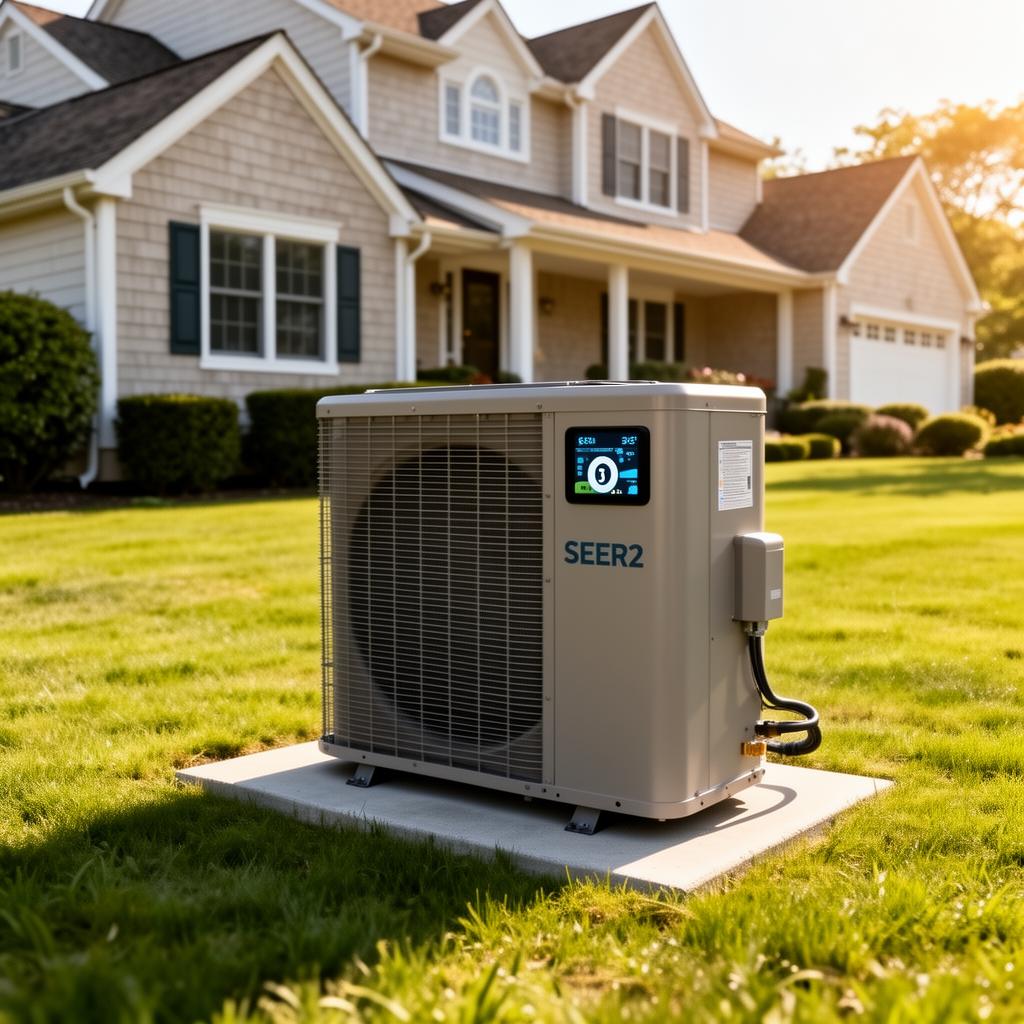
Key Takeaways
- SEER2 is the current federal efficiency standard — it replaced SEER in 2023 and uses more realistic testing conditions
- The minimum SEER2 rating for new central AC in the Northeast is 14.3; heat pumps must meet 14.3 SEER2 and 7.5 HSPF2
- Every 1-point increase in SEER2 saves roughly 6-8% on cooling electricity use — on a $300/month PSEG-LI summer bill, that's $18-24/month
- Federal 25C ended after 2025; SEER2 and HSPF2 describe equipment performance but do not establish current utility, state, or manufacturer eligibility
- For Long Island, 16-18 SEER2 is the sweet spot for most homeowners — premium 20+ SEER2 pays off fastest for homes with high summer usage or long-term ownership plans
Estimated Annual Cooling Cost by SEER2 Rating (3-Ton System, Long Island)
| Service | Cost Range | Notes |
|---|---|---|
| 14.3 SEER2 (minimum legal, fixed-speed) |
$1,450–$1,650
|
Base case; 1,200+ cooling hours/yr at PSEG-LI rates |
| 15 SEER2 (single-stage, common replacement) |
$1,350–$1,520
|
~6% savings vs. minimum; lowest upfront premium |
| 16 SEER2 (two-stage) |
$1,200–$1,380
|
~15% modeled savings vs. minimum; strong humidity control |
| 17 SEER2 (variable-speed, mid-premium) |
$1,080–$1,240
|
~24% savings vs. minimum; excellent humidity control |
| 18 SEER2 (high-end variable-speed) |
$980–$1,140
|
~31% savings vs. minimum; premium comfort and quiet operation |
| 20+ SEER2 (top-tier inverter) |
$850–$1,000
|
~40% savings vs. minimum; best for large homes or high-usage owners |
Cost estimates assume 1,200 annual cooling hours, PSEG-LI electric rates (approx. $0.22–$0.26/kWh all-in), and a 2,000 sq ft single-family home. Actual savings vary with home size, insulation, thermostat habits, and ductwork condition.
01What Is SEER2 — and Why Did SEER Disappear?
SEER stands for Seasonal Energy Efficiency Ratio — the measure of how much cooling an AC or heat pump delivers per unit of electricity consumed over a full cooling season. For decades, SEER was the number on the yellow EnergyGuide sticker. Then, in January 2023, the U.S. Department of energy changed the test procedure.
SEER2 uses the same math (cooling output ÷ energy input), but the test conditions are stricter and more realistic:
- Higher external static pressure — The test now accounts for real-world ductwork resistance, which makes systems work harder than the old lab setup assumed.
- More representative cycling — SEER2 better captures how often a system starts and stops in actual homes, not just continuous operation.
- Tighter fan energy measurement — Blower motor electricity is measured more accurately, which matters because the indoor fan runs every time the system does.
The result: a system rated at 16 SEER under the old test typically scores 15–15.5 SEER2 under the new one. The equipment didn't get worse — the ruler got more honest. That's why the legal minimum jumped from 13 SEER to 14.3 SEER2 in the North region (which includes Long Island). You cannot legally install a new central AC or heat pump below 14.3 SEER2 today.
02SEER to SEER2: A Quick Conversion Table
When comparing quotes, you may still hear contractors refer to "16 SEER" out of habit. Here's how the old numbers map to the new standard for typical equipment:
| Old SEER Rating | Approximate SEER2 | Equipment Type |
|---|---|---|
| 13 SEER | 12.0–12.5 SEER2 | Below current legal minimum; cannot be installed |
| 14 SEER | 13.0–13.5 SEER2 | Below current legal minimum; cannot be installed |
| 15 SEER | 14.0–14.5 SEER2 | Entry-level legal replacement; single-stage |
| 16 SEER | 15.0–15.5 SEER2 | Mid-efficiency; two-stage common at this level |
| 17 SEER | 16.0–16.5 SEER2 | Mid-premium; variable-speed blower typical |
| 18 SEER | 17.0–17.5 SEER2 | Premium; full variable-speed compressor |
| 20+ SEER | 18.5–20.0+ SEER2 | Top-tier inverter-driven systems |
Rule of thumb: subtract roughly 1.0–1.5 points from an old SEER rating to estimate the SEER2 equivalent. If a contractor quotes you a "16 SEER" system, ask whether they mean 16 SEER (old) or 16 SEER2 (new). The difference is meaningful for operating-cost estimates and for any current program that specifies a rating threshold.
Need professional help?
Nassau County service · Written scope and pricing · Scheduling confirmed by dispatch
03What SEER2 Actually Means for Your PSEG-LI Electric Bill
Long Island has some of the highest residential electricity rates in the continental United States. PSEG-LI's all-in rate (generation + delivery + taxes) typically runs $0.22–$0.26 per kWh for most Nassau and Western Suffolk households. That makes cooling efficiency one of the most impactful upgrades you can make.
Here's how SEER2 translates to real dollars for a typical 3-ton central AC running 1,200 hours per cooling season:
- 14.3 SEER2 (minimum legal): ~6,300 kWh/year = $1,450–$1,650
- 16 SEER2 (two-stage): ~5,400 kWh/year = $1,200–$1,380 — saves $250–$270/year
- 18 SEER2 (variable-speed): ~4,350 kWh/year = $980–$1,140 — saves $470–$510/year
- 20 SEER2 (top-tier inverter): ~3,800 kWh/year = $850–$1,000 — saves $600–$700/year
These are cooling-only estimates. If you're considering a heat pump, the savings compound because the same high-efficiency equipment heats your home in winter too. A 16 HSPF2 heat pump uses roughly one-third the energy of electric resistance heat and about half the energy of oil heat per delivered BTU.
For homeowners who run their AC heavily — large homes, south- or west-facing windows, home offices, or families that keep the thermostat at 72°F — the annual savings at 18+ SEER2 can exceed $600/year. Over a 15-year system life, that's $9,000 in electricity savings, which often exceeds the upfront premium for the higher-efficiency equipment.
04Current Incentive Rules and SEER2 Requirements
Federal 25C Status
The federal Energy Efficient Home Improvement Credit under Section 25C ended for property placed in service after December 31, 2025. A 2026 central AC, heat pump, or heat-pump-water-heater budget should not subtract a 25C amount, regardless of its SEER2 or HSPF2 rating.
Utility, State, and Manufacturer Programs
Separate programs may still use efficiency ratings as one part of eligibility, but a rating alone is not approval. Eligibility can also depend on the customer, property, matched equipment, Manual J design, contractor, installation date, application timing, current rules, and available funding.
HEAR/HEEHRA and other state-administered programs are separate from 25C and have their own funding and eligibility requirements. Ask for the program name, project-specific assumptions, estimated amount, and application status in writing before subtracting any incentive from installed cost.
Get a Quick Callback
No email required — we'll call you.
05The Sweet Spot: What SEER2 Rating to Target on Long Island
Not every homeowner needs a 20 SEER2 system. The right target depends on how long you'll keep the home, how much you use your AC, and your budget for upfront cost.
16 SEER2 — The "Smart Money" Choice
For many Long Island homeowners replacing a 10–15-year-old system, 16 SEER2 is a practical starting point. It is available in reliable two-stage equipment from every major brand (Trane, Carrier, Lennox, Rheem, American Standard), and the upfront premium over 14.3 SEER2 is usually modest ($800–$1,500 on a typical 3-ton replacement). Modeled electricity savings may pay back the premium over time, but results depend on the home, runtime, weather, ductwork, thermostat settings, and utility rates.
17–18 SEER2 — The "Comfort + Savings" Choice
Step up to 17–18 SEER2 if:
- You run your AC 4+ months per year (May through September, not just July–August)
- You have humidity problems (variable-speed equipment at this level dehumidifies dramatically better than single-stage)
- Your home is 2,400+ sq ft and cooling costs are already $300+/month
- You plan to stay in the home 10+ years
The upfront premium is typically $2,000–$3,500 over a 14.3 SEER2 baseline, but the combined electricity savings and superior humidity control make it worthwhile for heavy-use homes.
20+ SEER2 — The "Long-Term Owner" Choice
Top-tier inverter systems (Mitsubishi Hyper-Heat, Carrier Infinity 26, Trane XV20i, Bosch IDS) hit 20+ SEER2 and deliver the quietest, most precise comfort available. The premium is significant — often $4,000–$6,000 over entry-level equipment — so the math only works if:
- You're planning to stay in the home 15+ years
- You have very high summer electric bills ($400+/month)
- Comfort, noise, and humidity control are top priorities
- You're pairing the system with a whole-home electrification plan (heat pump + heat pump water heater + solar)
For the average Long Island homeowner replacing a dying 13 SEER system from 2010, 16 SEER2 is the right starting point. Upgrade to 17–18 SEER2 if the budget allows and the payback math works for your usage.
AC trouble during hot weather?
Call to confirm current repair availability or request written maintenance terms.
(516) 259-119106Why SEER2 Matters for Long Island Humidity — Not Just Temperature
Long Island's summer humidity averages 70–85%. Raw cooling capacity (tons/BTUs) handles temperature; efficiency and runtime handle humidity. This is where SEER2 and equipment staging intersect in ways that matter more here than in drier climates.
Here's the mechanism: your AC removes humidity by running long enough for condensate to form on the evaporator coil and drain away. A single-stage 14.3 SEER2 system blasts cold air at full capacity, drops the temperature quickly, then shuts off — often before meaningful dehumidification happens. The result is a house that reads 72°F on the thermostat but feels clammy.
A two-stage or variable-speed 16–18 SEER2 system runs longer at lower capacity. The indoor coil stays cold longer, more moisture condenses and drains, and the home feels genuinely comfortable at a higher thermostat setpoint. Many homeowners find they can raise their thermostat from 72°F to 74–75°F and feel more comfortable — which saves additional electricity on top of the SEER2 efficiency gain.
If you live near the South Shore (Long Beach, Atlantic Beach, Lido Beach, the Hamptons), coastal humidity is even more pronounced. Salt-laden air holds more moisture, and homes without vapor barriers in crawl spaces or basements experience higher latent loads. In these areas, variable-speed 17+ SEER2 equipment isn't a luxury — it's the difference between a comfortable home and a damp one.
07HSPF2: The Heating Side of the Equation (Heat Pumps Only)
If you're considering a heat pump, SEER2 only tells half the story. The companion metric is HSPF2 — Heating Seasonal Performance Factor 2 — which measures heating efficiency the same way SEER2 measures cooling efficiency.
Minimum HSPF2 for new heat pumps in the North region (including Long Island) is 7.5. Higher HSPF2 indicates better seasonal heating efficiency, but it does not establish current incentive eligibility.
Here's what HSPF2 means in practice for a typical Long Island home:
- 7.5 HSPF2 (minimum legal): Usable, but not impressive. Operating cost is competitive with oil but not dramatically better.
- 8.5–9.0 HSPF2: Good. Meaningful savings vs. oil or propane, especially at current fuel prices.
- 9.6+ HSPF2: Excellent. Many cold-climate heat pumps (Mitsubishi Hyper-Heat, Carrier Infinity, Bosch IDS, Trane XV) reach this range. Compare matched-system ratings and a home-specific operating-cost projection.
- 10.0+ HSPF2: Top-tier inverter heat pumps. At this level, a heat pump often costs less to operate than a 95% AFUE gas furnace at National Grid prices — while providing cooling in summer for no additional equipment cost.
When evaluating heat pump quotes, always ask for both SEER2 and HSPF2. A contractor who only quotes SEER2 for a heat pump is either inexperienced or hoping you won't notice the heating side.
🔧 Do You Need AC Repair?
Answer 5 quick questions
Is your AC blowing warm air?
08What to Ask Before You Buy
When getting quotes for a new AC or heat pump on Long Island, efficiency ratings should be part of every conversation. Ask your contractor:
- "What is the SEER2 rating of the equipment you're proposing — not the old SEER rating?" — Make sure you're comparing apples to apples under the new standard.
- "What is the HSPF2 rating?" — Critical for heat pumps. If they don't know or don't quote it, that's a red flag.
- "What current utility, state, or manufacturer program are you evaluating?" — Ask for the program name, current rules, and project-specific eligibility assumptions in writing.
- "Does the current program require a participating contractor or pre-approval?" — Confirm these requirements before equipment is ordered or installed.
- "Is this a single-stage, two-stage, or variable-speed system?" — Stage type affects comfort and humidity control as much as the SEER2 number itself.
- "What will my estimated annual cooling cost be with this system vs. my current one?" — A knowledgeable contractor can calculate this based on your home's Manual J load and PSEG-LI rates.
Installation quality matters more than brand name. A properly sized, well-installed 16 SEER2 system will outperform a poorly installed 18 SEER2 system every time. The Manual J, ductwork sealing, and refrigerant charge precision are what turn the SEER2 number on the sticker into real-world savings.
09Next Step: Get a Right-Sized, Efficiency-Optimized Quote
The SEER2 rating on the box is only a promise. The actual savings depend on proper sizing, ductwork condition, and installation quality. Here's what a real replacement quote should include:
- Manual J load calculation showing exact cooling and heating loads
- SEER2 and HSPF2 ratings for the proposed equipment (not old SEER/HSPF)
- Estimated annual operating cost based on your home and PSEG-LI rates
- Written review of current utility, state, or manufacturer program eligibility
- Required program paperwork when project eligibility is confirmed
- Ductwork inspection and sealing plan
- Side-by-side options at 14.3, 16, and 17–18 SEER2 so you can see the payback
Home+ Air & Heat is insured with EPA 608-certified technicians, and we run Manual J on every replacement quote — along with honest operating-cost projections so you can pick the SEER2 level that makes sense for your home and budget. Call (516) 259-1191 or book online for a no-pressure efficiency consultation across Nassau County and Western Suffolk.
Frequently Asked Questions
Home+ Team
Home+ Air and Heat editorial team
Service articles are reviewed against current company pricing, coverage and scheduling terms. Technician credentials are confirmed for the person and work assigned to each appointment.
Continue Reading
What Size AC Do I Need? Long Island Sizing Guide (Manual J Explained)
Wondering what size central AC or heat pump your Long Island home needs? Learn how Manual J load calculations work, why square-footage rules of thumb fail, and the sizing factors that actually matter on Nassau and Suffolk County homes.
Heat Pump vs. Central AC for Long Island Homes: Which Is Right for You?
Replacing your AC on Long Island? Compare heat pump vs. central AC on installed cost, winter performance, electric bills, lifespan, and how to verify current incentives before you buy.
Mini Split vs Central Air on Long Island (2026): Cost, Efficiency & Best Choice
Real 2026 install costs, SEER2 efficiency, retrofit options, and current incentive-verification guidance for mini split vs central AC across Nassau and Suffolk County.
Need help with the next HVAC step?
Call to confirm service-area fit, equipment capability, written terms and current scheduling.
5.0 Google rating · 94 reviews