
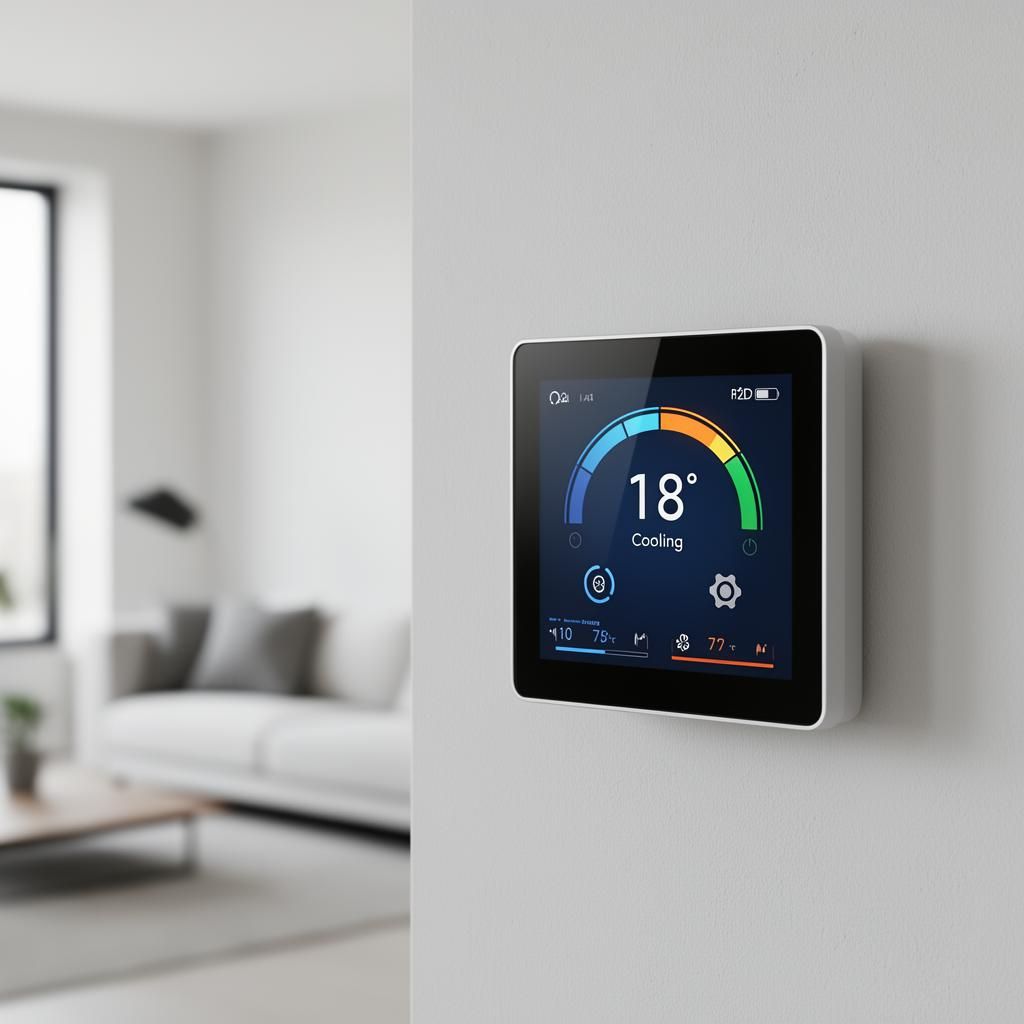
Key Takeaways
- Most central AC and heat pump systems made after 2010 are compatible with popular smart thermostats
- A C-wire (common wire) is required by most smart thermostats — older Long Island homes often lack one
- Mini-split systems generally require manufacturer-specific smart controllers, not universal thermostats
- Smart thermostats can reduce cooling costs 10–15% by automating setbacks during peak PSEG-LI hours
- Heat pump systems need smart thermostats with emergency heat lockout to avoid costly resistance heating
Smart Thermostat Costs & Savings for Long Island Homes
| Service | Cost Range | Notes |
|---|---|---|
| Entry-level smart thermostat (Amazon Smart, Wyze) |
$50–$100
|
Basic scheduling + app control |
| Mid-range smart thermostat (Nest Learning, Ecobee Lite) |
$130–$200
|
Auto-scheduling, remote sensors optional |
| Premium smart thermostat (Nest Learning 4th Gen, Ecobee Premium) |
$230–$300
|
AI scheduling, air quality monitoring, voice control |
| C-wire adapter / power kit installation |
$25–$75
|
DIY-friendly; included with some models |
| Professional installation (no C-wire, complex wiring) |
$150–$300
|
Includes running new low-voltage wiring |
| Estimated annual cooling savings |
$120–$250
|
Varies by usage, home size, and PSEG-LI rates |
Savings based on 10–15% cooling cost reduction for typical Long Island home with programmable setbacks. Heat pump homes with proper smart thermostat configuration see the highest savings by avoiding unnecessary auxiliary heat.
01Will a Smart Thermostat Work With Your AC System?
The short answer: probably yes — if you have a conventional central air conditioner or heat pump installed after 2010. The longer answer depends on your system type, wiring, and whether the thermostat needs to control auxiliary or emergency heat.
Smart thermostats are essentially advanced programmable thermostats with Wi-Fi, machine learning, and remote control. But they still need the same low-voltage wiring connections as a basic digital thermostat. The critical question is whether your existing wall plate has the wires the smart thermostat needs.
Here's the compatibility breakdown by system type:
- Central AC (cooling only) — Compatible with virtually all smart thermostats. You need R (power), Y (cooling call), G (fan), and ideally C (common/constant power). Most systems have these wires.
- Air-source heat pump — Compatible, but requires a thermostat that supports heat pump staging, O/B (reversing valve), and auxiliary heat lockout. Nest Learning, Ecobee Premium, and Honeywell T9 all handle heat pumps correctly.
- Gas furnace + AC dual fuel — Compatible with any smart thermostat. The most common setup in Long Island homes built before 2000.
- Ductless mini-split — Not compatible with universal smart thermostats like Nest or Ecobee. Mini-splits use proprietary communication protocols. You need the manufacturer's Wi-Fi adapter (Mitsubishi Kumo Cloud, Daikin One+, LG ThinQ, etc.).
- Baseboard / radiant heat only — Requires a line-voltage smart thermostat (Mysa, Stelpro). Standard 24V smart thermostats will not work.
02The C-Wire Problem: Why Older Long Island Homes Struggle
Smart thermostats need constant power to run Wi-Fi, displays, and sensors. In HVAC wiring, that constant power comes from the C-wire (common wire) — a low-voltage return path that completes the 24V circuit without triggering heating or cooling.
Older digital thermostats ran on batteries or stole power from the R wire during idle periods. Smart thermostats draw too much power for that trick to work reliably. Without a C-wire, you'll see symptoms like:
- Wi-Fi disconnects — The thermostat reboots when the battery runs low.
- Furnace/AC short-cycling — Power-stealing can confuse the control board.
- Blank screen — Insufficient power to maintain the display.
- Compressor damage — In rare cases, erratic voltage can damage the contactor.
Many post-war Long Island homes — Levittown, Hicksville, Wantagh, Massapequa — were built with 4-wire thermostat cables (R, W, Y, G) and no C-wire. If you're lucky, there's an unused wire tucked behind the wall plate. If not, you have three options:
1. Run a New 5-Wire Cable
The best long-term solution. A new 18/5 low-voltage cable from the thermostat to the air handler gives you a dedicated C-wire plus a spare. Cost: $150–$300 professionally, or $30 in materials if you're comfortable fishing wire through walls.
2. Install a Power Adapter / "C-Wire Kit"
Most smart thermostat manufacturers sell a small adapter that installs at the furnace or air handler. It repurposes the G (fan) wire as a C-wire and uses a relay to restore manual fan control. Ecobee's Power Extender Kit and Nest's Power Connector both work well. These are included free with many thermostat models.
3. Use a 24V Plug-in Transformer
A small wall-plug transformer near the thermostat provides the C-wire connection independently of the HVAC wiring. It's not elegant, but it's effective when running new cable is impractical. Cost: $15–$25.
Need professional help?
Nassau County service · Written scope and pricing · Scheduling confirmed by dispatch
03Best Smart Thermostats for Long Island AC & Heat Pump Systems
Not all smart thermostats handle heat pumps, humidity control, and multi-stage systems equally. Here's how the top models compare for Long Island homes:
Google Nest Learning Thermostat (4th Gen)
Best for: Homeowners who want true "set it and forget it" automation.
- Learns your schedule automatically after about two weeks of manual adjustments
- Excellent heat pump support with auxiliary heat lockout (prevents expensive resistance heating when outdoor temps are mild)
- Seasonal Savings feature estimates 5–10% additional savings by fine-tuning setpoints
- Requires C-wire or included Power Connector for most installs
- Price: ~$280
Ecobee Premium Smart Thermostat
Best for: Multi-zone homes and households with inconsistent room temperatures.
- Includes one SmartSensor; supports up to 32 remote sensors for room-by-room temperature averaging
- Built-in air quality monitoring (VOCs and CO2) — useful for older Long Island homes with tighter envelopes after insulation upgrades
- Advanced heat pump algorithms with configurable compressor lockout temperatures
- Ecobee's "Follow Me" occupancy detection avoids heating/cooling empty rooms
- Price: ~$250
Honeywell Home T9
Best for: Users who want reliability and a familiar interface.
- Geofencing for automatic home/away switching
- Smart room sensors (up to 20) for multi-room averaging
- Simpler interface than Nest or Ecobee; less of a learning curve
- Good heat pump support but fewer configuration options than Ecobee
- Price: ~$200
Amazon Smart Thermostat
Best for: Budget-conscious homeowners with simple central AC.
- $80 price point makes it the cheapest smart thermostat from a major brand
- Basic scheduling and Alexa integration
- No remote sensors, no air quality monitoring, limited heat pump configuration
- Requires C-wire; no power adapter included
Emerson Sensi Touch
Best for: DIYers who want a touchscreen without premium pricing.
- Works with or without C-wire (battery backup option)
- Compatible with most 24V systems including heat pumps
- Lacks advanced AI scheduling but covers the essentials well
- Price: ~$140
04Heat Pump Owners: The Thermostat Settings That Matter
Heat pumps are the fastest-growing HVAC category on Long Island, driven by PSEG-LI's $4,000–$7,500 Home Comfort rebate. But heat pumps are also the system type most often mismatched with the wrong thermostat settings — costing homeowners hundreds in unnecessary electric bills.
If you have a heat pump (or are planning to install one), your smart thermostat must support these functions:
- O/B terminal — Controls the reversing valve that switches between heating and cooling. Nest labels this O/B; Ecobee auto-detects it during setup.
- Auxiliary heat lockout — Prevents expensive resistance backup heat from running when the heat pump can still handle the load. On Long Island, heat pumps work efficiently down to about 25–30°F. Below that, auxiliary heat is necessary. A smart thermostat with configurable lockout (Ecobee and Nest both offer this) ensures you're not burning $0.30/kWh resistance heat when a $0.08/kWh heat pump would suffice.
- Compressor lockout — The inverse: prevents the outdoor compressor from running at extremely low temperatures where it's inefficient or at risk of damage. Relevant only for standard heat pumps without cold-climate inverter technology.
- Balance point calculation — Some advanced thermostats calculate the outdoor temperature at which auxiliary heat becomes cheaper than the heat pump alone. This varies by electricity rate and heat pump efficiency.
Important: If your heat pump installer set the thermostat to "always use auxiliary heat below 40°F," your PSEG-LI bill is probably 40–60% higher than it should be. A properly configured smart thermostat with lockout settings can pay for itself in a single winter.
Get a Quick Callback
No email required — we'll call you.
05Long Island Climate Factors That Affect Smart Thermostat Performance
Smart thermostats are universal hardware, but their effectiveness depends on how well they're configured for local conditions. Here's what Nassau and Suffolk County homeowners should know:
Humidity Control
Long Island summers average 70–85% relative humidity. Smart thermostats with humidity sensing (Ecobee Premium, some Honeywell models) can trigger overcooling by 1–2°F to pull moisture from the air without making the house uncomfortably cold. This is especially valuable in older homes with unsealed crawl spaces or basements.
Coastal Salt Air
Homes within a mile of the South Shore experience more rapid corrosion of outdoor equipment. A smart thermostat with filter change reminders and maintenance alerts helps you stay ahead of degradation. Set reminders for every 60 days if you're in Long Beach, Point Lookout, or the Hamptons.
Time-of-Use Rates
PSEG-LI has peak and off-peak rate structures. While not as aggressive as Con Edison's time-of-use plans, running pre-cooling before 2 PM on hot days and letting the temperature drift slightly during peak afternoon hours can reduce bills. Smart thermostats with "Rush Hour Rewards" or similar utility-linked programs (Nest and Ecobee both participate) automatically participate in demand-response events.
Seasonal Transitions
Long Island's shoulder seasons (April–May and September–October) often require switching between heating and cooling within the same week. Smart thermostats with automatic mode switching and deadband settings prevent the system from oscillating between heat and cool. We recommend a 4–5°F deadband (e.g., heat to 68°F, cool to 74°F) to avoid short-cycling.
AC trouble during hot weather?
Call to confirm current repair availability or request written maintenance terms.
(516) 259-119106What About Ductless Mini-Splits? Manufacturer Smart Controllers
If you have a ductless mini-split system — increasingly common in Long Island additions, garage conversions, and whole-home retrofits — standard smart thermostats like Nest or Ecobee will not work. Mini-splits communicate between the indoor head and outdoor condenser via proprietary digital protocols, not simple 24V on/off signals.
Each manufacturer offers its own smart controller:
- Mitsubishi — Kumo Cloud adapter ($165) adds Wi-Fi control via app; works with Alexa and Google Assistant. The newer M-Series units include Wi-Fi built-in.
- Daikin — Daikin One+ thermostat ($300) or Daikin One Touch ($200). The One+ is a full-color touchscreen with humidity and occupancy sensing.
- LG — ThinQ Wi-Fi module ($120–$150) enables app control and scheduling.
- Fujitsu — AnywAIR Wi-Fi adapter ($130) or the newer UTY-RNNUM module.
- Carrier/Bryant/Daikin-branded — Infinity System Control or Cor thermostat, depending on the model series.
Some third-party bridges like Flair and Sensibo claim universal mini-split compatibility by intercepting the infrared signal. They work in limited scenarios but lack the reliability and warranty protection of manufacturer-native solutions. We recommend the OEM adapter for any system under warranty.
07ROI, Installation, and When to Call a Pro
A smart thermostat pays for itself through reduced energy use, but the payback period varies:
- Central AC only — 10–15% cooling savings. For a home spending $1,200/year on cooling, that's $120–$180 annually. Payback: 1–2 years.
- Heat pump — 15–25% savings when auxiliary heat lockout is properly configured. The biggest wins come from preventing resistance heat operation above 30°F. Payback: 1–2 years.
- Gas furnace + AC — 8–12% heating/cooling combined savings. Less dramatic because gas is cheaper per BTU than electricity, but still worthwhile. Payback: 2–3 years.
DIY or Pro Install?
If you have a C-wire and a conventional central AC or furnace, installing a smart thermostat is genuinely DIY-friendly. Most manufacturers provide step-by-step apps that walk you through wire labeling and testing. Budget 30–45 minutes.
Call a professional if:
- You don't have a C-wire and aren't comfortable fishing cable or installing a power adapter at the air handler
- You have a heat pump with electric auxiliary heat and aren't sure how to configure lockout temperatures
- Your system has proprietary communicating controls (some Carrier Infinity and Trane ComfortLink systems)
- The thermostat controls a humidifier, dehumidifier, or ventilator in addition to heating/cooling
- You have a zoned system with multiple thermostats and a control panel
Installation costs on Long Island range from $150 (simple swap with C-wire present) to $400 (running new cable, configuring heat pump settings, and integrating accessories). Many HVAC contractors bundle thermostat installation with seasonal tune-ups at discounted rates.
Frequently Asked Questions
Home+ Team
Home+ Air and Heat editorial team
Service articles are reviewed against current company pricing, coverage and scheduling terms. Technician credentials are confirmed for the person and work assigned to each appointment.
Continue Reading
Eco-Friendly High Efficiency AC Units: Smart & Cost-Effective
Explore high-efficiency AC equipment, potential energy savings, and smart controls while verifying any current utility, state, or manufacturer incentive in writing.
What Size AC Do I Need? Long Island Sizing Guide (Manual J Explained)
Wondering what size central AC or heat pump your Long Island home needs? Learn how Manual J load calculations work, why square-footage rules of thumb fail, and the sizing factors that actually matter on Nassau and Suffolk County homes.
Mini Split vs Central Air on Long Island (2026): Cost, Efficiency & Best Choice
Real 2026 install costs, SEER2 efficiency, retrofit options, and current incentive-verification guidance for mini split vs central AC across Nassau and Suffolk County.
Need help with the next HVAC step?
Call to confirm service-area fit, equipment capability, written terms and current scheduling.
5.0 Google rating · 94 reviews