
Emergency Boiler Service and Heat Loss Solutions for Long Island Homeowners: Fast, Reliable Heating Repair and Energy Efficiency
Get fast emergency boiler repair in Nassau and Western Suffolk. Learn safety protocols, troubleshooting tips for no-heat emergencies, and how to identify steam vs. hot water system issues.
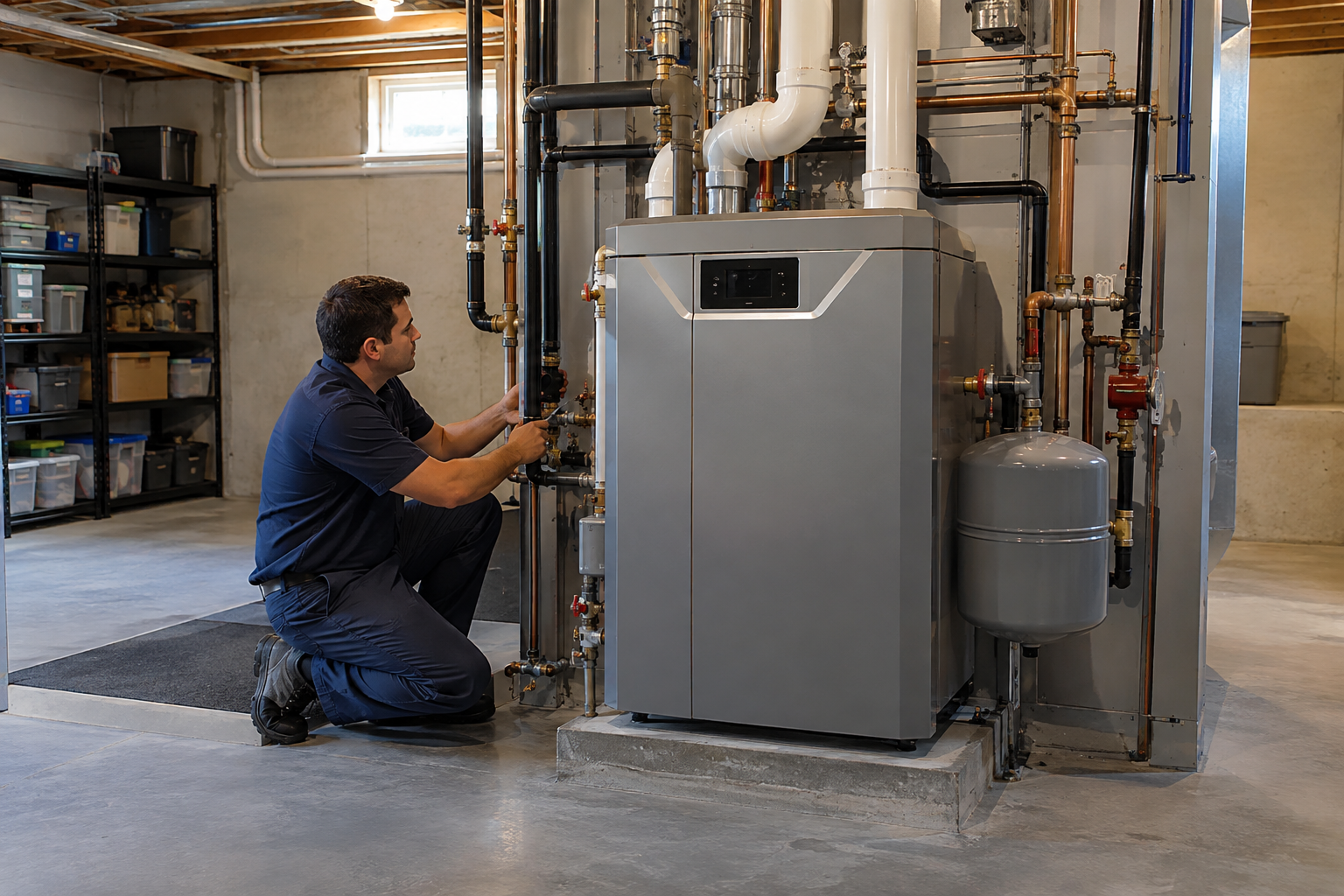
Emergency boiler service and heat-loss solutions for Long Island homes
When your boiler stops heating during a Long Island cold spell, the first question is not whether you need a replacement. It is whether the house is safe—and what has actually failed. A burner problem, a stuck zone valve and a drafty upstairs bedroom require very different solutions.
Home+ Air & Heat serves Nassau County and western Suffolk. Call (516) 259-1191 to discuss urgent heating repair and current scheduling. Describe any safety concerns first, then ask for an arrival estimate. An emergency appointment is not a guarantee that every repair can be completed immediately.

First, decide whether to evacuate or request service
Leave immediately for a gas odor or carbon monoxide alarm
If you smell gas, leave the building without operating switches, appliances or phones inside. From a safe location, contact your gas utility’s emergency service or emergency responders. Do not reenter until responders say it is safe. National Grid provides specific guidance for suspected gas leaks.[1]
If a carbon monoxide alarm sounds—or people develop headache, dizziness or nausea that could indicate exposure—get everyone outdoors and seek emergency help. Carbon monoxide is odorless; a normal-looking flame does not establish safety. Our carbon monoxide emergency guidance is supplemental information, not a substitute for evacuation.[2]
Install and maintain alarms according to their instructions. CPSC recommends CO alarms on every level and outside sleeping areas. Review carbon monoxide detector placement before the next heating emergency.[3]
Use temporary heat carefully
Never heat the house with an oven, grill or outdoor combustion appliance. Keep portable electric heaters at least three feet from combustible materials, plug them directly into wall outlets and turn them off when sleeping or leaving the room. If safe heat cannot be maintained, relocate vulnerable occupants rather than relying on unsafe improvisations.[2][4]
Safe checks before the technician arrives
When there is no gas odor, CO alarm, smoke or immediate electrical hazard, gather information without opening burner compartments or changing safety controls:
- Thermostat: Confirm heating mode, a setpoint above room temperature and working batteries where applicable.
- Pattern: Is the whole house cold, one zone cold, or only one radiator?
- Display: Photograph fault codes, the model label and visible gauge readings.
- Fuel: For oil heat, note the tank gauge and last delivery. Do not assume every shutdown means an empty tank.
- Water: Photograph visible leakage from a safe, dry location.
Do not repeatedly reset a locked-out burner, bypass a low-water cutoff, adjust a gas valve or add water to an overheated boiler. Reset and filling procedures are equipment-specific; leave uncertain steps to the technician. DOE identifies burner, venting, water-level and safety-control checks as professional maintenance tasks.[5]
Our boiler no-heat checklist helps organize symptoms. If the equipment heats air through ducts rather than water or steam, request furnace repair instead so the service request accurately describes the system.
What common boiler symptoms can mean
Boiler trouble can originate in heat production, controls or distribution. The following are diagnostic possibilities—not instructions to replace a part based on a symptom alone.[5][6]
| Symptom | Possible causes | Useful next step |
|---|---|---|
| Every zone is cold | Power, thermostat, fuel, ignition or safety-control interruption | Record displays and request a boiler diagnostic. |
| One zone stays cold | Zone valve, circulator, control or distribution problem | List affected rooms using our cold-radiator troubleshooting guide. |
| Water around the boiler | Pipe joint, seal, relief discharge or pressure-control problem | Avoid wet electrical equipment; arrange boiler leak assessment. |
| Banging or gurgling | Water-flow, air, expansion or steam-distribution issue | Describe when it happens; review boiler noise symptoms. |
| Repeated shutdowns | Control, ignition, venting or other safety-related fault | Preserve fault codes for a recurring shutdown investigation. |
A new burning smell near the boiler also deserves attention. Visible smoke, soot or suspected combustion leakage warrants stopping routine troubleshooting and obtaining urgent safety guidance.[2][5]
Steam and hot-water systems need different treatment
A hot-water boiler circulates heated water; a steam boiler produces steam that releases heat and condenses back into water. Their operating controls and distribution requirements differ. Do not apply generic hot-water pressure advice to steam equipment.[5][6]
For radiator-equipped homes, identify the system before authorizing changes. Our Long Island steam boiler guide and Nassau County hot-water boiler guide provide starting points for that conversation.
How quickly can heat be restored?
Restoration depends on the diagnosis, site access, parts availability and whether safe operation can be demonstrated. Ask separately about arrival time, diagnostic time and repair completion. Avoid treating “same-day service” as a promise of same-day restoration.
When requesting boiler repair, provide your town, fuel type, model, fault code, indoor temperature and whether children, older adults or medically vulnerable residents are present. Ask what happens if a required part is unavailable.
A useful heating repair process should explain the fault, the proposed correction and the verification steps. Request an itemized authorization before work proceeds, and ask how the diagnostic fee is handled. No responsible estimate should substitute an assumed part failure for testing.
Protect plumbing during an extended outage
Water lines in unheated areas are vulnerable to freezing. Open sink cabinets where appropriate, keep garage doors closed where water lines pass through and know the location of the main water shutoff. Move household chemicals out of children’s reach when opening cabinets.[7]
If a pipe freezes, never use a torch or other open flame. An inaccessible frozen section, suspected rupture or water near electrical equipment calls for professional assistance. See our frozen-pipe response guidance. Do not attempt to drain an entire boiler system as an improvised winterization measure.[7]
Is the boiler failing—or is the house losing too much heat?
A boiler repair restores equipment function. A building heat-loss assessment examines how heat escapes through walls, ceilings, windows and air leakage. These are related but separate investigations. DOE recommends evaluating the whole home rather than treating heating equipment in isolation.[8]
For a Nassau or western Suffolk Cape, split-level or home with an addition, ask the assessor to compare the original structure with remodeled areas. A finished attic, room over a garage or enclosed porch deserves its own evaluation rather than an assumption that the boiler is undersized.
Prioritize measurements over guesses
- Professional assessment: Request an envelope inspection and a prioritized improvement plan.[9]
- Blower-door testing: This measures building air leakage; it does not diagnose a failed circulator.[10]
- Thermography: Under suitable conditions, infrared inspection can help locate insulation and air-leakage problems.[11]
- Room-by-room heating load: Before replacement, request an ACCA Manual J calculation rather than copying the existing boiler size.[12]
Local winter planning should use appropriate outdoor design conditions, not a mild-day impression. NOAA’s climate normals provide regional context, while equipment sizing requires a design-load calculation.[12][13]
Fix the envelope without creating combustion problems
Air sealing and insulation address different heat-loss mechanisms. Start with identified leakage paths, then specify insulation appropriate to the assembly. Window weatherstripping or storm-window improvements may be worth evaluating before assuming full window replacement is necessary.[14][15][16]
Do not block combustion-air openings or pack ordinary insulation against hot vents. Tightening a home can affect ventilation and combustion safety, so coordinate envelope work with the heating assessment.[14][17]
If comfort is acceptable but fuel consumption seems excessive, our high boiler bill guide can help frame questions about weather, fuel prices, operating hours and equipment condition. High bills alone do not prove a defective boiler.
Repair, replace or add a heat pump?
Repair is worth considering when the fault is isolated and the boiler can return to safe service. Replacement deserves a closer look when there is significant deterioration, repeated failures, unavailable parts or an opportunity to correct a poorly matched system. AFUE describes annual fuel-conversion efficiency, not the entire house’s heat loss or every distribution loss.[5]
Before approving boiler replacement, request the load calculation, venting plan, control strategy and domestic-hot-water arrangement. Compare boiler brands by the exact model, local service support and installation requirements—not a blanket claim that one brand is always best.
Condensing equipment deserves careful system matching because return-water temperature affects condensing performance. Discuss those operating conditions when reviewing condensing boiler options. ENERGY STAR certification is a useful screening tool, but does not guarantee a particular household’s savings.[18][19]
Heat pumps offer cooling too, but require cold-weather planning
Air-source heat pumps move heat rather than producing it through combustion. Cold-climate models can serve heating needs in cold regions, but capacity at low outdoor temperatures, distribution and backup strategy must be evaluated.[20][21]
For a difficult addition or upstairs room, a ductless mini-split may provide targeted heating and cooling without new ducts. Tradeoffs include indoor-unit placement, condensate routing and maintaining comfort behind closed doors.[22]
Before a whole-home heat pump installation, compare operating costs using actual electricity and fuel rates. Review cold-climate heat pump selection alongside electrical capacity and a written plan for the existing boiler.
PSEG Long Island heat pump rebates are $4,000 market-rate or $7,500 income-qualified flat incentives, subject to program eligibility and current terms. These are not boiler-repair rebates. Verify equipment, project and application requirements before signing; our Long Island heat pump rebate guide can help organize the questions.[23]
Prevent another heating emergency
Schedule a professional boiler tune-up before the heating season and follow the manufacturer’s maintenance schedule. Ask which checks apply to your system: combustion, venting, safety controls, water pressure, expansion tank, circulators, leaks and condensate drainage. Maintenance reduces avoidable problems but cannot guarantee uninterrupted operation.[5]
Thermostat changes should match the equipment. Steam and radiant systems respond slowly, and heat-pump setbacks can trigger inefficient backup operation in some configurations. Discuss compatibility before selecting from thermostat options.[24]
Choose an insured and EPA 608-certified HVAC provider, and separately verify boiler-specific training and experience. EPA 608 certification concerns refrigerant handling; it is not a boiler competency credential. Ask about experience with your exact fuel and distribution system.[25]
Finally, do not mistake an air cleaner for combustion protection. Particle filtration does not resolve a CO source. For indoor air quality planning, prioritize source control and suitable ventilation; address persistent dampness as a moisture problem rather than masking it.[26][27][28]
Frequently asked questions
Should I keep resetting a boiler that will not start?
No. Record the fault code and follow only the homeowner procedures in the model’s manual. Repeated lockouts require diagnosis, not repeated attempts to override the shutdown.[5]
Why is one bedroom cold when the boiler runs?
The problem may involve distribution, controls or that room’s heat loss. Compare emitter temperature, thermostat location and envelope conditions before assuming the entire boiler needs replacement.[6][8]
Can boiler repair be completed the same day?
Possibly, but arrival and completion are different commitments. Ask about parts availability, authorization requirements and the contingency plan if heat cannot be restored during the first visit.
Will a higher-efficiency boiler fix drafts?
No. Better fuel-conversion efficiency does not seal air leaks or replace missing insulation. Equipment and envelope improvements should be evaluated together.[5][14][15]
Who should I contact for boiler service in Nassau or western Suffolk?
Contact Home+ Air & Heat at (516) 259-1191 for boiler service, availability and next steps. For a gas odor or CO alarm, evacuate and contact emergency responders first.
Sources
- [1] National Grid — Gas safety
- [2] CDC — Carbon monoxide poisoning basics
- [3] U.S. Consumer Product Safety Commission — Carbon monoxide
- [4] U.S. Fire Administration — Heating fire safety
- [7] American Red Cross — Preventing and thawing frozen pipes
- [12] Air Conditioning Contractors of America — Manual J residential load calculation
- [13] NOAA National Centers for Environmental Information — U.S. climate normals
- [18] Whole Building Design Guide — Condensing boilers
- [19] ENERGY STAR — Boilers
- [21] ENERGY STAR — Air-source heat pumps
- [23] PSEG Long Island — Heat pump rebates and program requirements
- [25] U.S. Environmental Protection Agency — Section 608 technician certification requirements
- [26] U.S. Environmental Protection Agency — Air cleaners and air filters in the home
- [27] U.S. Environmental Protection Agency — Improving indoor air quality
- [28] U.S. Environmental Protection Agency — A brief guide to mold, moisture and your home
- NYSERDA — Residential Energy Assessments
Related Home+ Air & Heat services
Talk to a local technician. Home+ Air & Heat serves Nassau County and western Suffolk with insured, EPA 608-certified technicians. Call (516) 259-1191 or book online.
Your Long Island HVAC team
Home+ Air & Heat55 Jericho Tpke, Suite 203
Jericho, NY 11753
Phone: (516) 259-1191
View us on Google Maps
Serving homeowners across Nassau County and western Suffolk County.