
Heat Pump Water Heater Savings for Nassau County Homeowners: Energy-Efficient Water Heating Benefits and Local Incentives
Learn how Nassau County homeowners can save with heat pump water heaters. Compare energy efficiency, local utility rates, and installation requirements for Long Island homes.
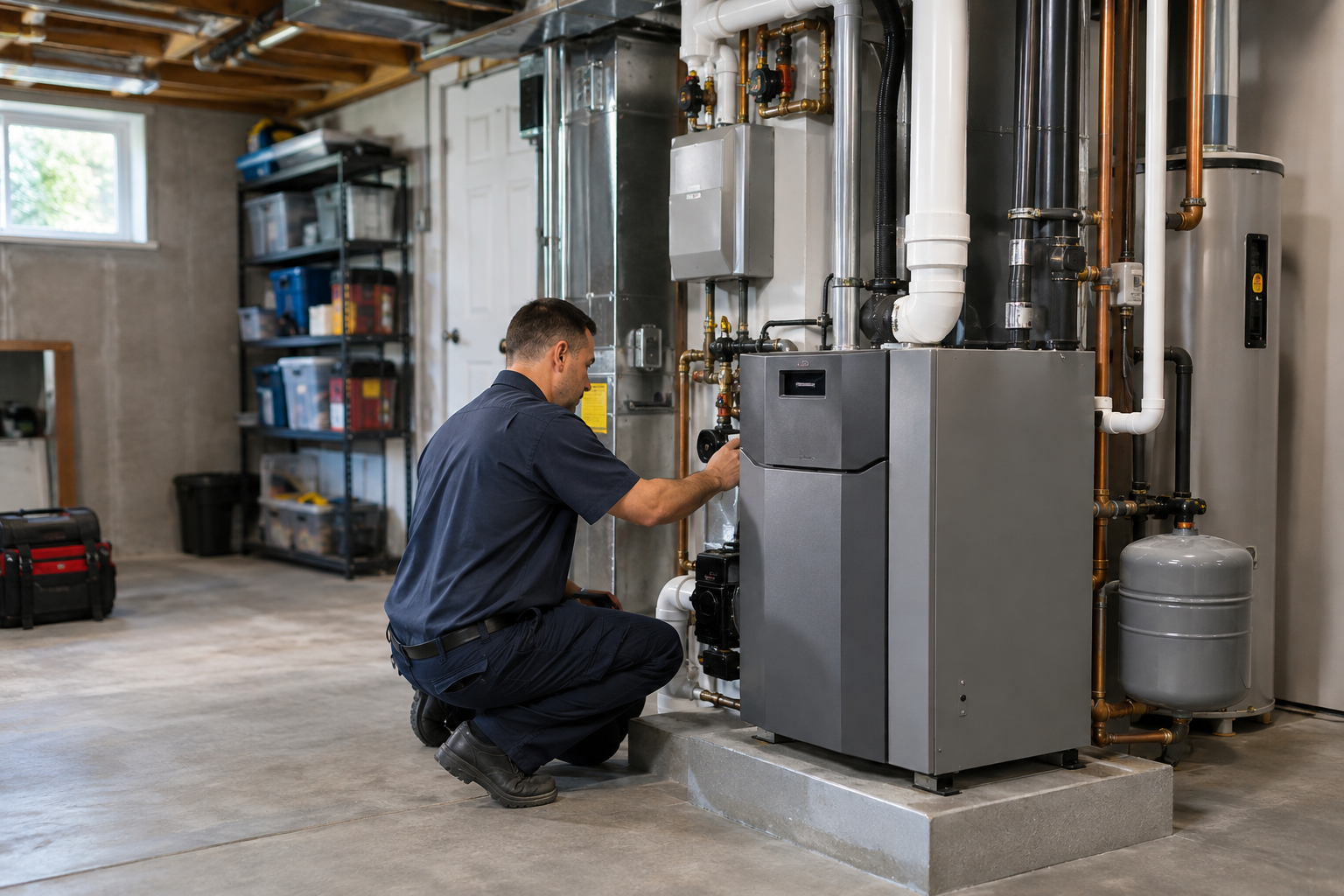
Heat pump water heater savings for Nassau County homeowners
A heat pump water heater can reduce the electricity needed to make hot water, especially when replacing a conventional electric-resistance tank. But Nassau County homeowners should not assume a fixed annual savings figure or a guaranteed payback period. Your existing fuel, electricity rate, basement temperature, household demand and installation requirements all matter.[1][2]
For homes in Nassau County and western Suffolk, the best starting point is a practical water heater installation assessment: identify what heats your water now, check the proposed location and compare complete installed options. This guide explains what to measure, which incentives to verify and when another system may be a better fit.

How a heat pump water heater works
Most residential heat pump water heaters pull heat from surrounding air and transfer it into a storage tank. They use electricity to move heat rather than relying entirely on electric resistance elements. Many hybrid models also have resistance elements for periods of high demand or operating conditions outside the heat pump’s preferred range.[1]
The U.S. Department of Energy says heat pump water heaters can be two to three times more energy-efficient than conventional electric-resistance water heaters. That is a water-heating comparison—not a promise to cut your entire utility bill by the same proportion.[1]
When reviewing water heater brands and options, compare the exact model’s uniform energy factor, first-hour rating, operating limits, warranty and service requirements. An efficiency rating alone does not establish whether a tank can handle your family’s busiest shower schedule.[2][3][4]
Is your Nassau County home a good candidate?
Basement temperature matters more than the outdoor forecast
Long Island has a real heating season; calling its climate universally ideal for heat pump water heaters is misleading. Local climate normals help describe outdoor conditions, but an indoor unit’s performance depends heavily on its installation space.[1][7]
DOE gives general location guidance of approximately 40°F–90°F and at least 1,000 cubic feet of surrounding air. Those figures are screening guidance, not substitutes for the selected manufacturer’s instructions. Some installations need approved ducting or other provisions.[1]
Measure winter basement temperatures before choosing equipment. A heat pump water heater cools its surroundings, and extracting heat from a heated room can add to the home’s space-heating load in winter. A small, chilly utility closet is therefore a different proposition from an open basement.[1]
Identify how your current system makes hot water
| Existing arrangement | Potential benefit | Important trade-off |
|---|---|---|
| Electric-resistance tank | Uses the same energy source, making an operating-cost comparison more straightforward. | Airflow, drainage and electrical compatibility still need checking. |
| Gas storage heater | Removes combustion from that water-heating appliance. | Lower energy consumption does not automatically mean lower cost when switching fuels. |
| Boiler-fed indirect tank or tankless coil | May allow the boiler to remain off when space heating is unnecessary. | The boiler controls and domestic-water piping must be evaluated together. |
These comparisons follow DOE guidance on water-heater selection and boiler-connected water heating.[2][4][5][6] If your boiler runs throughout summer, a boiler and hot-water diagnostic can clarify why. Investigating high boiler fuel bills before replacing equipment helps establish a useful baseline.
A water heater is not a whole-home heating system. If you are also considering space-heating heat pump installation or ductless mini-splits, evaluate those projects separately before combining their budgets or incentives.[1][8]
How to calculate savings without guessing
Start with the existing water-heating load, not a national dollar estimate. DOE’s comparison method uses equipment efficiency, energy consumption and your fuel price. EnergyGuide labels help compare equipment under standardized assumptions, but their printed annual costs are not personalized Nassau County forecasts.[2][11]
- Document the baseline. Record the existing model, fuel, age and household hot-water routine.
- Compare equivalent service. Evaluate equipment sized for the same peak demand.
- Use current utility charges. Obtain your applicable PSEG Long Island rate and, where relevant, National Grid gas charges or actual oil delivery costs.[9][10]
- Include installation differences. Request separate allowances for electrical work, drainage, piping changes and removal.
- Calculate the upgrade premium. Compare the heat pump option with a suitable conventional replacement—not only with keeping the old tank indefinitely.
Estimated annual operating savings = current annual water-heating energy cost − proposed annual water-heating energy cost. Simple payback divides the additional upfront investment, after confirmed incentives, by those estimated annual savings. It does not account for financing, future rate changes or every maintenance expense.[2]
Use the electricity charges that actually change with consumption; do not assume a fixed monthly customer charge disappears. Similarly, removing a gas water heater may not eliminate gas account charges if other gas appliances remain.[9][10]
For an oil-heated home, pair your delivery records with a heating oil system review. Summer fuel use can be informative, but it is not a perfect hot-water measurement. Ask for a savings range with its assumptions, not a guaranteed result.
Local incentives: separate water heating from space heating
Rebates should improve an already sensible project—not rescue a poorly suited installation. Check current program documents before ordering equipment, and make sure the offer specifically covers a heat pump water heater.[13][17]
PSEG Long Island offers are not interchangeable
PSEG Long Island’s qualifying space-heating heat pump rebate framework uses flat amounts of $4,000 market-rate or $7,500 income-qualified. These are not automatic heat pump water heater rebates and should not be deducted from a standalone water-heater quote. Confirm the current eligible project scope and program terms with the utility.[13]
Use our Long Island heat pump rebate guide for the space-heating discussion and our rebate planning page to organize questions. For water heating, request written confirmation of the exact model’s eligibility, purchase dates, required paperwork and whether approval is needed before installation.[13][17]
State assistance and federal tax rules
NYSERDA’s EmPower+ program is another place for income-eligible households to check for energy-improvement assistance. Eligibility does not mean every proposed appliance or contractor arrangement is covered; confirm the assessment and approval process first.[14]
Do not carry an older federal tax-credit claim into a new quote. The IRS states that the Energy Efficient Home Improvement Credit is unavailable for property placed in service after December 31, 2025. For an earlier qualifying installation, review the applicable tax-year rules. An ordinary air-source heat pump water heater also should not be confused with equipment covered by the separate Residential Clean Energy Credit.[15][16]
Do not budget for a generic Nassau County rebate without an identifiable current program. If you need installation financing, compare total repayment as well as monthly payments; a financing calculator is a planning tool, not an incentive approval.
What a complete installation assessment should cover
- Peak demand: Use first-hour rating and the busiest hour of household hot-water use, not tank capacity alone.[3]
- Electrical supply: Confirm the exact model’s voltage, circuit and connection requirements before assuming the existing supply is suitable.[1][12]
- Air and service space: Check available air volume, clearances and access for filter cleaning and future repairs.[1][12]
- Condensate: Identify an approved drainage route and whether a condensate pump is necessary.[12]
- Comfort and sound: Consider compressor operation and cool exhaust near finished rooms.[1][12]
- Flood exposure: In vulnerable locations, discuss protecting or elevating electrical equipment as part of broader flood planning.[26]
If the new tank replaces boiler-produced hot water, coordinate the change with boiler service. If a boiler replacement is also planned, compare a combined boiler installation proposal with a separate water-heating option rather than paying for overlapping work.
Ask for evidence that the team is insured and EPA 608-certified for applicable refrigerant work. EPA certification concerns refrigerant handling; it does not replace the need to verify electrical, plumbing and local permit requirements.[25] Review technician qualifications and ask who handles each part of the project.
Humidity, indoor air and safety: useful benefits with limits
A heat pump water heater can remove moisture from the air while operating, but it is not a whole-basement humidity-control guarantee. Its runtime follows hot-water demand, not necessarily the basement’s moisture needs.[1][12]
Address groundwater, leaks and damp materials directly. EPA recommends controlling moisture to prevent mold; installing a water heater does not remediate an existing mold problem.[19] Persistent dampness may call for dedicated dehumidification or a broader indoor air quality assessment.
An electric heat pump water heater has no fuel-burning burner at the appliance. However, a remaining boiler, furnace, fireplace or other combustion source can still create carbon monoxide hazards. Keep appropriate carbon monoxide detection and maintain remaining fuel-burning equipment.[20][21]
In a cool installation area, also review exposed plumbing. Proper frozen-pipe prevention matters independently of the new tank’s efficiency, and hot-water pipe insulation can reduce distribution heat loss.[18]
Protect savings after installation
Follow the exact model’s maintenance schedule. Keep its air filter clean, preserve airflow, inspect the condensate route and arrange tank maintenance according to the manufacturer’s water-quality and service instructions. ENERGY STAR product information and the manufacturer’s manual should guide operation—not a generic schedule applied to every unit.[12]
Ask the installer to explain efficiency, hybrid and high-demand modes. Frequent resistance-element use can reduce the energy advantage, so investigate repeated hot-water shortages rather than permanently changing modes without understanding the cause.[1][12]
Also reduce avoidable demand: repair hot-water leaks and consider efficient fixtures. DOE discusses lower temperature settings as an energy-saving measure, but household health needs, appliance requirements and scald protection should inform the final setting.[22][23]
For a larger plumbing renovation, ask whether drain-water heat recovery is practical; it captures some heat otherwise lost down the drain and is separate from the water heater itself.[24] Keep any remaining boiler on an appropriate boiler maintenance schedule.
Frequently asked questions
Will a heat pump water heater cut my whole electric bill dramatically?
Not necessarily. Its efficiency advantage applies to water heating. Total bill savings depend on how much electricity the old water heater used and how the replacement operates.[1][2]
Can it work in a Nassau County basement during winter?
Yes, if the installation meets the model’s temperature, airflow and clearance requirements. Measure actual basement conditions; an unheated, cramped enclosure deserves closer evaluation than an open, temperate basement.[1]
Is it always cheaper than gas or oil?
No. Fuel prices, existing equipment efficiency, boiler standby operation and installation costs affect the comparison. Request a household-specific estimate using current rates and realistic demand.[2][6]
Does the space-heating heat pump rebate cover my water heater?
Do not assume so. Space-heating and water-heating eligibility are separate questions. Obtain written confirmation naming the appliance and applicable program before including a rebate in your budget.[13][17]
Should I replace a working tank now?
Compare its condition, repair needs and operating costs with the net cost of replacement. Planning before a failure gives you time to assess fit and incentives, but efficiency alone does not establish the right replacement date.[4]
Get a recommendation based on your home
Home+ Air & Heat serves Nassau County and western Suffolk. Learn about our company, request a water-heating project estimate or contact our team at (516) 259-1191.
Have your current equipment information, utility bills and installation-space photos ready. Ask for a written comparison showing equipment sizing, installation scope, savings assumptions and confirmed incentives. The right choice is the one that reliably meets your household’s demand at a defensible total cost.
Sources
- [7] NOAA National Centers for Environmental Information — U.S. Climate Normals
- [9] PSEG Long Island — Rates and Tariffs
- [10] National Grid — Long Island Residential Customer Resources
- [12] ENERGY STAR — Heat Pump Water Heaters
- [13] PSEG Long Island — Energy Efficiency and Rebates; confirm current program-specific eligibility and amounts
- [14] New York State Energy Research and Development Authority — EmPower+
- [15] Internal Revenue Service — Energy Efficient Home Improvement Credit
- [16] Internal Revenue Service — Residential Clean Energy Credit
- [17] ENERGY STAR — Rebate Finder
- [19] U.S. Environmental Protection Agency — A Brief Guide to Mold, Moisture and Your Home
- [20] U.S. Environmental Protection Agency — Carbon Monoxide's Impact on Indoor Air Quality
- [25] U.S. Environmental Protection Agency — Section 608 Technician Certification
- [26] Ready.gov — Floods and Household Preparedness
- NYSERDA: NYS Clean Heat—State Heat Pump Program Information
- U.S. Energy Information Administration: New York Electricity Profile—State Electricity Price Context
Related Home+ Air & Heat services
Talk to a local technician. Home+ Air & Heat serves Nassau County and western Suffolk with insured, EPA 608-certified technicians. Call (516) 259-1191 or book online.
Your Long Island HVAC team
Home+ Air & Heat55 Jericho Tpke, Suite 203
Jericho, NY 11753
Phone: (516) 259-1191
View us on Google Maps
Serving homeowners across Nassau County and western Suffolk County.