
Long Island Boiler Repair Services and Maintenance Plans for Homeowners
Expert boiler repair and maintenance for Long Island homeowners. Our EPA 608-certified technicians service steam, hot water, and condensing boilers in Nassau and Western Suffolk County.
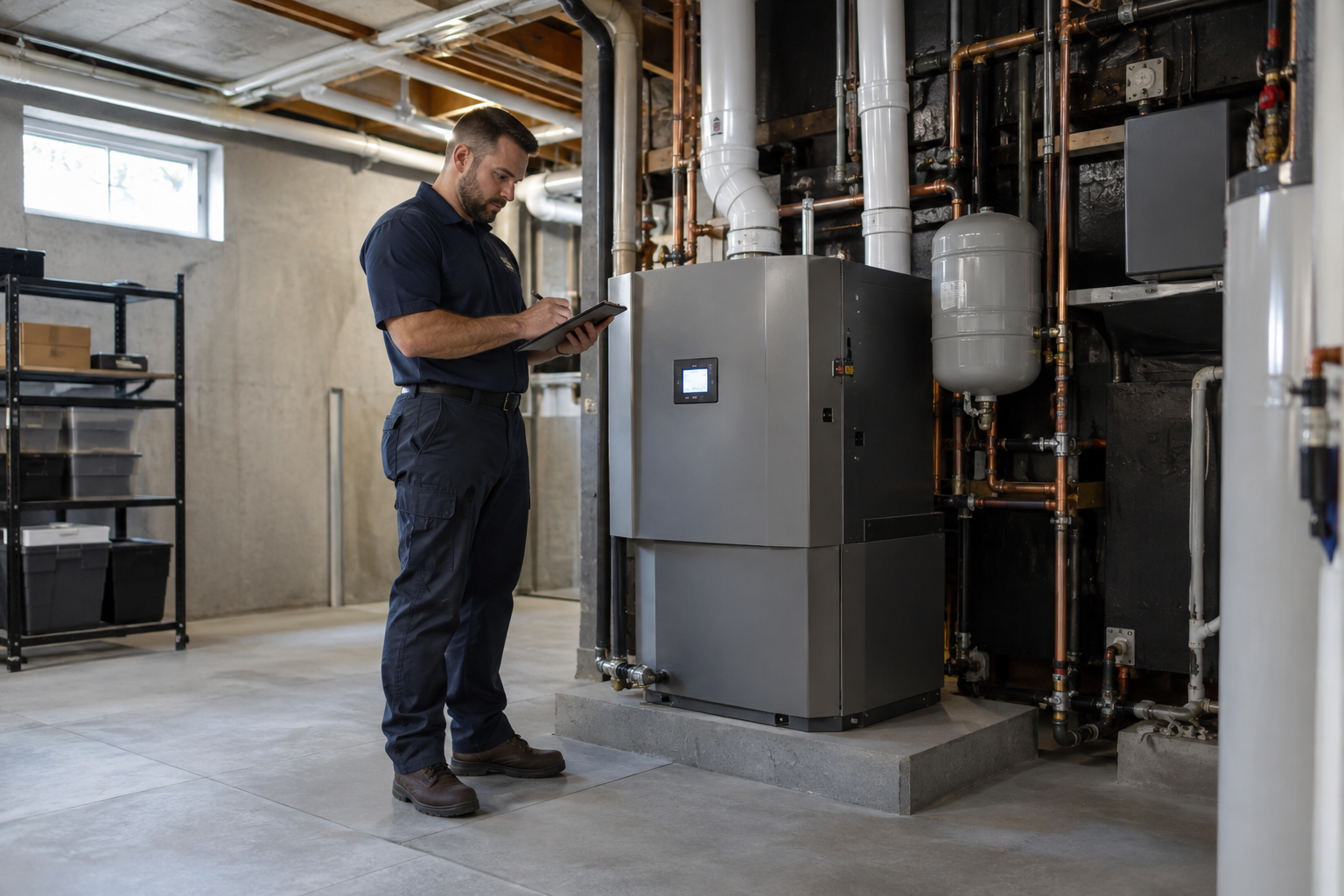
Long Island boiler repair services and maintenance plans for homeowners
A boiler service visit should answer three questions: Is the system safe? Why is it not heating properly? What work is necessary now—and what can wait? For homeowners in Nassau County and western Suffolk, that means looking beyond the burner to the piping, radiators, controls, venting and, sometimes, domestic hot water.
Home+ Air & Heat provides residential boiler service throughout this area. This guide explains how to recognize urgent problems, evaluate a maintenance plan and make a practical repair-or-replacement decision without relying on promised savings or one-size-fits-all recommendations.

Start with the boiler system you actually have
“Gas,” “steam” and “condensing” describe different characteristics. Fuel type, heat distribution and combustion design all affect troubleshooting and maintenance. Boilers distribute heat using hot water or steam, unlike furnaces, which heat air.[1]
| System | What matters during service | Homeowner takeaway |
|---|---|---|
| Hot-water boiler | Circulation, system pressure, expansion tank, zone controls and air removal | A cold room does not automatically mean the boiler needs replacement. |
| Steam boiler | Water level, low-water protection, operating pressure, vents and piping | Steam requires different troubleshooting from hot-water heat. |
| Condensing boiler | Heat exchanger, combustion settings, venting and condensate drainage | Efficiency depends partly on operating conditions, not just the label. |
| Combination boiler | Space-heating operation plus domestic-hot-water performance | A shower-temperature complaint may involve a different circuit than a heating complaint. |
DOE explains the distinction between steam and hot-water distribution; ENERGY STAR describes condensing technology, while manufacturer documentation identifies model-specific service requirements.[2][3][4] Our guides to hot-water boilers, steam boiler selection and combination boilers help narrow the conversation.
In an older house, addition or converted living space, ask the technician to map the heating zones rather than assume every thermostat controls the same equipment. Record whether the boiler also heats an indirect water tank; that relationship changes how a summer shutdown or replacement should be planned.[5]
When a boiler problem becomes an emergency
Leave first for suspected gas or carbon monoxide
If you smell gas or suspect a gas leak, leave immediately. Do not operate switches, use a phone inside or attempt a repair. Contact the gas utility’s emergency service or emergency responders from outside. National Grid provides gas-safety instructions for its New York customers.[6]
If a carbon monoxide alarm sounds, move everyone outside into fresh air and contact emergency responders. Do not search for the source or re-enter until responders say it is safe. Carbon monoxide is colorless and odorless; headache, dizziness, weakness and confusion can be warning symptoms.[7][8] Our carbon monoxide emergency guidance and detector information are planning resources, not substitutes for evacuation.
Arrange prompt service for leaks, shutdowns or loss of heat
A water leak near electrical equipment, repeated safety shutdowns or no heat during freezing weather deserves prompt attention. Do not touch wet electrical equipment or repeatedly reset a burner. Flood-affected heating equipment needs professional evaluation before reuse.[9][10]
For urgent heating service, describe the symptoms and household conditions when requesting availability. Mention vulnerable occupants, falling indoor temperatures and any risk of frozen plumbing. Exposed pipes in unheated spaces are particularly vulnerable during cold weather.[11]
Common boiler symptoms—and useful information to collect
Before booking boiler repair, photograph the model label, display code and any visible leak from a safe position. Note when the problem started, which rooms are affected and whether domestic hot water still works.
| Symptom | Possible investigation | Safe homeowner observation |
|---|---|---|
| No heat anywhere | Thermostat demand, power, fuel supply, ignition and safety controls | Confirm the thermostat is set to heat; note any displayed fault. |
| Only one zone is cold | Zone valve, circulator, thermostat or distribution issue | List the rooms affected and whether other zones work. |
| Water around the boiler | Pipe connections, relief discharge, condensate system or boiler block | Photograph the apparent origin without removing covers. |
| Banging or gurgling | Steam condensate return, trapped air, circulation or piping arrangement | Record when the sound occurs and where it is loudest. |
These are diagnostic starting points, not conclusions. DOE’s distribution guidance and manufacturer troubleshooting resources explain why similar symptoms can have different causes.[2][12] Read the relevant guide for a boiler producing no heat, cold radiators, boiler water leaks or unusual boiler noises.
A proper boiler diagnostic visit should establish the cause before a part is proposed. With recurring shutdowns, ask what triggered the safety control and how the technician verified the correction. Avoid opening combustion chambers, adjusting fuel valves or bypassing protective controls.[12]
What an annual boiler tune-up should include
Schedule professional maintenance annually, using the equipment manual to determine the actual tasks and any more frequent checks. DOE recommends heating-system maintenance, and boiler manufacturers publish model-specific inspection procedures.[1][12][13] Booking a boiler tune-up before the heating season leaves time to address discovered problems.
Ask for a written checklist covering the equipment installed in your home:
- Combustion and burner: Inspect and clean as specified; assess ignition and combustion using the manufacturer’s procedures.
- Exhaust and combustion air: Inspect accessible venting, connections and air openings.
- Safety controls: Check applicable limit controls, low-water protection and relief-device condition.
- Hot-water components: Evaluate pressure, expansion tank, circulators, zone operation and leakage.
- Steam components: Inspect water-level controls and investigate water loss, venting or return problems.
- Condensing equipment: Inspect the condensate trap, drainage, heat exchanger and neutralizer where fitted.
- Service report: Record findings, measurements, completed work and remaining recommendations.
Not every boiler requires every task. Weil-McLain, U.S. Boiler and Lochinvar provide technical literature that should govern the service scope rather than a generic checklist.[12][13][14]
There is no universal instruction to flush every boiler every few years. Closed-loop heating-water treatment, steam-boiler cleaning and domestic-water descaling are different procedures. Ask what condition justifies the work and which manual specifies it. Likewise, do not use a generic internet pressure target for both steam and hot-water systems.[12][13][14]
For oil-fired equipment, ask whether burner service and fuel-supply components are included. Keep fuel deliveries, tank concerns and heating oil service in the same maintenance record; DOE discusses oil-system efficiency measures, and New York DEC provides homeowner oil-tank guidance.[15][16]
How to compare boiler maintenance plans
A maintenance plan is only as useful as its written scope. Do not assume it includes repairs, replacement parts, emergency labor or an arrival-time guarantee. FTC guidance recommends examining service-contract coverage, exclusions and claim requirements before buying.[17]
| Ask about | Get the answer in writing |
|---|---|
| Annual maintenance | Included tasks, cleaning, testing and scheduling responsibility |
| Covered equipment | Boiler only, or also zones, circulators, controls and indirect tank? |
| Repair charges | Diagnostic fees, labor, parts and any discount limitations |
| Urgent calls | Coverage hours, surcharges and what priority service actually means |
| Exclusions | Pre-existing faults, corrosion, flooding, inaccessible piping and fuel issues |
| Contract terms | Renewal, cancellation, transfer and coverage limits |
Ask Home+ Air & Heat about current maintenance-plan options and request equipment-specific terms. Clarify the diagnostic fee before authorizing a visit. A plan can simplify scheduling and budgeting, but it cannot guarantee that a component will never fail.
Compare annual membership cost plus likely uncovered expenses against purchasing maintenance separately. For larger repairs, review financing options by total repayment cost—not monthly payment alone.
Lower heating bills without overlooking the house
Long Island heating demand changes with winter weather. NOAA’s climate normals provide a baseline, while EIA explains how heating degree days relate weather to heating demand. Compare fuel use across similar weather periods instead of treating a higher bill as proof of boiler failure.[18][19]
Investigating high boiler operating costs should include fuel prices, thermostat schedules, hot-water use and distribution problems. A home energy assessment can also identify envelope improvements that equipment service will not address.[20]
- Air sealing: Target identified leakage while preserving combustion safety and required ventilation.[21]
- Insulation: Evaluate attic and other accessible areas before choosing replacement equipment capacity.[22]
- Controls: Check thermostat compatibility and discuss schedules suited to the system’s response time.[23]
Our thermostat selection guide can help frame control questions. If air sealing is planned, include indoor air quality in the discussion: EPA identifies source control and ventilation as important parts of healthier indoor air.[24]
Repair, replace or supplement the boiler?
Repair is worth considering when the boiler is otherwise sound and the fault is isolated. Replacement deserves closer evaluation when there is significant deterioration, repeated failures or a major mismatch between equipment and the home. DOE recommends considering efficiency, sizing, distribution and the building envelope together.[1]
Before approving boiler replacement, request an explanation of sizing, venting, distribution compatibility and domestic-hot-water arrangements. For steam, ask how connected radiation informed selection; for hot-water systems, ask about heat loss and available emitter output.[12][13]
Our condensing boiler guide explains an important tradeoff: these boilers recover additional heat from exhaust, but actual performance depends on installation and operating conditions. The highest label efficiency is not a guarantee of a particular bill reduction.[1][3]
Compare boiler brands by the specific model, local service capability, parts access and warranty terms—not unsupported rankings. Ask who handles warranty claims and whether labor is included.
A heat pump installation or ductless system may offer cooling and an alternative source of heat. Evaluate cold-weather capacity, electricity versus delivered-fuel costs, electrical work and whether the boiler will remain as backup. DOE and NYSERDA provide guidance on heat pump applications and cold-climate considerations.[25][26] If replacing a boiler also removes your hot-water source, include water-heater planning in the project.
Choosing a contractor and preparing for service
Look for an insured and EPA 608-certified HVAC provider, but ask separately about boiler training and experience with your system. EPA Section 608 certification concerns refrigerant handling; it is not itself a boiler-service credential.[27]
Confirm model familiarity, written authorization procedures and repair warranty terms. Clear safe access, gather service records and keep children and pets away from the work area. For replacement work, ask the local town or village building department which permits and inspections apply rather than assuming one countywide rule.
Homeowners in Nassau County and western Suffolk can contact Home+ Air & Heat at (516) 259-1191 to discuss boiler repair, maintenance and current scheduling availability. Have the fuel type, model number and symptoms ready.
Frequently asked questions
How often should my boiler be serviced?
Arrange annual professional maintenance and follow the model manual for additional checks. Equipment condition and manufacturer instructions determine whether extra attention is needed.[1][12]
Does a maintenance plan cover every repair?
Only if the written agreement explicitly provides that coverage. Review parts, labor, exclusions, service hours and coverage limits before enrolling.[17]
Why are some radiators cold when the boiler runs?
The problem may involve circulation, air, zone controls or steam venting rather than the burner. Diagnosis depends on whether the system uses steam or hot water; do not apply hot-water bleeding instructions to steam radiators.[2]
Can I keep resetting a boiler that shuts down?
No. Follow the operating manual and arrange service for repeated lockouts. Resetting does not correct the underlying fault, and safety controls should never be bypassed.[12][13]
Will a new boiler definitely lower my bill?
No fixed savings can be promised. Results depend on the existing equipment, replacement efficiency, weather, fuel prices, installation and household use. Compare the complete system and building—not just the boiler’s efficiency rating.[1][19][20]
Sources
- [3] ENERGY STAR — Boilers
- [4] Navien — Download Center: product manuals and technical documentation
- [6] National Grid — New York residential gas safety
- [7] U.S. Consumer Product Safety Commission — Carbon Monoxide
- [8] Centers for Disease Control and Prevention — Carbon Monoxide Poisoning Basics
- [10] AHRI — Floods and HVACR Equipment
- [11] American Red Cross — Preventing and Thawing Frozen Pipes
- [18] NOAA National Centers for Environmental Information — U.S. Climate Normals
- [19] U.S. Energy Information Administration — Degree Days
- [24] U.S. Environmental Protection Agency — Improving Indoor Air Quality
- [27] U.S. Environmental Protection Agency — Section 608 Technician Certification Requirements
- U.S. Boiler Company — Technical Literature and Boiler Manuals
- Lochinvar — Boiler Manufacturer Resources and Product Documentation
- U.S. Fire Administration — Home Heating Fire Safety
- U.S. Environmental Protection Agency — Carbon Monoxide's Impact on Indoor Air Quality
- Federal Trade Commission — Warranties, Extended Warranties and Service Contracts
- Federal Trade Commission — Hiring a Contractor and Avoiding Home Improvement Scams
Related Home+ Air & Heat services
Talk to a local technician. Home+ Air & Heat serves Nassau County and western Suffolk with insured, EPA 608-certified technicians. Call (516) 259-1191 or book online.
Your Long Island HVAC team
Home+ Air & Heat55 Jericho Tpke, Suite 203
Jericho, NY 11753
Phone: (516) 259-1191
View us on Google Maps
Serving homeowners across Nassau County and western Suffolk County.