
What Is Central Air Installation? A Homeowner's Guide
Learn what is central air installation and how it provides consistent cooling, dehumidification, and air filtration for your home.
What Is Central Air Installation? A Homeowner’s Guide
Central air installation is the professional process of setting up a complete home cooling system by connecting an outdoor condenser unit, indoor air handler, ductwork, thermostat, and refrigerant lines into one integrated system. The result is consistent cooling, dehumidification, and air filtration throughout every room in your home. Unlike portable or window units that cool one room at a time, a central air system setup treats the entire home as a single climate zone. Done correctly, it delivers comfort that lasts 15–20 years. Done poorly, it wastes energy and breaks down early.
What is central air installation and what does it include?
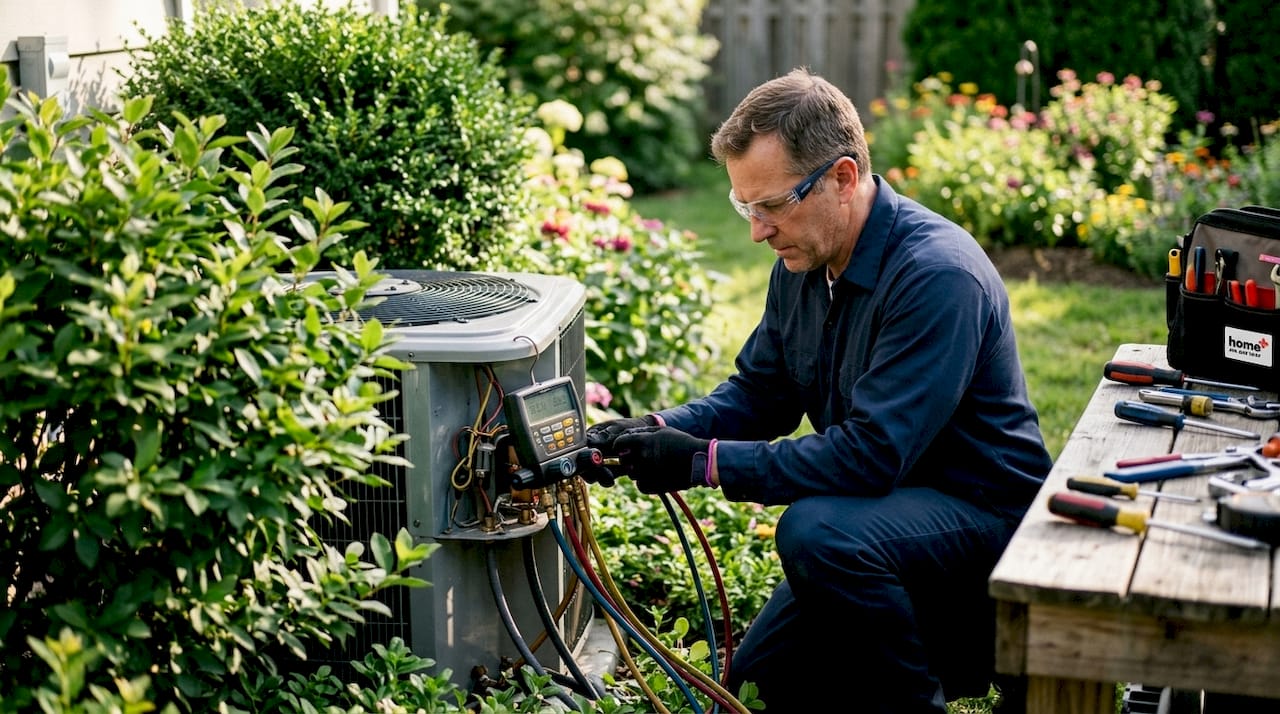
Central air installation, known in the HVAC industry as a split system installation, involves five core components working together. The outdoor condenser unit releases heat pulled from inside your home. The indoor air handler circulates cooled air through your ductwork. Refrigerant lines connect the two units and carry the heat-transfer fluid. A thermostat controls the whole system. Every component must be correctly sized, placed, and connected for the system to perform as rated.
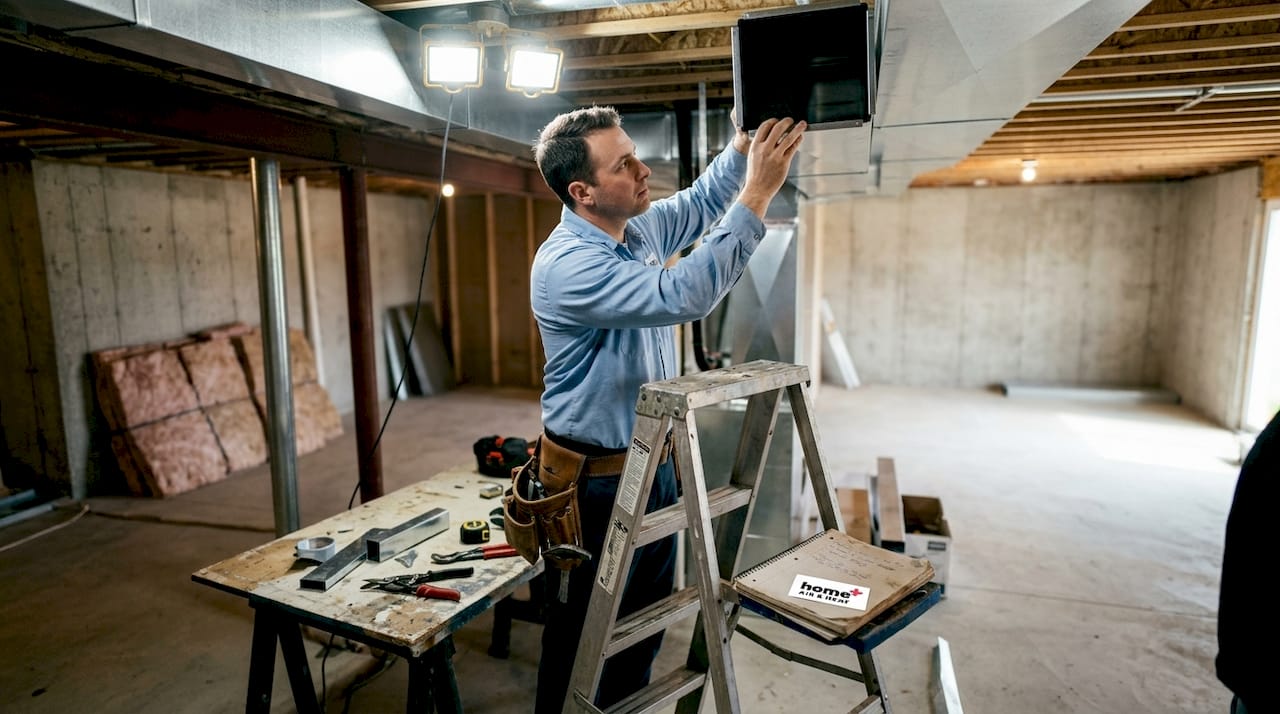
The ductwork is the part most homeowners underestimate. In homes without existing ducts, adding them is the single largest cost and labor driver in the entire central air installation process. In homes with older ducts, leaks or undersized passages can undercut a brand-new system’s performance before it ever runs a full cycle. Ductwork is not an afterthought. It is the delivery network that determines whether cooled air actually reaches every room.
Professional installation also affects your warranty. Most equipment manufacturers require licensed installation as a condition of their warranty coverage. A system installed without proper credentials may cool your home for a season, then leave you with no recourse when a compressor fails.
What are the main steps in the central air installation process?
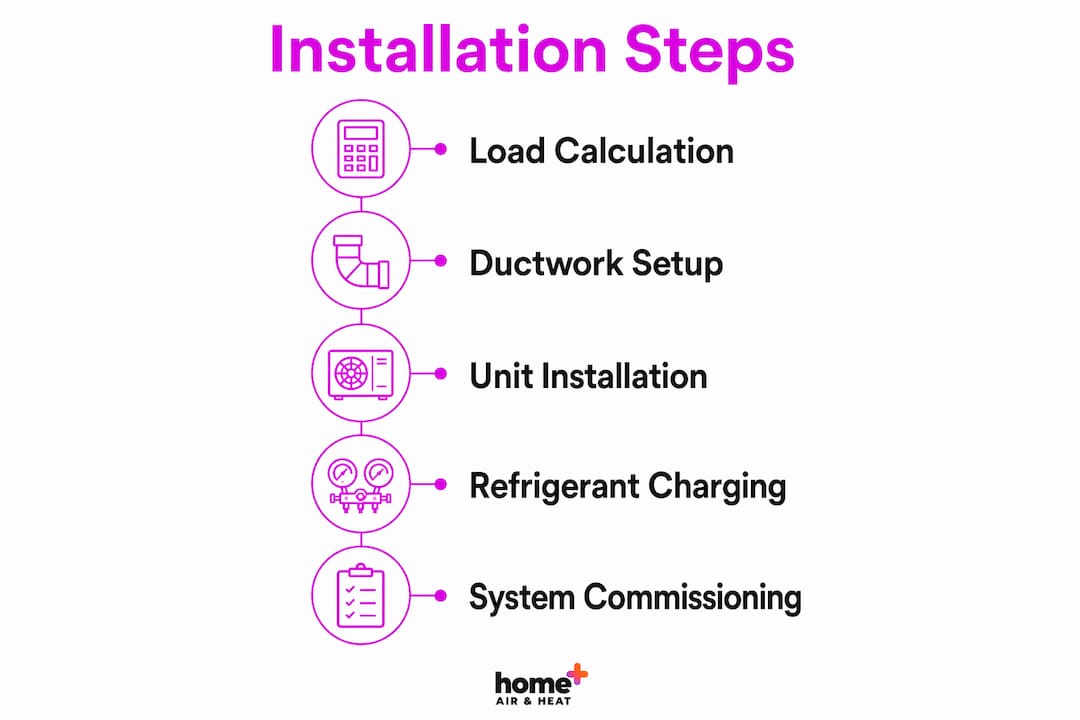
A professional central air installation follows a clear sequence. Skipping any step creates problems that show up months or years later.
-
Home evaluation and load calculation. A technician performs a Manual J load calculation to determine the exact BTU capacity your home requires. This accounts for insulation levels, window size and orientation, ceiling height, and local climate. Square footage alone is not enough.
-
Ductwork inspection and preparation. The technician inspects existing ducts for leaks, blockages, or undersized sections. New duct layouts follow Manual D design standards, which calculate airflow volumes, friction loss, and register placement for balanced delivery.
-
Indoor air handler installation. The air handler is mounted in a utility closet, attic, or basement. Proper placement affects both airflow efficiency and noise levels in living spaces.
-
Outdoor condenser unit placement. The condenser needs level ground, adequate clearance on all sides, and protection from direct sun where possible. Poor placement reduces efficiency and shortens equipment life.
-
Refrigerant line and electrical connections. Lines are run between the indoor and outdoor units. Electrical work must meet local code requirements, which sometimes means upgrading your panel.
-
Thermostat installation and system commissioning. The technician installs the thermostat, then runs the full commissioning sequence: leak tests, airflow testing, refrigerant charge verification, and fan speed calibration.
Central air installation timelines run 4–8 hours for a straightforward replacement and 1–3 days for complex jobs involving new ductwork or electrical upgrades. That range matters when you are planning around a summer heat wave.
Pro Tip: Ask your contractor for a written commissioning report after installation. It should document refrigerant charge levels, airflow readings, and thermostat calibration. That report is your proof that the system was set up correctly, and it protects you if warranty issues arise later.
How do home size, ductwork, and efficiency affect installation cost?
Standard central AC installation costs range from $6,000 to $11,500 for a full system replacement. That spread is wide because several factors push the price in different directions.
Key cost drivers:
- System size (tonnage). Larger homes need more cooling capacity, which means larger and more expensive equipment.
- SEER rating. Higher SEER (Seasonal Energy Efficiency Ratio) units cost more upfront but reduce monthly energy bills. A high-efficiency unit is worth reviewing at this resource on efficiency options before you commit to a quote.
- Ductwork condition. Existing ducts in good shape save thousands. New duct installation or major repairs add significantly to the total.
- Electrical upgrades. Older homes may need a panel upgrade or dedicated circuit, adding labor and materials cost.
- Local permit and code requirements. Long Island municipalities, for example, have specific permit requirements that affect both cost and timeline.
| Cost factor | Lower cost scenario | Higher cost scenario |
|---|---|---|
| Ductwork | Existing ducts in good condition | New ductwork required |
| Equipment efficiency | Standard SEER rating | High SEER, variable speed |
| Electrical work | Panel already adequate | Panel upgrade needed |
| Home size | Under 1,500 sq ft | Over 3,000 sq ft |
| Installation complexity | Straightforward replacement | Multi-zone or attic install |
The biggest mistake homeowners make is comparing quotes without knowing what each one includes. A low quote that excludes duct sealing, commissioning, or permit fees is not actually a low quote.
What are the benefits of professional installation versus DIY?
DIY central air installation is not a realistic option for most homeowners. The barriers are legal, technical, and financial.
EPA certification is legally required for anyone handling refrigerants. Technicians use vacuum pumps to evacuate refrigerant lines and calibrated gauges to charge the system precisely. Without that equipment and certification, you cannot legally or safely complete the job. Improper refrigerant charging reduces compressor life, and the compressor is the most expensive component in the system.
The electrical side carries its own risks. Central AC systems run on 240-volt circuits. Mistakes at that voltage cause fires and electrocution. Local building codes require permits and inspections for this work, and unpermitted electrical work creates liability issues when you sell your home.
Lowest installation quotes often skip commissioning, the final phase where a technician tunes fan speeds, verifies refrigerant charge, and confirms airflow balance. That 15–20 minute process determines whether your system runs efficiently for years or struggles from day one. Skipping it is how a new system ends up with high energy bills and uneven temperatures.
Pro Tip: Before signing any installation contract, ask specifically whether commissioning is included and what it covers. If a contractor cannot describe their commissioning process, that is a warning sign worth taking seriously.
The warranty argument alone settles the DIY question for most homeowners. Manufacturers tie warranty coverage to licensed installation. A self-installed system that fails after two years leaves you paying full replacement cost out of pocket.
How does sizing and ductwork design affect comfort?
Correct sizing is the foundation of a comfortable home. Manual J calculations factor in insulation quality, window area and orientation, number of occupants, ventilation rates, and local climate data. A contractor who sizes your system based only on square footage is cutting corners.
The consequences of wrong sizing are concrete:
- Oversized systems cool the air quickly but shut off before removing enough humidity. The result is a cold, clammy home. Oversized units also short cycle, which wears out the compressor faster.
- Undersized systems run constantly without reaching the set temperature on the hottest days. Your energy bill climbs while comfort drops.
Ductwork design follows Manual D standards, which calculate cubic feet per minute (CFM) airflow for each room, duct diameter, friction loss, and register placement. A duct that is too small for its airflow creates noise and pressure imbalance. A duct that is too large loses velocity and fails to mix air properly.
Legacy ductwork leaks are one of the most common reasons a new system underperforms. A duct system losing 20–30% of conditioned air through leaks into an unconditioned attic is effectively running a smaller system than you paid for. Sealing and insulating ducts before or during installation is not optional. It is the difference between a system that performs as rated and one that never quite does.
Pro Tip: Request a copy of the Manual J report before your installation date. A reputable contractor will provide it without hesitation. If they cannot produce one, ask why.
Key takeaways
Central air installation requires accurate load calculations, proper ductwork design, and licensed commissioning to deliver the comfort and efficiency the equipment is rated for.
| Point | Details |
|---|---|
| Professional installation is required | EPA refrigerant laws and warranty terms make licensed installation non-negotiable. |
| Manual J sizing determines comfort | Square footage alone does not determine system size; insulation, windows, and climate all factor in. |
| Ductwork quality drives performance | Leaky or undersized ducts undercut even a brand-new, high-efficiency system. |
| Cost range is wide | Full installation runs $6,000–$11,500 depending on ductwork, efficiency, and electrical needs. |
| Commissioning is not optional | Fan tuning and refrigerant verification during commissioning determine long-term efficiency. |
What homeowners get wrong about central air installation
Here is what I have seen trip up homeowners more than anything else: they treat central air installation like buying an appliance. They pick a unit, get a price, and expect the job to be done in an afternoon. The reality is that cooling a home well is an engineering problem, not a shopping problem.
The unit itself is almost secondary. What actually determines whether your home is comfortable is how well the system manages heat load and airflow. A correctly sized, properly commissioned system in a home with sealed ducts will outperform a premium unit dropped into a leaky duct system every single time. I have seen homeowners spend more on equipment upgrades when the real fix was a $400 duct sealing job.
The other thing I keep coming back to is commissioning. Contractors who skip it are not saving you money. They are deferring a problem. A system that was never properly tuned will run longer, cool unevenly, and wear out faster. When you get your post-installation system check done and the numbers look wrong, you want documentation from commissioning to know where the baseline was.
My honest advice: ask more questions than you think you need to. Ask for the Manual J report. Ask what commissioning covers. Ask whether the ductwork will be tested for leaks. A contractor who welcomes those questions is the one worth hiring.
— Blake
Hometsair can handle your central air installation
Getting central air installation right the first time means working with technicians who treat sizing, ductwork, and commissioning as equally important as the equipment itself.

Hometsair serves Long Island homeowners with NATE-certified technicians, same-day response, and zero overtime fees. Every AC installation in Nassau County includes a full Manual J sizing assessment, ductwork evaluation, and complete commissioning. Hometsair currently offers $1,000 off AC installations, making this a practical time to act before peak summer demand. Homeowners in the area can also explore local HVAC services for a free consultation and transparent pricing with no surprise fees.
FAQ
What does central air installation include?
Central air installation includes setting up the outdoor condenser, indoor air handler, ductwork, refrigerant lines, and thermostat, followed by commissioning to verify airflow, refrigerant charge, and system calibration.
How long does central air installation take?
A standard replacement takes 4–8 hours. Jobs that require new ductwork or electrical upgrades typically take 1–3 days.
How much does central air installation cost?
Full central air installation costs range from $6,000 to $11,500, depending on system size, equipment efficiency, ductwork condition, and local electrical requirements.
Can I install central air conditioning myself?
No. EPA regulations require certified technicians to handle refrigerants, and most manufacturers void warranties on systems not installed by licensed contractors. Electrical work also requires permits and inspections.
What is a Manual J calculation and why does it matter?
A Manual J calculation determines the exact cooling capacity your home needs by factoring in insulation, window size, occupancy, and climate. It prevents the comfort and efficiency problems caused by an oversized or undersized system.