
Boiler vs Furnace: Choosing the Most Energy Efficient Heating System for Older Long Island Homes
Comparing boilers and furnaces for Long Island homes? Learn why system distribution and home insulation matter more than AFUE ratings alone for efficiency in Nassau and Suffolk counties.
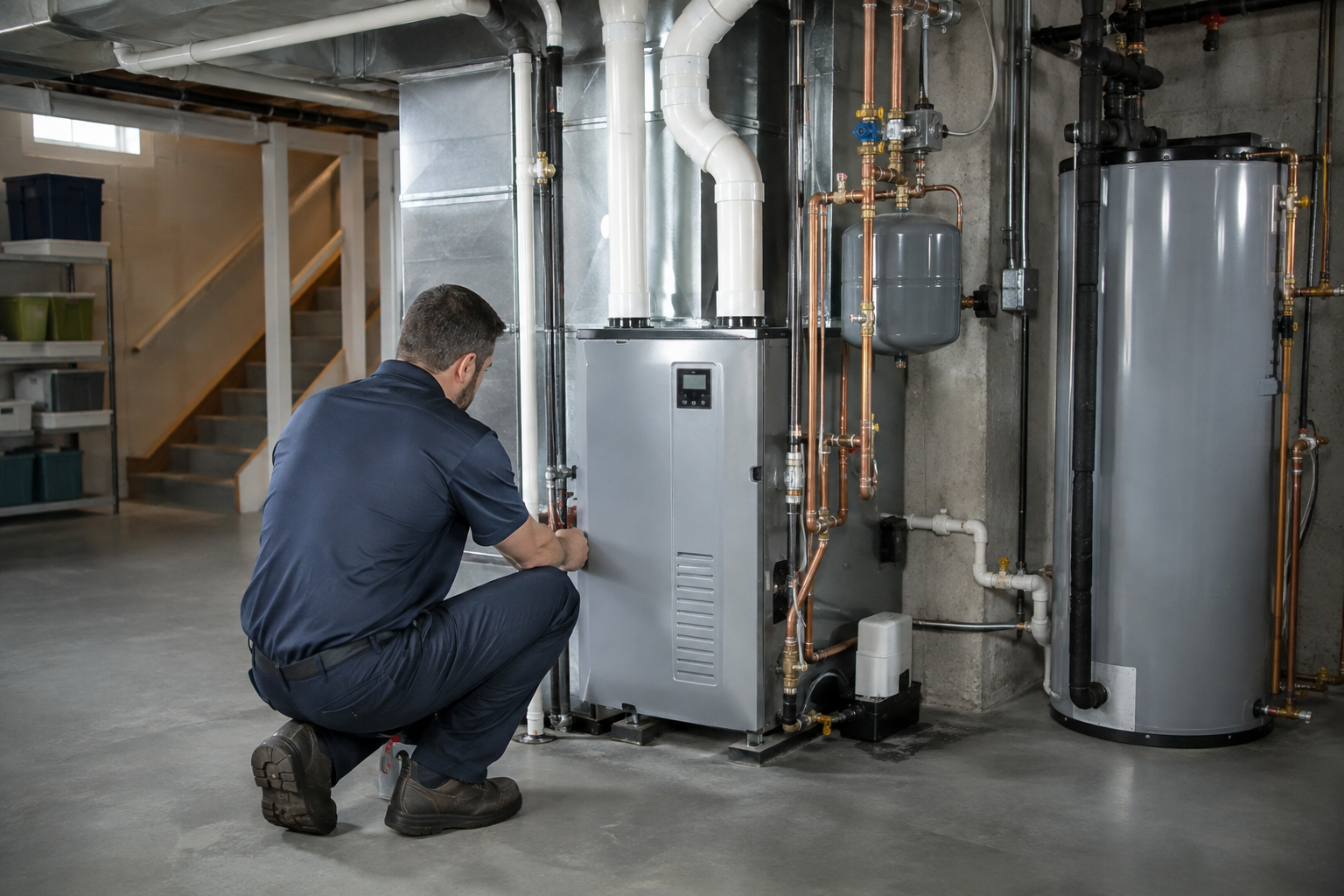
Boiler vs. furnace: choosing efficient heat for an older Long Island home
A boiler is not automatically more energy efficient than a furnace. Both can provide efficient heating, but the better choice depends on the equipment, the home’s heat loss, and the pipes or ducts delivering that heat. An impressive efficiency label cannot compensate for poor sizing or a struggling distribution system.[1]
For homeowners in Nassau County and western Suffolk, start with what the house already has. Preserving working radiators may make more sense than opening finished walls for ducts. A house with sound ductwork deserves a different comparison. Before replacing anything, evaluate the building, the distribution system, and the available fuels together.

What is the difference between a boiler and a furnace?
A boiler heats water and distributes either hot water or steam. A furnace heats air and moves it through ducts. Hot-water and steam systems are not interchangeable: their piping, controls, and service requirements differ.[1][2]
| Consideration | Boiler | Furnace |
|---|---|---|
| Heat delivery | Radiators, baseboard, or compatible radiant systems | Supply ducts and return-air paths |
| Existing infrastructure to inspect | Piping, emitters, valves, pumps, or steam vents | Duct sizing, leakage, insulation, and airflow |
| Cooling integration | Usually requires a separate cooling system | May share suitable ducts with central air conditioning |
| Efficiency opportunity | Appropriate controls and water temperatures; sound distribution | Efficient equipment paired with properly designed, sealed ducts |
| Main retrofit concern | Matching the replacement to the existing heating system | Finding adequate space and capacity for ducts and returns |
These distinctions follow DOE guidance on heating and distribution systems.[1][2][3] If you are unsure what you own, begin with a boiler diagnostic assessment or a furnace performance evaluation, rather than shopping by equipment name alone.
Compare delivered efficiency, not just AFUE
What the efficiency rating tells you
Annual fuel utilization efficiency, or AFUE, describes the annual ratio of useful heat output to fuel energy consumed. A 95% AFUE appliance converts approximately 95% of its fuel energy into heat under the rating procedure. AFUE does not include losses from ducts or pipes outside the conditioned space.[1]
Both boilers and furnaces have high-efficiency options. ENERGY STAR maintains separate criteria for comparing boiler equipment and comparing furnace equipment; compare specific models rather than assuming one category always wins.[4][5]
Why a condensing boiler needs a system-level assessment
Condensing equipment recovers additional heat from combustion gases. For a hydronic boiler, the ability to operate with sufficiently cool return water is important to that process. A system requiring very hot water throughout cold weather may not achieve its best efficiency continuously.[1][6]
Before choosing a condensing boiler for Long Island, ask whether the existing radiators or baseboard can satisfy room loads at lower water temperatures. Request an explanation of outdoor-reset controls, minimum firing rate, and how small zones will be handled.
Duct condition can change the furnace comparison
Leaky ducts can waste conditioned air, especially when they run through attics or other unconditioned areas. Sealing and insulating accessible ducts may therefore belong in the replacement scope, not on a future wish list.[7] Our guide to high furnace energy bills can help organize the symptoms worth discussing.
Start with the older house, not the old equipment size
Long Island needs both winter heating and summer cooling. NOAA climate normals provide a sound basis for understanding seasonal conditions, but equipment sizing should use appropriate local design conditions—not annual averages or the coldest day someone remembers.[8][9]
In a Levittown house, Garden City colonial, or Huntington home with additions, ask the estimator to document the actual construction. Original rooms and renovated spaces should not be assumed to have identical insulation, windows, or heat loss.
- Calculate the load: request a room-by-room heating assessment using an accepted method such as ACCA Manual J.[9]
- Investigate drafts: air sealing can reduce unwanted leakage, but combustion safety and ventilation must be considered together.[10]
- Check insulation: attic, wall, and foundation conditions affect the load the new equipment must serve.[11]
- Preserve character: in a historic home, plan equipment routes and penetrations to minimize damage to significant materials.[12]
A preliminary furnace sizing tool can orient you, but it should not replace a site assessment. For a comprehensive starting point, a professional home energy assessment can identify leakage and insulation priorities before equipment is selected.[13]
When keeping a boiler makes sense
The existing hot-water system is serviceable
If piping and emitters are sound, retaining hydronic heat avoids introducing an entirely different distribution system. Nevertheless, uneven temperatures deserve investigation. Air, controls, valves, or circulation problems may need attention independently of the boiler.[2]
Have cold radiators investigated before assuming replacement will solve every comfort problem. A boiler service visit can help separate equipment condition from distribution faults.
The house has steam radiators
Steam requires a steam-specific assessment. Venting, pipe insulation, radiator operation, and the manufacturer’s replacement-sizing requirements matter; do not apply a hot-water boiler selection approach without accounting for the connected steam system.[1][2]
When comparing steam boiler options, ask the contractor to document the radiator survey and explain the proposed near-boiler piping. A boiler installation proposal should identify necessary system corrections, not merely list the new appliance.
You value room-by-room radiant comfort
Hydronic systems do not require a central air stream to deliver heat, and compatible systems can provide zoning. However, radiant heat is not ventilation, filtration, or summer cooling.[14] If cooling is also needed, compare a separate ductless mini-split system with the disruption of adding ducts.
When a furnace makes sense
A furnace deserves serious consideration when the home already has appropriately sized, serviceable ducts. Those ducts may also support central cooling, provided their design and airflow suit the selected equipment.[3][15]
Before committing to furnace replacement, request:
- A heating-load calculation rather than a like-for-like capacity assumption.
- An assessment of supply ducts, return paths, leakage, and insulation.
- Verification of airflow and external static pressure against equipment requirements.
- A venting, combustion-air, condensate, and filter-access plan.
Installation quality and verified performance are central to ENERGY STAR’s contractor checklist.[16] Coordinate furnace installation with any planned central air installation, so heating and cooling are not designed as unrelated projects.
Changing from radiators to forced air can require substantial interior work. For an older house without ducts, ask for a routing plan before agreeing to abandon the existing heating distribution.
Compare fuel costs and complete project scope
Do not compare a gallon of oil, a therm of gas, and a kilowatt-hour of electricity by their sticker prices. They contain different amounts of energy. EIA provides conversion factors, while its heating outlooks explain why fuel expenditures change with prices and weather.[17][18]
Ask for operating-cost estimates using your recent bills, current applicable rates, and clearly stated efficiency assumptions. PSEG Long Island publishes electric rate information; National Grid provides Long Island gas-rate information. Confirm gas availability at the property before planning a conversion.[19][20]
There is no responsible universal installation price for an unseen older home. Compare written scopes covering:
- Equipment, removal, piping or duct modifications, and controls.
- Chimney or venting work, combustion air, and condensate disposal.
- Electrical work, permits, and required inspections.
- Fuel-tank work if applicable, commissioning, and warranty terms.
- Domestic hot water if the heating appliance currently provides it.
A boiler replacement can affect a tankless coil or indirect water heater, so include that equipment in the comparison.[21] Review water-heater replacement options alongside the heating proposal. Use our furnace replacement cost guide to structure questions, and compare financing terms by total repayment—not just monthly payment.
Include a heat pump in the decision
The choice does not have to end with two combustion appliances. Heat pumps move heat rather than generating it through combustion, and air-source systems can provide both heating and cooling. Cold-weather capacity and system design still require careful evaluation.[22]
In a house without ducts, ductless equipment may avoid extensive duct construction, although indoor-unit placement and comfort in closed bedrooms need planning.[23] Compare cold-climate heat pump options and a written heat pump installation assessment against the boiler or furnace proposal.
A hybrid arrangement commonly pairs a heat pump with backup combustion heat. Retaining a boiler while adding heat pumps is another possible strategy. Either approach needs an explicit control plan identifying when each system operates.[22] For ducted homes, our furnace-to-heat-pump conversion guide helps frame that discussion. Check current rebate eligibility before relying on incentives in a purchase decision.
Safety, indoor air quality, and maintenance
Both fuel-burning boilers and furnaces can create carbon monoxide hazards. Water-based heat delivery does not eliminate combustion risk. Venting, combustion air, appliance condition, and maintenance all matter.[1][24]
Install and maintain carbon monoxide alarms according to applicable requirements and manufacturer instructions. CPSC recommends alarms on every level and outside sleeping areas. If an alarm sounds, move outside and contact emergency responders; do not remain inside troubleshooting.[24]
A furnace can accommodate central filtration, but filter selection must account for equipment compatibility and airflow. Neither a furnace nor a boiler automatically guarantees clean indoor air. EPA emphasizes source control, ventilation, and appropriate filtration.[25] An indoor air quality assessment should address the actual concern rather than defaulting to an accessory sale.
Duct cleaning is not a substitute for sealing ducts or correcting moisture problems; EPA does not recommend routine cleaning for every home.[26] Consider duct cleaning when inspection reveals an appropriate reason.
Schedule professional maintenance before heating season. A boiler tune-up or furnace tune-up should follow the appliance’s requirements and address safety and operating performance. Avoid treating age alone as a replacement verdict; condition, repair history, and performance also belong in the decision.[1][27]
Frequently asked questions
Which is more efficient: a boiler or a furnace?
Neither category always wins. Compare model-specific AFUE, distribution losses, sizing, controls, and projected fuel costs. A well-designed furnace system can outperform a poorly matched boiler system, and vice versa.[1]
Should I remove working radiators to save energy?
Not automatically. First assess the boiler, controls, piping, and building envelope. Radiators may remain useful with an appropriately selected replacement; converting distribution requires a separate cost and disruption analysis.[1][2]
Can a boiler provide air conditioning?
A conventional residential boiler does not provide air conditioning. Homes with boilers generally need separate cooling equipment, such as central air or ductless heat pumps.[15][23]
Will a more efficient replacement definitely lower my bill?
It can reduce fuel needed for the same useful heat, but bills also reflect weather, energy prices, thermostat settings, and distribution performance. Ask for estimates with stated assumptions, not guaranteed savings.[1][18]
What should I ask a heating contractor?
Ask whether the team is insured and EPA 608-certified where refrigerant work is involved; EPA 608 certification concerns refrigerant handling, not boiler-design expertise.[28] Also request relevant steam or hydronic experience, load calculations, a complete scope, commissioning documentation, and written warranty terms.
Choose the system that fits your house
For an older Long Island home, the practical starting point is to evaluate existing distribution, reduce avoidable heat loss, and compare complete proposals. Preserve useful infrastructure when it makes sense, but include cooling needs and heat pump alternatives before deciding.
Home+ Air & Heat serves Nassau County and western Suffolk. Call (516) 259-1191 or request a heating consultation to discuss your current system, comfort problems, and replacement priorities.
Sources
- [4] ENERGY STAR — Boilers
- [5] ENERGY STAR — Furnaces
- [6] U.S. Department of Energy — Purchasing Energy-Efficient Residential Gas Boilers
- [8] NOAA National Centers for Environmental Information — U.S. Climate Normals
- [9] Air Conditioning Contractors of America — Technical Manuals
- [12] National Park Service — Preservation Briefs, including Brief 24 on heating, ventilating, and cooling historic buildings
- [17] U.S. Energy Information Administration — Units and Calculators Explained
- [18] U.S. Energy Information Administration — Winter Fuels Outlook
- [19] PSEG Long Island — Electric Rates
- [20] National Grid — Long Island Residential Rates
- [24] U.S. Consumer Product Safety Commission — Carbon Monoxide Information Center
- [25] U.S. Environmental Protection Agency — Air Cleaners and Air Filters in the Home
- [26] U.S. Environmental Protection Agency — Should You Have the Air Ducts in Your Home Cleaned?
- [27] ENERGY STAR — Maintenance Checklist
- [28] U.S. Environmental Protection Agency — Section 608 Technician Certification
Related Home+ Air & Heat services
Talk to a local technician. Home+ Air & Heat serves Nassau County and western Suffolk with insured, EPA 608-certified technicians. Call (516) 259-1191 or book online.
Your Long Island HVAC team
Home+ Air & Heat55 Jericho Tpke, Suite 203
Jericho, NY 11753
Phone: (516) 259-1191
View us on Google Maps
Serving homeowners across Nassau County and western Suffolk County.