
Ductless Mini Split Cost and Sizing Guide for Long Island Homeowners
Learn how to size and budget for a ductless mini-split in Long Island. Discover why Nassau and Suffolk homes require custom load calculations over generic square-footage charts.
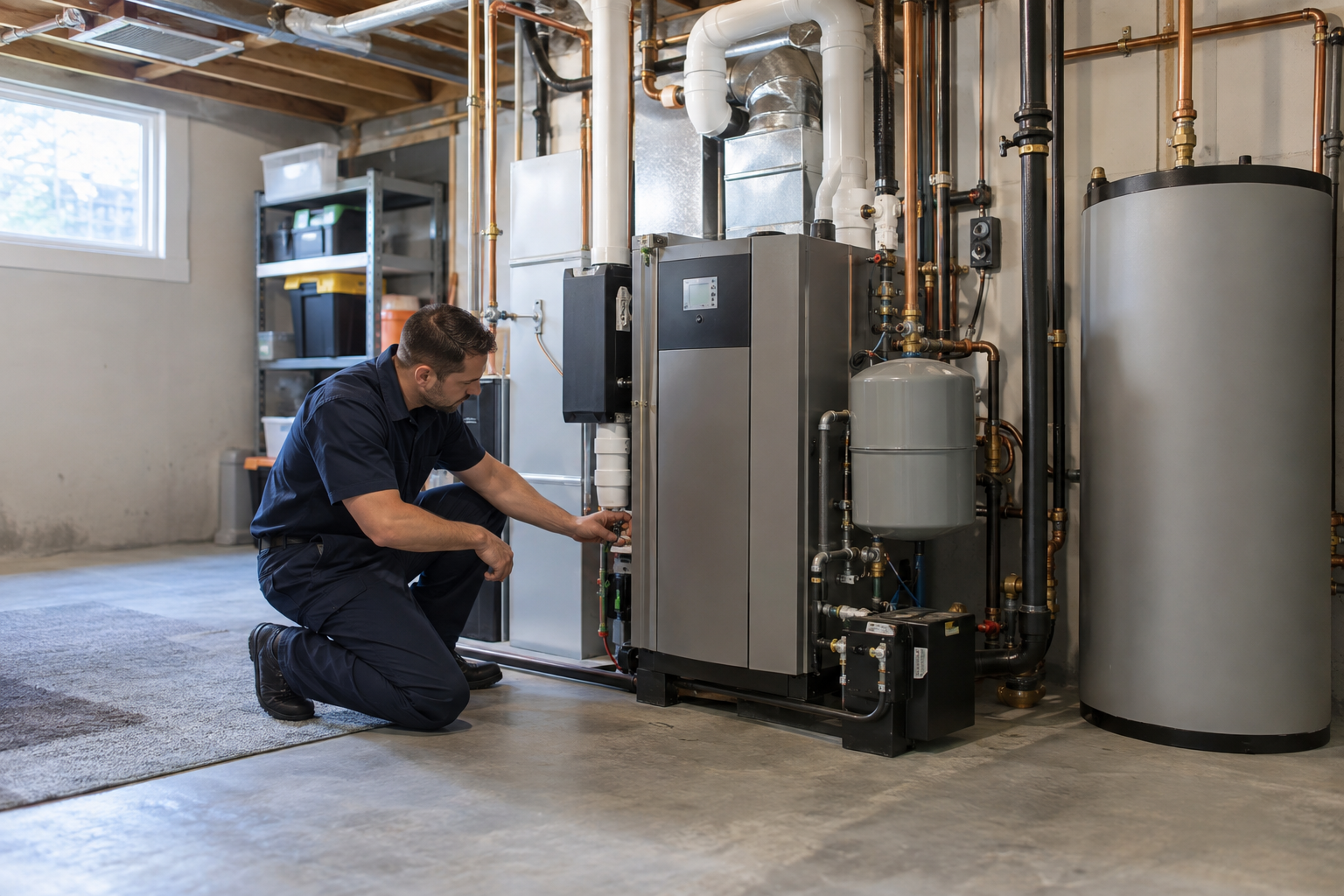
Ductless mini-split cost and sizing guide for Long Island homeowners
A ductless mini-split can solve an uncomfortable upstairs bedroom, add cooling to a home with radiators, or become a whole-home heating system. Those are different projects—not different versions of the same price. Mini-splits connect an outdoor compressor unit to indoor units without requiring conventional distribution ducts.[1]
For homeowners in Nassau County and western Suffolk, the right starting point is a room-by-room assessment, not an online square-footage chart. This guide explains what an installation quote should include, how sizing works, and how to compare equipment without relying on unsupported price ranges or future rebate promises.
Explore our ductless mini-split options as you build your project checklist.

How much does a mini-split installation cost?
There is no defensible single installed price for every Long Island home. A straightforward one-room installation and a whole-house system with several indoor units, electrical work, and concealed piping have different scopes. Equipment-only prices do not tell you the finished project cost.
Rather than budgeting around an unverified local average, request an itemized proposal after a site visit. Mini-split installation involves equipment placement, refrigerant connections, electrical service, and condensate drainage; each deserves explicit treatment in the quote.[1]
What should your estimate include?
| Quote item | What to ask |
|---|---|
| Equipment | What are the exact indoor and outdoor model numbers and proposed combinations? |
| Zones | Which rooms receive indoor units, and how will closed bedrooms be served? |
| Electrical work | Are circuits, disconnects, and any necessary service work included? |
| Piping and finishes | Where will refrigerant lines run, and are covers, penetrations, and patching included? |
| Drainage | Will condensate drain by gravity or require a pump? |
| Outdoor installation | What support, clearances, and winter drainage provisions are included? |
| Project administration | Who handles applicable permits, inspections, and rebate documentation? |
| Startup and protection | What commissioning records, labor coverage, and manufacturer warranty documents will you receive? |
Ask every bidder to price the same scope. Use our installation estimate request to organize a site visit. If you are comparing ductless with a conventional replacement, our Long Island AC replacement cost guide helps frame that separate decision.
Single-zone versus multi-zone costs
A single-zone system pairs one outdoor unit with one indoor unit. A multi-zone system connects several indoor units to a shared outdoor unit. Multiple single-zone systems are another possible design.[1]
Do not assume one shared outdoor unit is automatically the cheapest or most efficient answer. Request comparable designs when practical, including electrical work and outdoor placement. Multiple systems also create more equipment to maintain, while a shared outdoor unit creates a common point of failure.
For a whole-house project, compare heat pump installation approaches. For payment plans, review financing options and use the financing calculator to compare payments—not to substitute for the actual interest rate, fees, and total repayment disclosed in your agreement.
How to size a ductless mini-split correctly
BTU/h measures heating or cooling capacity. Square footage matters, but it does not capture window exposure, insulation, air leakage, ceiling height, or occupancy. ACCA Manual J addresses residential load calculations; Manual S addresses equipment selection.[3]
A chart assigning a fixed equipment size to every room of a particular area is not an adequate design method. DOE specifically warns that oversized or improperly located mini-splits can short-cycle and waste energy.[1]
Start with room-by-room loads
Ask for a calculation that reflects:
- Room dimensions, ceiling heights, and exterior surfaces.
- Window area, orientation, glazing, and shading.
- Insulation and reasonable air-leakage assumptions.
- Local outdoor design conditions and intended indoor temperatures.
- Separate sensible cooling, moisture-removal, and heating requirements.
These are load-calculation considerations—not reasons to add arbitrary extra capacity.[3] An HVAC energy assessment can help identify envelope problems before equipment selection; a professional home assessment may also include diagnostic testing.[4]
For example, in a Levittown Cape, an upstairs room beneath the roof should not automatically receive the same equipment as a similarly sized shaded first-floor room. In a Garden City colonial, a hallway unit should not be assumed to serve every bedroom with doors closed. These are layout questions to investigate, not universal sizing rules.
Address insulation and leakage before final selection
Air sealing and insulation can reduce heating and cooling demand. If attic work or window improvements are already planned, calculate the loads for the intended finished condition rather than locking in equipment around deficiencies you will soon correct.[5][6]
Ask the designer to show both the room loads and the selected equipment capacity. Our HVAC terminology guide can help you interpret the proposal.
Long Island winters and summer humidity need different checks
The National Weather Service New York office provides local weather and climate resources for Long Island. Equipment design should use appropriate local design conditions, not an annual average or a single recent cold snap.[23][3]
For winter, check capacity at low outdoor temperatures
A system’s nominal size does not establish how much heat it delivers on a cold night. Ask for heating output and efficiency at the outdoor temperatures used in your design. Also ask how defrost operation and any supplemental heat are handled.[8]
The NEEP cold-climate product database helps compare documented low-temperature performance. It is more useful than a broad claim that a brand is “winter ready.”[10] Our cold-climate heat pump guide and mini-split heating installation information explain the questions to bring to an estimate.
Have the contractor identify whether the system covers the full calculated heating load or intentionally relies on backup below certain conditions. If you retain a boiler or furnace, a hybrid heating system plan should specify controls and operating responsibilities.
For summer, bigger is not a humidity strategy
Cooling equipment must handle both temperature and moisture. Oversizing can reduce operating time and compromise humidity control; adding capacity simply because summers feel humid is not a sound solution.[24]
Ask about minimum cooling output as well as maximum capacity, especially for small bedrooms on a shared outdoor unit. If a basement remains damp, investigate moisture entry and drainage rather than expecting a wall-mounted unit upstairs to fix it. EPA emphasizes correcting water problems as part of mold prevention.[27] Our dehumidifier options address a separate moisture-control need.
How many indoor units do you need?
A zone is not automatically an entire floor. Ductless heads deliver conditioned air where they are installed; room arrangement and air distribution matter.[1]
- Open living area: One indoor unit may work if its capacity, location, and airflow match the space.
- Closed bedrooms: Ask for a specific distribution solution rather than relying on an open hallway.
- Finished attic: Evaluate roof exposure, insulation, and installation access separately.
- Addition: Compare a dedicated system with extending existing equipment.
Discuss wall-mounted heads, floor units, ceiling cassettes, and compact ducted options where appropriate. Installation flexibility is a ductless advantage, but visible equipment, drain routing, and maintenance access remain trade-offs.[1]
If usable ducts already exist, compare central AC installation with ductless rather than dismissing either option. Leaky or poorly insulated ducts can affect system performance, so their condition belongs in the comparison.[28]
Compare exact models—not brand-wide claims
There is no responsible universal efficiency or warranty ranking for Mitsubishi, Daikin, Fujitsu, or other manufacturers. Product families, indoor/outdoor combinations, and warranty terms differ. Treat our mini-split brand comparison and heat pump brand guide as starting points for a model-specific discussion.
Use the AHRI directory to check certified equipment combinations where applicable. ENERGY STAR identifies qualifying efficient heat pumps, but a certification does not replace sizing or installation design.[11][9]
| Compare | Why it matters |
|---|---|
| SEER2 and HSPF2 | Standardized seasonal cooling and heating efficiency measures. |
| Cold-weather capacity | Shows whether output aligns with the winter design load. |
| Minimum output | Helps assess how equipment matches smaller loads. |
| Approved equipment combination | Ratings belong to the specified system, not a mix of unrelated components. |
| Written warranty terms | Clarifies registration, exclusions, parts coverage, and separate labor obligations. |
Seasonal ratings are useful comparisons, not personalized utility-bill forecasts.[8][9]
Rebates and incentives: verify before signing
PSEG Long Island heat pump rebates use flat amounts of $4,000 market-rate or $7,500 income-qualified for eligible projects—not per-ton figures. Confirm current availability, eligibility, equipment requirements, and application procedures directly with the utility before including a rebate in your budget. These amounts are not a guarantee for every ductless installation or a promise of future-year funding.[12]
Our Long Island heat pump rebate guide and rebate information can help organize the questions. NYSERDA also provides homeowner heat pump guidance; do not assume incentives can be combined without checking each program’s rules.[13]
The original draft’s blanket promise of incentives in 2027 should not guide a purchase. For federal tax treatment, check the IRS rules for the installation year; do not subtract an assumed tax credit from your contract price.[14]
Will a mini-split lower your energy bills?
Heat pumps move heat rather than generating it entirely through electric resistance. That can make them substantially more efficient than resistance heating, but savings against oil or gas depend on fuel prices, system performance, and the home’s load.[2][21][22]
Request an operating-cost comparison using your actual electricity tariff, fuel bills, estimated seasonal performance, and backup-heating assumptions. Compare total annual heating and cooling costs—not just the electric bill after fuel use shifts to electricity.
If bills are already unusually high, investigate the cause through an AC energy-use assessment. If replacing a furnace, our furnace-to-heat-pump conversion guide helps organize the transition.
Installation quality and maintenance protect the investment
Choose insured and EPA 608-certified professionals, and request documentation. EPA Section 608 certification concerns refrigerant-related work; it does not replace a sound design or a clear contract.[15] FTC guidance recommends checking insurance, obtaining written estimates, and reviewing contract details before committing.[26]
Ask for commissioning records covering the manufacturer’s required leak testing, evacuation, refrigerant procedures, drainage checks, and operation. Keep model numbers, startup documentation, rebate submissions, and warranty information together.
Clean filters according to the equipment manual and keep outdoor airflow unobstructed. Dirty filters and coils can reduce performance.[16] Schedule cooling maintenance or seek heat pump repair when performance changes. Indoor dripping deserves prompt attention through AC water-leak troubleshooting, not repeated cosmetic cleanup.
Most ductless systems are not whole-house fresh-air systems. Ventilation and pollutant source control remain separate considerations.[17][19] Discuss indoor air quality improvements where needed; filtration alone cannot remove every indoor pollutant.[18]
Frequently asked questions
Can I size a mini-split by square footage?
Only as a rough early screening tool—not final equipment selection. Request room-by-room heating and cooling loads and a documented equipment match.[3]
Can one indoor unit heat my entire house?
Do not assume so. Capacity and distribution are separate issues. A head in a living room may not adequately condition distant bedrooms with closed doors; the design must address the actual layout.[1]
Should I remove my existing boiler?
Not before verifying cold-weather capacity and the backup strategy. Keeping it may be appropriate, but it preserves maintenance obligations. Have existing equipment evaluated through boiler service before relying on it as backup.[8][22]
Should I turn the heat pump down sharply overnight?
Ask for operating guidance specific to your equipment and controls. DOE cautions that heating setbacks can cause some heat pump systems to use inefficient backup heat; heat-pump-compatible controls matter.[20]
What should I prepare for an estimate?
Gather recent energy bills, identify uncomfortable rooms, list planned insulation work, and note whether bedroom doors stay closed. Ask Home+ Air & Heat to compare suitable options for your Nassau County or western Suffolk home. Call (516) 259-1191 or contact our team to discuss a site-specific proposal.
Sources
- [3] Air Conditioning Contractors of America — Technical Manuals
- [10] Northeast Energy Efficiency Partnerships — Cold Climate Air Source Heat Pump Product List
- [11] Air-Conditioning, Heating, and Refrigeration Institute — Directory of Certified Product Performance
- [12] PSEG Long Island — Heat Pumps; verify current program terms and eligibility
- [13] NYSERDA — Heat Pumps for Residents and Homeowners
- [14] Internal Revenue Service — Energy Efficient Home Improvement Credit
- [15] U.S. Environmental Protection Agency — Section 608 Technician Certification
- [17] U.S. Environmental Protection Agency — Introduction to Indoor Air Quality
- [18] U.S. Environmental Protection Agency — Air Cleaners and Air Filters in the Home
- [23] National Weather Service — New York, NY Forecast Office
- [26] Federal Trade Commission — How To Avoid a Home Improvement Scam
- [27] U.S. Environmental Protection Agency — A Brief Guide to Mold, Moisture and Your Home
- ENERGY STAR: Air-Source Heat Pumps—efficiency certification and cold-climate equipment guidance
- ENERGY STAR: Seal and Insulate—home comfort and building-envelope improvements
- New York State Clean Heat: Heat Pump Education and Program Resources
- Consumer Reports: Heat Pump Buying Guide—system selection, costs, and contractor considerations
- U.S. Department of Energy — Guide to Sizing and Selecting Air-Source Heat Pumps in Cold Climates
- U.S. Department of Energy — Guide to Installing Air-Source Heat Pumps in Cold Climates
- ENERGY STAR — Ductless Heating and Cooling
- NYSERDA — Air Source Heat Pumps: Don’t Oversize
Related Home+ Air & Heat services
Talk to a local technician. Home+ Air & Heat serves Nassau County and western Suffolk with insured, EPA 608-certified technicians. Call (516) 259-1191 or book online.
Your Long Island HVAC team
Home+ Air & Heat55 Jericho Tpke, Suite 203
Jericho, NY 11753
Phone: (516) 259-1191
View us on Google Maps
Serving homeowners across Nassau County and western Suffolk County.