
Signs You Need Furnace Repair in Nassau County: How to Identify Heating System Failure Symptoms and When to Call Emergency Repair
Is your Long Island home losing heat? Learn how to identify furnace failure symptoms, from short cycling to strange noises, and know when to call for emergency Nassau County heating repairs.
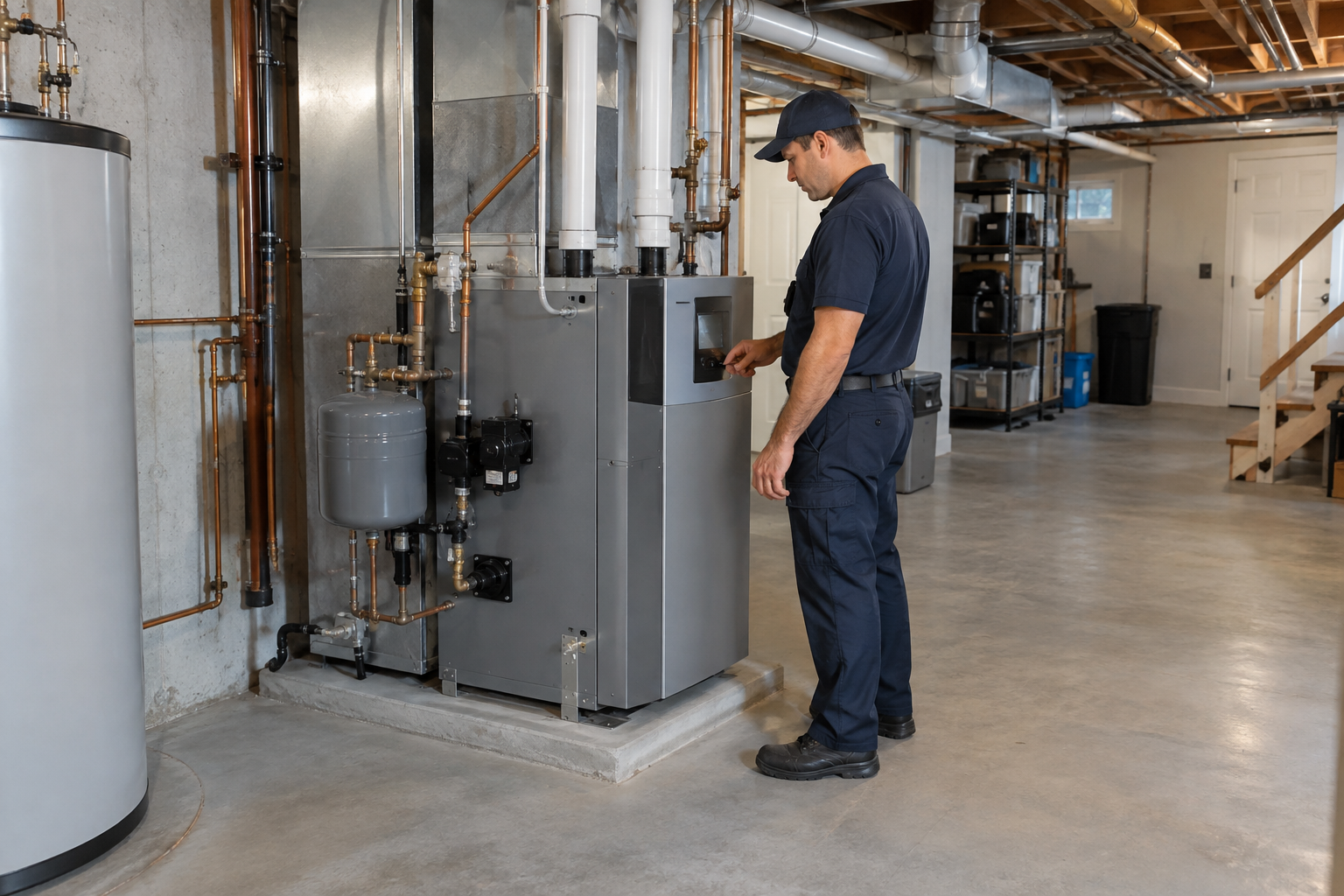
Signs you need furnace repair in Nassau County
A furnace rarely announces exactly what is wrong. It may run without warming the house, shut off repeatedly, make a new noise, or quietly use more fuel. The important distinction is whether you are facing an ordinary service problem, an urgent loss of heat, or a situation that requires leaving the house.
This guide helps homeowners in Nassau County and western Suffolk make that distinction. Start with safety, then use the symptoms below to prepare for professional furnace repair—not to attempt combustion or electrical repairs yourself.

First: know when to leave and when to call for repair
Gas odor, carbon monoxide alarms, smoke, or fire
If you smell gas or suspect a gas leak, leave immediately. Do not operate switches, use a phone inside, light a flame, or try to locate the leak. From a safe location outside, contact your gas utility’s emergency service or emergency responders. Do not reenter until authorities say it is safe.[1]
If a carbon monoxide alarm sounds, move everyone outdoors into fresh air and contact emergency responders. Headache, dizziness, weakness, nausea, and confusion can indicate CO exposure. Seek urgent medical help for suspected exposure. CO has no smell; the absence of an odor does not establish safety.[2][3] Our carbon monoxide emergency guidance explains why an HVAC appointment is not the first step.
For smoke or fire, evacuate and contact the fire department. Do not investigate a smoking furnace or return inside to shut it down.[4]
No heat without signs of a gas or fire emergency
Request urgent heating repair when the system cannot maintain safe conditions, particularly during freezing weather or when infants, older adults, or medically vulnerable people are present. Cold exposure can become dangerous indoors as well as outdoors.[5]
For heating service in Nassau County and western Suffolk, call Home+ Air & Heat at (516) 259-1191. During a suspected gas, CO, or fire emergency, contact emergency responders first.
Match the symptom to the next safe step
These are possibilities, not remote diagnoses. Similar symptoms can have different causes, and modern equipment may intentionally change its output or fan speed.[6][7]
| Symptom | Possible explanation | Recommended response |
|---|---|---|
| No heat or cool supply air | Thermostat settings, interrupted power or fuel, ignition trouble, or a safety shutdown | Check accessible controls; arrange service if heat does not return. |
| Repeated brief heating cycles | Restricted airflow, control trouble, overheating, or equipment sizing problems | Check the filter and open registers; request diagnosis if it continues. |
| New scraping, squealing, or banging | Blower trouble, loose components, duct movement, or an ignition problem | Stop operation if safe when noise is severe; do not repeatedly restart. |
| Weak airflow or uneven rooms | Filter restriction, duct leakage, distribution problems, or building heat loss | Check obstructions and document which rooms are affected. |
| Water beside the furnace | A condensate problem or a nearby plumbing leak | Avoid wet electrical equipment and request inspection. |
1. The furnace runs but blows cold air
Brief cool airflow before or after heating can be part of normal operation. Persistent cool air while the thermostat calls for heat needs investigation. First, check whether the fan is set to ON, which can circulate air between heating cycles, rather than AUTO.[7]
If changing that setting does not help, use our cold-air furnace guide to organize observations. Note whether the system never warms up, warms briefly before stopping, or runs continuously without reaching the setpoint. Those distinctions are more useful than assuming the thermostat is defective.
2. It starts and stops repeatedly
Furnace short cycling means repeated brief operation rather than a stable heating cycle. A dirty filter can restrict airflow, while oversized equipment can cycle too frequently. The correct diagnosis requires separating an airflow or safety-control problem from sizing and thermostat issues.[6][8]
Do not bypass a safety switch or keep clearing a fault to force operation. Record the timing and any visible error code for a furnace diagnostic appointment.
3. New noises occur during startup or operation
A small duct tick is different from a forceful bang when the burner starts. Likewise, persistent scraping or squealing deserves attention even if the house remains warm. Furnace noises can originate in the blower, ductwork, or ignition sequence; sound alone cannot reliably identify the failed part.[9]
Our guide to furnace noises can help you describe when the sound happens. Record it only from a safe distance. A hiss accompanied by gas odor belongs in the evacuation category—not routine troubleshooting.
4. Heating costs rise or particular rooms stay cold
Compare fuel consumption, billing-period length, and weather—not just the bill’s dollar total. Heating demand changes with outdoor temperatures, and heating degree days help explain weather-related consumption changes.[10] Our high furnace energy bill checklist separates usage questions from repair symptoms.
A cold upstairs bedroom or rear addition does not automatically mean the furnace is failing. Duct leakage, insufficient insulation, and air leaks can create comfort problems even when the appliance operates correctly.[11][12] Ask for a distribution assessment before approving a larger furnace.
5. There is soot, an unusual flame, or water
For gas equipment, unexpected soot or a persistent abnormal flame warrants professional inspection. Many modern furnaces use electronic ignition rather than a standing pilot. Flame appearance alone cannot confirm safe combustion, and gas-flame guidance should not be applied to oil equipment.[6][13] Review gas furnace flame warning signs, but never remove burner covers to watch operation.
High-efficiency condensing furnaces intentionally produce condensate. Water outside the intended drain system is not normal and needs investigation; it does not automatically mean the heat exchanger has failed.[6] Do not touch equipment while standing in water.
Safe checks before the technician arrives
Only troubleshoot when there is no gas odor, CO alarm, smoke, or other immediate danger. Follow the equipment manual and keep checks external.[7]
- Check the thermostat. Select HEAT, raise the setpoint above room temperature, and check replaceable batteries if applicable. Review schedules and setbacks; our thermostat selection guide is useful later if replacement is actually needed.[14]
- Look at the filter. With the system turned off as directed by its manual, inspect an accessible filter. Replace it with the specified size and compatible type. Do not run without it.[6][8]
- Clear household obstructions. Move furniture away from supply registers and return grilles. Do not close numerous registers to force heat elsewhere.[8][11]
- Check visible controls. Note whether the service switch is off or a breaker has tripped. Do not repeatedly reset a breaker, open electrical panels, or reset an oil burner to force another start. Leave recurring faults to a technician.[7][15]
- Observe outdoor vent openings from a safe location. Snow and ice can obstruct fuel-burning appliance vents. Do not climb, dismantle piping, or chip ice from fragile components.[16]
If these checks do not restore heat, stop. Our furnace startup troubleshooting guide and broader homeowner troubleshooting checklist can help you prepare a clear service request without attempting hazardous repairs.
Why the Nassau County house matters as much as the furnace
Long Island winter storms can combine snow, freezing conditions, and power interruptions. A fuel-burning furnace also needs electricity for controls and air movement, so an outage can stop heat even when fuel is available.[6][17]
For a Levittown house with an addition, a Garden City home with older ductwork, or a Massapequa property with equipment in a crawlspace, ask the technician to evaluate the actual layout. Which rooms were added? Where do ducts run? Are exposed pipes near an exterior wall? These questions are more useful than treating every Nassau County home alike.
Also confirm what equipment you own. A furnace heats air through ducts; a boiler heats water or produces steam.[6] If your heat comes through radiators or hydronic baseboards, start with boiler service or our boiler no-heat guide. Oil-fired equipment calls for appropriate heating oil service, not gas pilot-light instructions.
During a prolonged outage, protect vulnerable plumbing and arrange a safe place to stay if necessary. Never thaw pipes with an open flame; our frozen-pipe guidance complements the Red Cross’s prevention and thawing recommendations.[18] Never use an oven for heat. Keep portable heaters away from combustible materials and plug electric heaters directly into a wall outlet.[19]
What a worthwhile furnace diagnosis should include
Ask for findings, not simply a replacement recommendation. Depending on the equipment and symptom, a technician should evaluate controls, electrical connections, airflow, temperature rise, ignition, venting, condensate drainage, and combustion safety.[6][20]
Before your visit, prepare:
- The make, model, fuel type, and approximate installation date.
- A photograph of a visible fault display, without removing access panels.
- When the problem began and whether it follows wind, snow, or thermostat changes.
- Filter history, recent renovations, and previous repair paperwork.
Our heating repair process overview explains how to organize the visit. Request a written scope distinguishing the diagnosis, proposed work, parts availability, and warranty terms. Review diagnostic fee information and furnace repair cost considerations before authorizing work.
When choosing a contractor, ask whether the business is insured and whether technicians handling regulated refrigerants are EPA 608-certified. That certification concerns refrigerant work; it does not by itself establish expertise in gas or oil combustion diagnosis.[21]
Maintenance, indoor air quality, and replacement decisions
Maintenance reduces avoidable problems—not every failure
Schedule a professional furnace tune-up before heavy winter use. ENERGY STAR recommends annual preseason checks, including controls, connections, and appropriate fuel-system inspections. Maintenance can identify developing issues but cannot guarantee failure-free operation.[20]
Check filters regularly and follow the equipment and filter manufacturer’s replacement guidance rather than assuming every filter has the same service interval. Higher-efficiency filtration must remain compatible with the system’s airflow requirements.[8][22]
For persistent dust or odors, consider an indoor air quality assessment. Air cleaners do not replace safe venting or CO alarms, and particle filters do not remove every gaseous pollutant.[22][23] Likewise, duct cleaning is not a universal cure for furnace problems; EPA does not recommend routine cleaning without a specific reason.[24]
Install and maintain carbon monoxide detectors according to manufacturer instructions. CPSC recommends alarms on each level and outside sleeping areas.[25]
Repair or replace?
A repair may make sense when the fault is isolated and the rest of the system is sound. Compare furnace replacement options when repairs recur, major components fail, or safe operation cannot be restored economically. Age alone should not replace an actual condition assessment.
Before a new furnace installation, request a heating-load calculation rather than simply matching the old nameplate. ACCA Manual J provides a recognized residential load-calculation method.[26]
A furnace-to-heat-pump conversion may also be worth evaluating. Heat pumps provide heating and cooling, but the proposal should address low-temperature performance, electrical capacity, duct compatibility, utility costs, and any backup-heat strategy.[27] Compare complete installed scopes and operating assumptions, not promised savings alone.
Frequently asked questions
Is a furnace blowing cold air an emergency?
Not always. First check the thermostat’s fan setting. It becomes urgent when the house cannot maintain safe conditions, especially in freezing weather or with vulnerable occupants. Gas odors, CO alarms, and smoke require emergency safety action rather than routine troubleshooting.[1][2][5][7]
Does a yellow flame prove there is carbon monoxide?
No. An abnormal gas flame can signal a combustion problem, but appearance cannot measure CO or establish safety. Arrange inspection and rely on working CO alarms—not flame color alone.[13][25]
Can I keep resetting a furnace that shuts down?
Do not repeatedly reset it. Follow the model-specific instructions and report recurring shutdowns. A reset does not correct the underlying fault, and repeated oil-burner resets can create a hazardous condition.[7][15]
Why is one room cold when the furnace still works?
Possible explanations include duct leakage, blocked airflow, insulation gaps, or air leakage. Ask for room-by-room evaluation before concluding that the furnace needs replacement or greater capacity.[11][12]
Who should I call for furnace repair in Nassau County?
Call Home+ Air & Heat at (516) 259-1191 for service in Nassau County and western Suffolk. Describe the symptom, fuel type, indoor temperature, and any fault code. For a suspected gas leak, CO alarm, smoke, or fire, leave first and contact emergency responders from outside.
Sources
- [1] National Grid — Gas safety and emergency guidance
- [2] CDC — Carbon monoxide poisoning basics
- [3] EPA — Carbon monoxide's impact on indoor air quality
- [4] American Red Cross — Home fire safety
- [5] National Institute on Aging — Cold weather safety for older adults
- [8] ENERGY STAR — A guide to energy-efficient heating and cooling
- [10] U.S. Energy Information Administration — Degree days
- [13] UK Health and Safety Executive — Gas safety: carbon monoxide
- [15] R.W. Beckett — Oil burner technical support and troubleshooting
- [17] National Weather Service — Winter weather safety
- [18] American Red Cross — Preventing and thawing frozen pipes
- [19] U.S. Fire Administration — Heating fire safety
- [20] ENERGY STAR — HVAC maintenance checklist
- [21] EPA — Section 608 technician certification
- [22] EPA — Guide to air cleaners in the home
- [23] EPA — Introduction to indoor air quality
- [24] EPA — Should you have the air ducts in your home cleaned?
- [25] U.S. Consumer Product Safety Commission — Carbon monoxide information center
- [26] Air Conditioning Contractors of America — Manual J residential load calculation
- MedlinePlus, U.S. National Library of Medicine — Carbon Monoxide Poisoning
- Ready.gov — Winter Weather: Extreme Cold, Power Outages, and Emergency Preparedness
Related Home+ Air & Heat services
Talk to a local technician. Home+ Air & Heat serves Nassau County and western Suffolk with insured, EPA 608-certified technicians. Call (516) 259-1191 or book online.
Your Long Island HVAC team
Home+ Air & Heat55 Jericho Tpke, Suite 203
Jericho, NY 11753
Phone: (516) 259-1191
View us on Google Maps
Serving homeowners across Nassau County and western Suffolk County.