
Why HVAC Rebates Lower Heating Costs in 2026
Discover why HVAC rebates lower heating costs in 2026. Learn how these incentives reduce upfront expenses and enhance energy savings.

Why HVAC Rebates Lower Heating Costs in 2026
HVAC rebates are direct financial incentives that reduce what you pay to install energy-efficient heating equipment, and they lower your heating costs both on day one and every month after. The industry term for these programs is “demand-side incentives,” though most homeowners simply call them rebates or HVAC incentives. In 2026, the primary federal program is HEAR (the High-Efficiency Electric Home Rebate Act), which replaced the expired 25C tax credit. State programs, utility rebates, and performance-based programs like HOMES layer on top of federal funding. Together, they explain why hvac rebates lower heating costs far more than most homeowners realize before they start shopping.
Why HVAC rebates lower heating costs on your bill and at installation
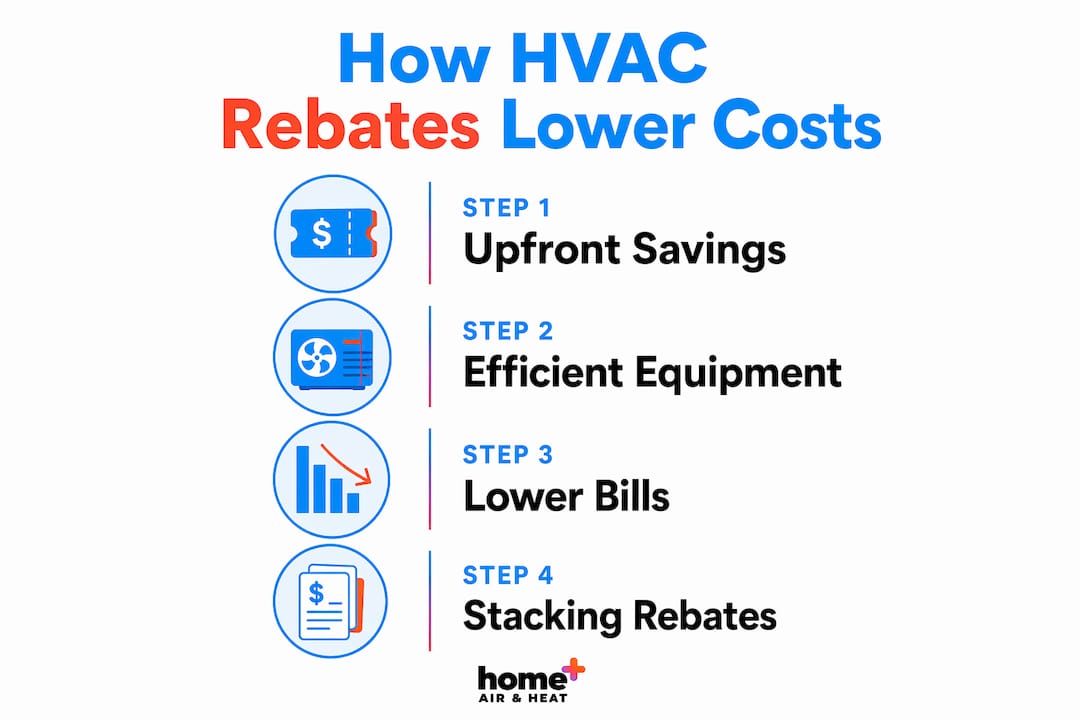
Rebates cut your costs in two distinct ways. The first is immediate: they reduce what you pay upfront for equipment and labor. The second is ongoing: the high-efficiency systems that qualify for rebates use less energy every month, which shrinks your utility bill for years.
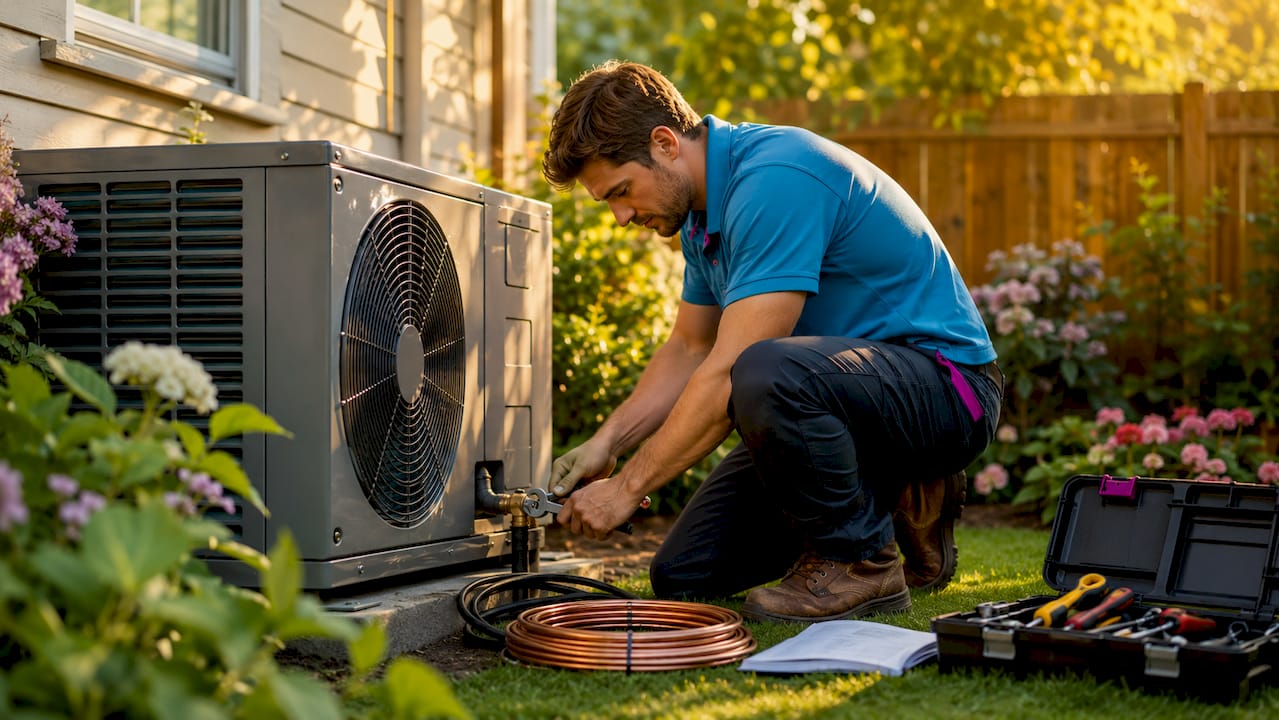
The upfront cost reduction
HEAR rebates apply directly at the point of sale, meaning your contractor subtracts the rebate from your invoice on installation day. You never wait for a tax refund. For qualifying low-income households earning at or below 80% of Area Median Income (AMI), the federal HEAR program covers up to 100% of project costs up to $8,000 for a ducted heat pump. That is not a coupon. That is a full system paid for before you write a single check.
When you stack state and utility programs on top, the numbers grow fast. Combined federal, state, and utility incentives for a heat pump installation can reach $8,000 to over $18,000, covering both equipment and labor. Massachusetts homeowners, for example, can access up to $10,000 more through the Mass Save program on top of federal HEAR funds.
The monthly savings from efficiency
High-efficiency systems earn rebates because they genuinely use less energy. The U.S. Department of Energy estimates that heat pumps cut heating electricity use by about 50% compared to traditional electric resistance heating. That means a household spending $200 a month on electric heat could drop to roughly $100 with a qualifying heat pump. Over a decade, that difference compounds into thousands of dollars.
The combination of lower upfront cost and lower monthly bills is what makes rebate programs so effective. Neither benefit alone is as powerful as both together.
- Rebates reduce the payback period on a new system from years to months in many cases.
- Lower operating costs continue long after the rebate is spent.
- HVAC upgrades that lower energy bills fast tend to be the same systems that qualify for the largest rebates.
Pro Tip: Ask your contractor to show you the projected annual energy cost for the new system versus your current one. That number, combined with the rebate amount, gives you a real payback timeline before you commit.
Why energy-efficient HVAC qualifies for rebates
Rebates exist because efficiency ratings are not just marketing. They represent verified thresholds that guarantee real energy savings. Programs use standards like CEE (Consortium for Energy Efficiency) Tier 1 and Tier 2 benchmarks to define which equipment qualifies. A system that meets CEE Tier 2 uses measurably less electricity than a standard unit, and that difference is what justifies the financial incentive.
The core logic behind why hvac installation rebates exist is simple: high-efficiency equipment costs more to manufacture and buy. Rebates bridge that price gap so homeowners choose the better technology instead of the cheaper one. Without that bridge, most buyers default to lower-cost, less efficient systems, and energy consumption stays high.
What qualifies and what does not
Not every new HVAC system earns a rebate. Programs set specific requirements:
- Equipment must meet CEE Tier benchmarks or equivalent efficiency ratings for the product category.
- Installation must be performed by a certified or registered contractor. Missing this requirement can disqualify the entire rebate, even if the equipment itself qualifies.
- Some programs require a pre-installation home energy assessment.
- Performance-based programs like HOMES reward whole-home energy savings rather than just equipment swaps, requiring modeled or measured efficiency gains.
Pro Tip: Before purchasing any system, cross-reference the model number against your state’s qualifying equipment list. Manufacturers sometimes sell near-identical models where one qualifies and one does not.
Understanding HVAC EER ratings helps you identify which systems will clear the efficiency bar for rebate eligibility before you visit a showroom.
What are the top heating rebate programs for homeowners in 2026?
The rebate landscape in 2026 has three layers: federal, state, and utility. Each layer has its own rules, income thresholds, and application process. Stacking all three is legal and often the fastest path to maximum savings.
Federal programs: HEAR and HOMES
The 25C tax credit expired December 31, 2025 and is no longer available. HEAR is now the primary federal rebate for heat pumps. It is income-qualified and point-of-sale based, meaning it reduces your invoice directly rather than arriving as a future tax refund.
Income tiers for HEAR:
- At or below 80% AMI: Up to 100% of project costs covered, capped at $8,000 for ducted heat pumps.
- 80–150% AMI: Up to 50% of project costs covered, same cap.
- Above 150% AMI: Generally ineligible for federal HEAR rebates but may access state or utility programs.
The HOMES program works differently. It rewards whole-home retrofits that achieve substantial net energy savings, requiring a home energy assessment and modeled efficiency gains. HOMES suits homeowners doing comprehensive upgrades rather than a single equipment swap.
State and utility programs
State programs vary widely. Massachusetts’ Mass Save adds up to $10,000 on top of federal funds. New York’s Clean Heat program offers rebates based on equipment type and efficiency tier. Utility companies add another layer, often providing hundreds to thousands of dollars in additional rebates for customers who upgrade to qualifying systems.
Stacking rebates from all three sources is legal and recommended. In some Massachusetts cases, combined incentives have exceeded the total project cost, meaning the upgrade was effectively free.
| Rebate layer | Typical range | Income requirement |
|---|---|---|
| Federal HEAR | Up to $8,000 | ≤150% AMI |
| State programs | $500–$10,000+ | Varies by state |
| Utility rebates | $200–$2,000+ | Usually none |
| HOMES program | Varies by savings | None, but requires assessment |
Pro Tip: Check your state energy office portal and your utility’s website separately. They do not always advertise each other’s programs, and missing one layer can cost you thousands.
Common mistakes homeowners make when claiming HVAC rebates
The biggest misunderstanding about energy efficiency rebates is that they work like tax credits. They do not. Point-of-sale rebates reduce your upfront cost directly, while tax credits reduce your tax liability the following spring. With the 25C credit gone in 2026, most federal benefits now come as point-of-sale reductions, which means better cash flow but stricter contractor requirements.
The most common pitfalls
- Using an uncertified contractor. Many homeowners pick a contractor based on price, not certification status. Certified installers are required for most point-of-sale rebates. An uncertified contractor cannot submit the rebate paperwork, and you lose the incentive entirely.
- Buying equipment before checking the qualifying list. Not every high-efficiency model qualifies. Always verify the specific model number against the program’s approved equipment list before purchase.
- Waiting for a better program. Delaying an upgrade while waiting for a hypothetical future rebate costs money every month in higher energy bills. The opportunity cost of waiting often exceeds any incremental improvement in future rebate amounts.
- Missing the application window. Some programs require pre-approval before installation begins. Applying after the fact disqualifies the project.
- Assuming programs are available everywhere. Rebate programs are fragmented by state and utility, with different names, portals, and rules in each jurisdiction. What works in New York may not exist in another state.
Pro Tip: Call your utility company before scheduling installation. Ask specifically which rebate programs they administer and whether your contractor is registered in their system. This one call prevents the most common disqualification.
The benefits of HVAC rebates only materialize when the paperwork is done correctly. A heating cost reduction checklist can help you track every step from equipment selection through rebate submission.
Key Takeaways
HVAC rebates lower heating costs by cutting upfront installation expenses and encouraging the adoption of high-efficiency systems that reduce monthly energy consumption for years.
| Point | Details |
|---|---|
| Point-of-sale rebates reduce upfront cost | HEAR rebates apply directly at installation, covering up to 100% of costs for qualifying low-income households. |
| Efficiency drives eligibility | Systems must meet CEE Tier benchmarks; equipment that clears these thresholds uses measurably less energy. |
| Stacking maximizes total savings | Combining federal, state, and utility rebates can bring total assistance to $18,000 or more on a single project. |
| Certified contractors are non-negotiable | Using an uncertified installer disqualifies point-of-sale rebates regardless of equipment quality. |
| Waiting costs money | Every month without an efficient system adds to your energy bill, often outpacing any future rebate improvement. |
What I’ve learned from watching homeowners leave rebate money behind
The pattern I see most often is homeowners who do the research, understand the rebates, and then stall. They wait for a state program to launch, or they want to see if federal funding improves, or they are not sure their contractor is certified. Meanwhile, their old system runs at 60% efficiency through another winter.
Here is the uncomfortable truth: the rebate you can claim today is almost always worth more than the rebate you might claim next year, because the energy you waste while waiting has a real dollar cost. A heat pump in winter operating at peak efficiency pays for itself faster than most homeowners expect, especially when rebates front-load the savings.
The other thing I have seen consistently is that homeowners who work with certified contractors who understand the current rebate landscape get far better outcomes. Not because the equipment is different, but because the paperwork gets done right the first time. A missed form or a wrong model number on an application can wipe out thousands in rebates. The contractor’s knowledge of the system is as valuable as their installation skill.
My honest advice: check your income tier against HEAR eligibility today, call your utility to ask about their current programs, and get a quote from a certified installer before the end of the month. The programs available right now are real, the savings are real, and the cost of waiting is also real.
— Blake
How Hometsair helps Long Island homeowners capture every rebate dollar
Upgrading your heating system is straightforward when you have a certified team that knows the rebate process as well as the equipment.
Hometsair’s NATE-certified technicians handle HVAC installations across Long Island with same-day response and zero overtime fees. The team is registered with rebate programs and manages the paperwork so you do not miss a dollar of available incentives. If your current system is driving up your energy bills in Nassau County, Hometsair can assess your home, recommend qualifying equipment, and submit rebate applications on your behalf. The current promotion includes $1,000 off AC installations, which stacks with available federal and utility rebates. Contact Hometsair for a free quote and a clear picture of what your upgrade will actually cost after incentives.
FAQ
What is the difference between a rebate and a tax credit?
A rebate reduces your upfront cost at the point of sale, so you pay less on installation day. A tax credit reduces your tax bill the following year when you file.
Does the 25C tax credit still apply in 2026?
No. The 25C tax credit expired on December 31, 2025. The HEAR program is now the primary federal incentive for heat pump installations in 2026.
Can I stack federal, state, and utility rebates on one project?
Yes. Stacking rebates from all three sources is legal and recommended. Combined incentives can reach $18,000 or more on a single heat pump installation.
Do I need a certified contractor to get a rebate?
Yes. Most point-of-sale rebate programs require a certified or registered contractor to submit the application. Using an uncertified installer typically disqualifies the rebate entirely.
How much can a heat pump reduce my monthly heating bill?
The DOE estimates heat pumps reduce electricity use for heating by about 50% compared to traditional electric resistance heating, which translates to significant monthly savings depending on your current system and usage.