
HVAC Two-Stage Cooling: What Homeowners Need to Know
Learn what is HVAC two-stage cooling and how it enhances comfort while lowering energy bills. Discover the benefits for your home today!
HVAC Two-Stage Cooling: What Homeowners Need to Know
HVAC two-stage cooling is defined as a compressor system that operates at two distinct power levels: a lower capacity for mild days and full capacity for the hottest conditions. Most homeowners assume an air conditioner is either on or off. A two-stage cooling system proves that assumption wrong, and the difference shows up directly on your energy bill and in how comfortable your home actually feels. Understanding what is HVAC two-stage cooling gives you a real advantage when shopping for a new system or evaluating your current one.
How does two-stage cooling work in an HVAC system?
A two-stage cooling system runs its compressor at two separate output levels rather than one fixed speed. The low stage typically operates at 60–70% capacity, handling the mild heat that makes up most of a Long Island summer. The high stage kicks in at 100% capacity only when outdoor temperatures spike or indoor heat load demands it.
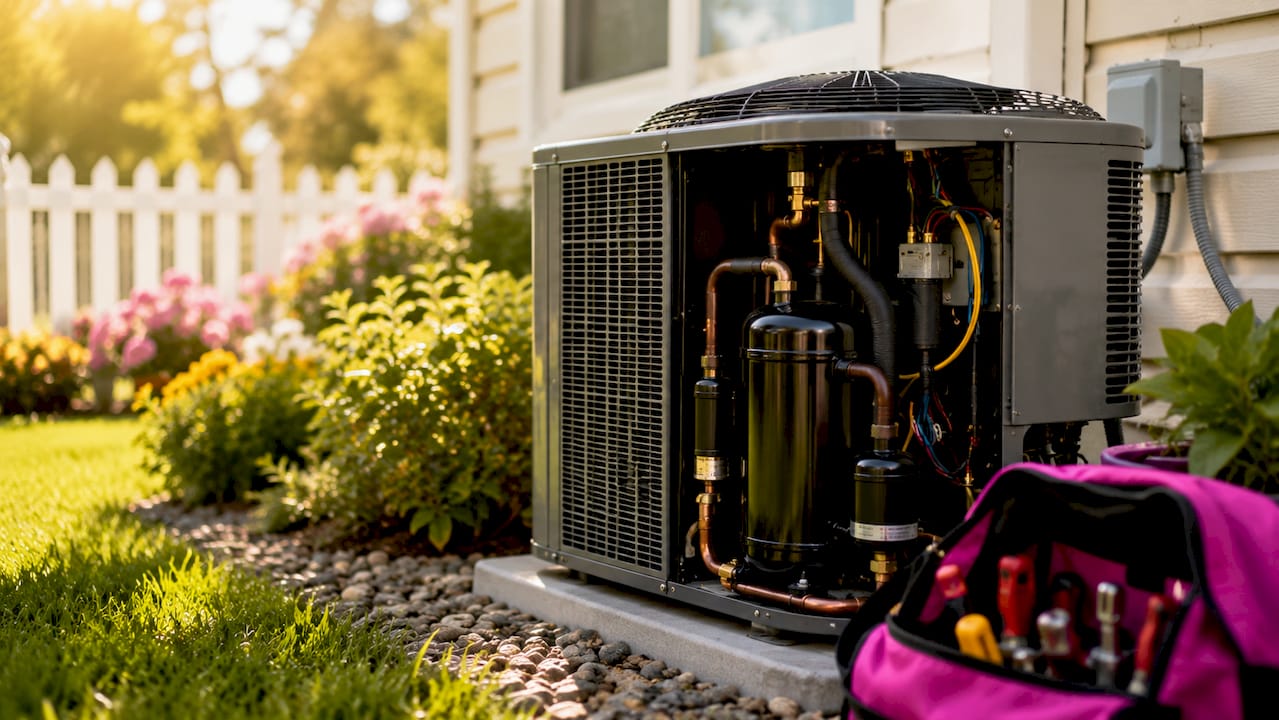
The transition between stages happens automatically. A thermostat with two-stage capability reads indoor temperature and signals the compressor to shift up or down. On a day that reaches 85°F, the system may run at low stage all afternoon. On a 95°F day with high humidity, it ramps to full power until the home cools, then drops back down.
Two compressor designs make this possible:
- Single scroll unloading compressors: One compressor modulates its output by bypassing refrigerant, reducing capacity without a full shutdown.
- Dual compressor setups: Two distinct compressors switch between a smaller and a larger unit, each handling a different load level.
Both designs achieve the same result, but they differ in how they fail and what repairs cost. A dual compressor setup means two potential failure points. An unloading compressor has fewer parts but requires a technician familiar with its bypass mechanism.
The air handler matters just as much as the compressor. A two-stage compressor paired with a single-speed blower captures only part of the efficiency benefit. The blower needs to match the compressor’s output level to move the right amount of air at each stage.
Pro Tip: Ask your installer specifically whether the air handler blower is compatible with two-stage operation before signing any contract. A mismatched blower is the most common reason homeowners don’t feel the comfort improvement they paid for.
What are the benefits of two-stage cooling vs. single-stage systems?
Single-stage systems run at 100% every time they turn on. That creates a cycle of blasting cold air, shutting off, and blasting again. A two-stage system breaks that pattern, and the results are noticeable from the first week of operation.
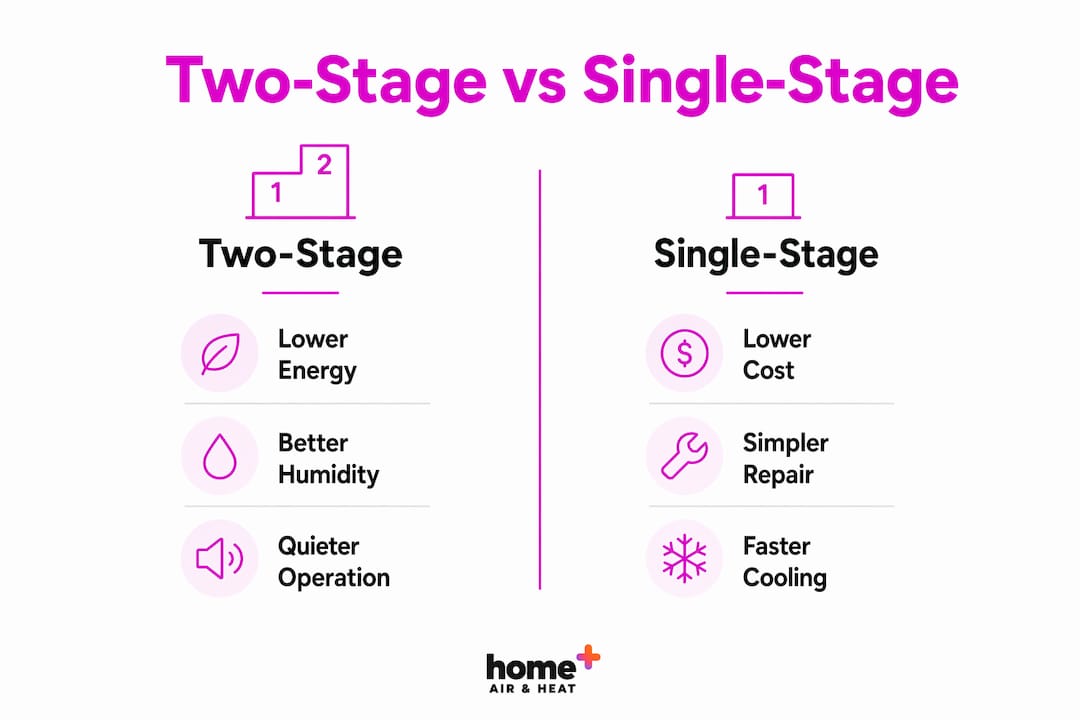
Two-stage air conditioners run at low capacity roughly 80% of the time. Running at 60–70% power instead of 100% uses significantly less electricity during those long, steady cooling cycles. That translates directly to lower monthly utility costs without sacrificing comfort.
The benefits stack up across several areas:
- Humidity control: Longer run cycles at low stage give the evaporator coil more time to pull moisture from the air. Longer operating cycles extract more moisture than the short, aggressive bursts of a single-stage unit.
- Temperature consistency: The system maintains a steadier indoor temperature instead of swinging between too cold and too warm. Hot spots and cold spots become far less common.
- Quieter operation: Low-stage operation is noticeably quieter than a single-stage system firing at full power. The noisy “blast” startup that single-stage units produce disappears most of the time.
- Longer equipment life: Fewer hard starts and stops reduce mechanical stress on the compressor. Reducing compressor cycling extends the lifespan of the entire system.
The humidity benefit deserves extra attention for Long Island homeowners. Coastal air carries more moisture than inland climates. A system that runs longer at low stage pulls that moisture out continuously, which makes 78°F feel genuinely comfortable instead of sticky and oppressive.
Single-stage systems are not without merit. They cost less upfront and have simpler repair paths. But for a home where the cooling season runs from may through september, the operating cost difference adds up fast.
What technical factors affect two-stage cooling performance?
Two-stage cooling is not about cooling your home faster. Two-stage systems provide steadier temperature control rather than faster temperature drops. That distinction matters because homeowners who expect rapid cooldown are sometimes disappointed, even when the system is working exactly as designed.
Performance depends heavily on how the full system is configured. Matching a two-stage compressor with a variable-speed air handler is the configuration that delivers the most comfort and efficiency. A variable-speed blower adjusts airflow to match whichever compressor stage is active. A single-speed blower cannot do that, so it either moves too much air at low stage or too little at high stage.
Four technical factors determine whether a two-stage system performs as advertised:
- Air handler compatibility: The blower motor must support two-stage or variable-speed operation. Installing a two-stage compressor with an old single-speed air handler is a partial upgrade that limits results.
- Thermostat capability: A standard single-stage thermostat cannot send the two-stage signal. The thermostat must be rated for two-stage control.
- Refrigerant charge accuracy: An improperly charged system loses efficiency at both stages. This is a calibration issue that only a certified technician can verify.
- Duct sizing: Undersized ducts restrict airflow regardless of compressor output. Proper duct sizing is a prerequisite for any efficiency gain.
Partial upgrades using outdated blowers are the most common mistake homeowners make when switching to two-stage. The compressor gets replaced, the old air handler stays, and the homeowner wonders why their energy bills barely changed.
Pro Tip: Request a full system assessment before any upgrade. A NATE-certified technician can identify whether your existing air handler, thermostat, and ductwork will support two-stage operation before you spend money on a new compressor.
Is a two-stage cooling system right for your home?
Two-stage systems are recommended for regions with long, moderate-to-hot cooling seasons where the system runs for extended periods rather than short bursts. Long Island fits that profile well. Summers here are long, humid, and variable, which is exactly the condition where two-stage operation earns its cost premium.
The decision comes down to a few practical questions:
- How long is your cooling season? Homes that run AC from may through october benefit more than those with a short summer.
- Do you have humidity problems? If your home feels muggy even when the AC is running, two-stage operation will make a noticeable difference.
- Is noise a concern? Bedrooms near the outdoor unit benefit significantly from the quieter low-stage operation.
- What is your budget? Two-stage systems cost more upfront than single-stage units but less than high-efficiency variable-speed systems. They sit in the middle of the market on both price and performance.
- Are you replacing the full system? If you are replacing only the outdoor unit, confirm the indoor air handler is compatible before committing.
Variable-speed systems offer finer control and higher efficiency ceilings, but they carry a higher purchase price and more complex repair requirements. Two-stage cooling provides comfort comparable to variable-speed systems at a lower cost, making it the practical choice for most homeowners who want better performance without paying for the top tier.
Proper sizing is non-negotiable. An oversized two-stage system short-cycles just like an oversized single-stage unit. A Manual J load calculation by a licensed technician is the only reliable way to determine the correct system size for your home.
Key Takeaways
Two-stage cooling is the most practical upgrade for Long Island homeowners who want lower energy bills, better humidity control, and quieter operation without paying for a variable-speed system.
| Point | Details |
|---|---|
| Two-stage operation | The compressor runs at 60–70% capacity most of the time, shifting to 100% only when needed. |
| Humidity and comfort | Longer low-stage run cycles pull more moisture from the air, reducing that sticky feeling. |
| Equipment longevity | Fewer hard starts and stops reduce mechanical wear and extend compressor life. |
| Full system match required | Pairing a two-stage compressor with an incompatible blower or thermostat limits all efficiency gains. |
| Best fit for Long Island | Homes with long, humid cooling seasons benefit most from two-stage technology. |
Two-stage cooling: what I’ve seen that most articles miss
Most articles on two-stage cooling focus on the compressor and stop there. The compressor is only half the story. I have seen homeowners spend money on a quality two-stage outdoor unit, keep their old air handler, and then call back six weeks later wondering why their electric bill looks the same. The blower is where the efficiency actually lives during low-stage operation.
The other thing I want to address directly: two-stage cooling will not cool your home faster after a hot afternoon away. If you leave the house at 72°F, come back to 85°F inside, and expect rapid recovery, a single-stage system at full blast will actually cool the space faster in that specific moment. Two-stage earns its value over the full season, not in recovery speed. Homeowners who understand that going in are always more satisfied with the system.
Investing in reducing compressor wear is also an investment in avoiding a $2,000 to $4,000 compressor replacement five years early. The math on two-stage makes sense when you factor in equipment life, not just monthly energy savings.
One caution worth repeating: never let a contractor install a two-stage compressor without replacing or verifying the thermostat. A single-stage thermostat sends one signal. The compressor never gets the instruction to run at low stage. You end up with an expensive compressor behaving exactly like the cheap one it replaced.
— Blake
Hometsair installs and services two-stage cooling systems on Long Island
Hometsair’s NATE-certified technicians handle two-stage cooling system installations across Nassau County, including AC installation in Cedarhurst, Roslyn, and Bayville. Every installation includes a full system assessment to confirm air handler compatibility, thermostat pairing, and duct sizing before any equipment goes in.
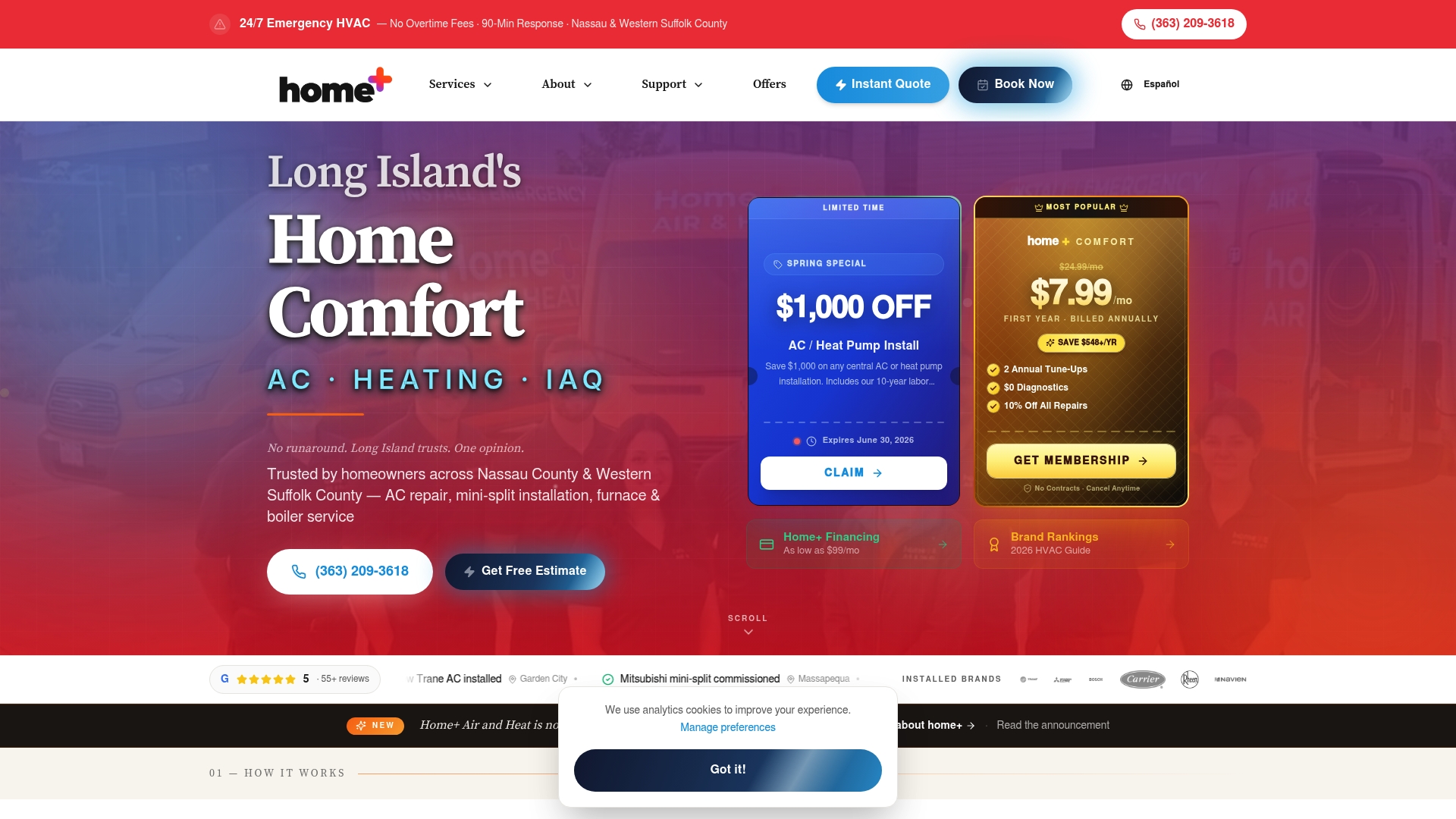
Hometsair currently offers $1,000 off AC installations, with zero overtime fees and a 90% first-visit fix rate. If your current system is short-cycling, running loud, or leaving rooms muggy, an AC tune-up can identify whether a two-stage upgrade makes sense for your home. Call Hometsair for same-day service and a free quote.
FAQ
What is HVAC two-stage cooling in simple terms?
Two-stage cooling means your air conditioner’s compressor runs at two power levels: a lower level for mild days and full power for hot days. Most of the time it runs at the lower level, which saves energy and controls humidity better than a single-stage system.
How does two-stage cooling improve humidity control?
The system runs longer at low capacity instead of cycling on and off rapidly. Longer run times give the evaporator coil more contact time with indoor air, pulling out more moisture with each cycle.
Is two-stage cooling worth the extra cost?
For homes with long cooling seasons and humidity concerns, yes. Two-stage systems balance comfort and cost better than single-stage units, and the reduced compressor wear extends equipment life.
Can I add a two-stage compressor to my existing air handler?
Only if the air handler’s blower motor supports two-stage or variable-speed operation. A mismatched single-speed blower will limit the efficiency and comfort gains of the new compressor.
How is two-stage cooling different from variable-speed cooling?
Two-stage systems operate at two fixed levels: low and high. Variable-speed systems adjust output continuously across a wide range. Variable-speed offers finer control but costs more. Two-stage is the practical middle ground for most homeowners.