
Hybrid Heating Systems for Long Island Winters: Energy Efficient Home Heating Solutions
Learn how hybrid heating systems combine electric heat pumps with fuel-burning furnaces to optimize energy efficiency and comfort during Long Island's freezing winters.
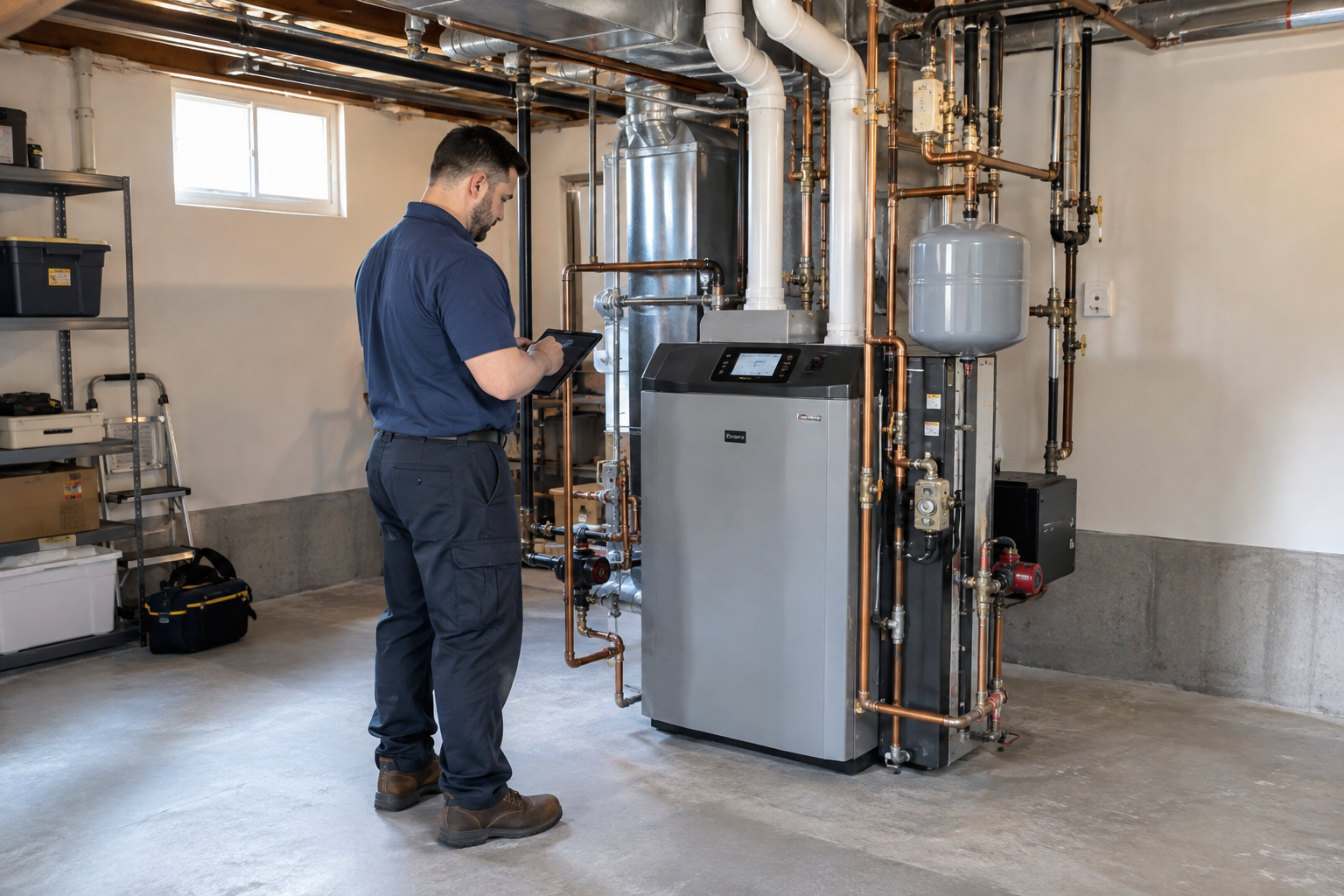
Hybrid heating systems for Long Island winters: a practical homeowner’s guide
A hybrid heating system combines an electric heat pump with a fuel-burning furnace or another backup heat source. The goal is not simply to install two heating appliances. It is to coordinate them so your home stays comfortable while using the appropriate heat source for the conditions.[1]
For homeowners in Nassau County and western Suffolk, that can mean adding a heat pump while retaining a serviceable furnace, or installing ductless equipment alongside an existing boiler. Neither approach guarantees lower bills. Equipment performance, utility rates, insulation, and control settings determine whether the investment makes sense.[1][2]
This guide explains what to request in a heat pump installation proposal, when keeping fuel backup is reasonable, and which claims deserve closer scrutiny.

What makes a heating system hybrid?
An air-source heat pump transfers heat rather than generating it through combustion. It can provide heating in winter and cooling in summer. In a conventional dual-fuel arrangement, controls select either the heat pump or the furnace according to the installation’s operating strategy.[1][2]
You do not need a heat pump, furnace, and condensing boiler together. Start with your existing distribution system and the rooms you need to condition.
| Existing system | Possible hybrid approach | Main design question |
|---|---|---|
| Furnace with central ducts | Matched heat pump and compatible furnace | Can the ducts and blower deliver the required airflow? |
| Boiler with radiators or baseboards | Ductless heat pumps with coordinated boiler backup | How will both systems respond to room temperatures? |
| Mixed heating and room additions | Selected heat pump zones alongside existing heat | Which rooms remain dependent on the original system? |
These configurations use different distribution methods; an ordinary air-to-air heat pump does not directly heat boiler water.[2][3][4] Compare furnace-to-heat-pump conversion options with ductless mini-split systems before choosing equipment.
Keeping a boiler requires a separate control plan
A ductless unit’s thermostat and a boiler thermostat do not automatically coordinate. Ask which system leads, what triggers backup, and how bedrooms behind closed doors will be heated. Multiple systems may operate together intentionally, but accidental overlap can undermine the savings strategy.
Have existing equipment evaluated through boiler service before treating it as dependable backup. If it is already near replacement, compare a hybrid project with a complete boiler replacement proposal.
Design for the house and Long Island weather
Local weather records include both freezing conditions and snowfall. Monthly averages alone are not suitable equipment-sizing targets; the design must address colder conditions as well as ordinary winter days.[5]
For a Levittown Cape, a Garden City colonial, or a Huntington split-level, ask the contractor to investigate the actual building rather than size equipment from its architectural label. Attic insulation, additions, window changes, duct routes, and room exposure all belong in the assessment.
Start with a room-by-room load calculation
Request an ACCA Manual J heating and cooling load calculation. Equipment selection should then follow a recognized method such as Manual S, using the proposed equipment’s performance data—not just the old furnace’s input rating.[6][7]
A preliminary furnace sizing calculator can help organize questions, but it cannot replace that calculation. An oversized existing furnace is not proof that an equally large heat pump is necessary.
Air sealing and insulation can reduce heating demand before equipment is selected.[8][9] Ask for two scenarios if improvements are planned: the house as it stands and the house after the work. A professional energy assessment can identify where those improvements are most useful.[10]
Check cold-weather output, not just the label
Heat pump capacity and efficiency vary with outdoor temperature. Ask for heating output, electrical input, and coefficient of performance at temperatures relevant to the design. ENERGY STAR cold-climate criteria and the NEEP product database provide useful screening information, but neither substitutes for matching equipment to your home.[11][12]
Use our cold-climate heat pump guide and heat pump brand comparison to frame questions about specific models, indoor-unit combinations, service support, and low-temperature performance.
When should the heat pump switch to backup?
There is no universal outdoor temperature at which every Long Island hybrid system should change over. Two different thresholds matter:[1][2]
- Capacity balance point: when heat pump output alone no longer meets the building’s heating load.
- Economic balance point: when the alternative heat source becomes less expensive per unit of delivered heat.
Those temperatures need not match. A heat pump may still provide enough heat when fuel is cheaper, or remain economical while needing supplemental capacity.
Compare delivered heat costs
For a useful estimate, compare electricity and fuel on the same energy basis. EIA publishes standard energy conversions, while DOE explains furnace and boiler efficiency ratings.[4][13]
- Heat pump: dollars per million Btu delivered ≈ electricity price per kWh × 293.1 ÷ COP.
- Gas furnace: dollars per million Btu delivered ≈ gas price per therm × 10 ÷ efficiency expressed as a decimal.
- Oil system: dollars per million Btu delivered ≈ oil price per gallon × 1,000,000 ÷ (Btu per gallon × efficiency).
These are screening calculations, not annual savings predictions. Use temperature-dependent COP, realistic system efficiency, and the charges that actually change with consumption. Fixed customer charges may remain when you keep a fuel account. PSEG Long Island’s rate information is the starting point for electric costs.[14]
Investigate unusually high existing consumption through furnace high-bill troubleshooting or boiler energy-bill diagnostics before using it as the baseline for promised savings.
Controls matter as much as equipment
Request written settings for compressor lockout, backup operation, thermostat staging, and temperature setbacks. Large setbacks can cause some heat pump controls to call for inefficient resistance backup; the right strategy depends on the equipment and thermostat.[15]
A product on a thermostat comparison list is not necessarily compatible with your dual-fuel system. Confirm compatibility and the manufacturer-approved operating sequence before installation.
Installation details that affect winter comfort
Ducts and airflow
Existing ducts need an airflow and leakage assessment. Duct sealing can reduce losses, particularly where ducts pass through unconditioned spaces.[16] Request measured static pressure and airflow verification rather than assuming ducts suitable for the old furnace will suit the new system.
If replacing cooling equipment too, compare the entire matched system through a central air installation assessment. The AHRI directory can verify certified equipment combinations and ratings.[17]
Outdoor placement and defrost drainage
Outdoor coils can accumulate frost during heating and periodically defrost. Placement must allow airflow, service access, and drainage; DOE also recommends considering snow accumulation and prevailing winds.[2]
Ask where meltwater will go during freezing weather. Avoid a location that directs runoff across a walkway. Follow the selected manufacturer’s elevation and clearance requirements, and discuss coastal exposure where relevant. Persistent icing or repeated shutdowns warrant heat pump diagnostics, not improvised changes to defrost controls.
Electrical and domestic hot water planning
Have the installer identify circuit requirements and arrange an electrical capacity assessment. Include any proposed resistance heat, not just the outdoor compressor.
Also ask whether the existing boiler heats domestic water through a tankless coil or indirect tank. Retaining that arrangement can keep the boiler operating outside the heating season.[18] Review water heater installation alternatives when comparing whole-home operating costs.
Benefits, limitations, and alternatives
A well-designed hybrid system offers flexibility: heat pump heating and cooling plus retained fuel capacity. Its disadvantages include maintaining two heat sources, more complicated controls, and continued combustion-related responsibilities.[1][4]
It is not automatically preferable to an all-electric system. Compare both options when the house has a manageable load and suitable cold-climate equipment. Conversely, if the existing furnace needs extensive furnace repairs, retaining it solely as backup may be poor value. Price a coordinated new furnace installation separately.
Heat pumps can reduce direct onsite fuel use, but a hybrid system still burns fuel whenever backup runs. Overall emissions depend on equipment operation and the electricity supply; EPA’s eGRID documents regional electricity emissions.[19]
Hybrid heating does not automatically improve air quality
Filtration depends on filter selection, airflow, and maintenance—not the hybrid label. Source control and ventilation remain important, and filters do not remove every pollutant.[20][21] Consider an indoor air quality assessment when planning changes.
Humidity also needs separate attention. EPA recommends keeping indoor relative humidity below 60%, ideally between 30% and 50%; cold window surfaces may require a lower winter setting to avoid condensation.[22] Persistent dampness may justify investigating leaks, ventilation, or dedicated dehumidification, rather than expecting heating alone to solve it.
Project costs and PSEG Long Island rebates
Request itemized proposals covering equipment, controls, duct modifications, electrical work, refrigerant piping, outdoor support, permits, commissioning, and disposal. Include the cost of keeping the backup system safe and operational.
PSEG Long Island heat pump rebate amounts are $4,000 market-rate and $7,500 income-qualified, flat—not per ton. Eligibility is not automatic for every hybrid configuration. Confirm current equipment, household, installation, and existing-system requirements with the utility before signing; do not assume that retaining operational fossil-fuel backup qualifies.[23]
Use our Long Island heat pump rebate guide to organize that review, and request written confirmation of the incentive included in your quote. If considering project financing, compare total repayment, not just the monthly payment.
A responsible savings estimate should state its assumptions and show several fuel-price scenarios. Avoid proposals promising a fixed percentage reduction or a guaranteed short payback without a house-specific analysis.
Maintenance and safety checklist
DOE recommends professional heat pump service at least annually and regular homeowner attention to filters and outdoor obstructions.[24] A hybrid system also needs maintenance for its combustion equipment.
- Check filters on the equipment manufacturer’s schedule.
- Keep outdoor airflow paths clear without damaging the coil.
- Arrange a furnace tune-up or boiler tune-up before relying on backup.
- Have the technician test changeover operation, not just each appliance independently.
- Record control settings and any changes after service.
Retained combustion equipment means carbon monoxide precautions still matter. Install and maintain alarms following CPSC guidance and manufacturer instructions; see our carbon monoxide detector guidance.[25]
Seek an insured and EPA 608-certified contractor, and ask who will commission both the refrigerant system and backup controls. EPA Section 608 certification applies to technicians performing covered refrigerant work; it is not a substitute for verifying project-specific competence.[26]
Frequently asked questions
Can a heat pump work below freezing?
Yes. Suitable cold-climate equipment can provide heat below freezing, but output and efficiency vary by model and temperature. Compare documented performance with your home’s calculated load instead of choosing an arbitrary backup temperature.[2][11][12]
Can I keep my oil boiler and add mini-splits?
Yes, these separate distribution systems can serve the same house. The important questions are room coverage, thermostat coordination, boiler condition, and rebate eligibility. A mini-split does not directly supply hot water to existing baseboards.[3][4]
Will backup heat work during a power outage?
Do not assume it will. Furnaces and boiler systems commonly need electricity for controls, blowers, or pumps.[4] Any backup-power arrangement needs appropriate electrical planning. Never operate a portable generator indoors or in a garage because of carbon monoxide risk.[27]
Will hybrid heating definitely lower my bills?
No. Savings depend on electricity and fuel prices, cold-weather efficiency, distribution losses, and control settings. Ask for a delivered-heat comparison and an annual estimate using your actual bills and calculated heating load.[1][4][13]
What should I bring to an estimate?
Bring a year of energy bills, equipment model numbers, service records, and a list of uncomfortable rooms. Note planned insulation work and whether the boiler also heats domestic water. Ask for separate hybrid and all-electric options where practical.
Plan the system before choosing the equipment
The best hybrid heating proposal explains the load calculation, equipment match, backup strategy, installation details, and expected operating costs in plain language.
Home+ Air & Heat serves Nassau County and western Suffolk. To discuss your existing equipment and request a house-specific comparison, contact Home+ Air & Heat or call (516) 259-1191.
Sources
- [5] National Weather Service, New York — Local Climate Records and Resources
- [6] Air Conditioning Contractors of America — Manual J Residential Load Calculation
- [7] Air Conditioning Contractors of America — Manual S Residential Equipment Selection
- [11] ENERGY STAR — Air-Source Heat Pumps
- [12] Northeast Energy Efficiency Partnerships — Cold Climate Air Source Heat Pump Product List
- [13] U.S. Energy Information Administration — Units and Calculators Explained
- [14] PSEG Long Island — Rates and Tariffs
- [17] Air-Conditioning, Heating, and Refrigeration Institute — Directory of Certified Product Performance
- [19] U.S. Environmental Protection Agency — Emissions & Generation Resource Integrated Database
- [20] U.S. Environmental Protection Agency — Air Cleaners and Air Filters in the Home
- [21] U.S. Environmental Protection Agency — Improving Indoor Air Quality
- [22] U.S. Environmental Protection Agency — A Brief Guide to Mold, Moisture and Your Home
- [23] PSEG Long Island — Energy Efficiency Programs and Current Incentive Resources; Confirm Heat Pump Eligibility and Terms Before Purchase
- [25] U.S. Consumer Product Safety Commission — Carbon Monoxide
- [26] U.S. Environmental Protection Agency — Section 608 Technician Certification Requirements
Related Home+ Air & Heat services
Talk to a local technician. Home+ Air & Heat serves Nassau County and western Suffolk with insured, EPA 608-certified technicians. Call (516) 259-1191 or book online.
Your Long Island HVAC team
Home+ Air & Heat55 Jericho Tpke, Suite 203
Jericho, NY 11753
Phone: (516) 259-1191
View us on Google Maps
Serving homeowners across Nassau County and western Suffolk County.