
How Blower Efficiency in Heating Affects Your Bills
Discover the role of blower efficiency in heating and how it impacts your bills. Optimize your HVAC system for comfort and savings today!
How Blower Efficiency in Heating Affects Your Bills
Blower efficiency is the measure of how effectively your HVAC system moves heated air through your home, and it directly determines both your comfort and your monthly energy costs. Most homeowners focus on furnace output when heating problems arise, but the role of blower efficiency in heating is just as critical. A furnace can generate plenty of heat and still leave rooms cold if the blower cannot distribute that air properly. Understanding the difference between PSC and ECM motor standards, and knowing what degrades blower performance, gives you real control over your heating system.
How does blower efficiency affect heating performance?
Blower efficiency is the single biggest factor in whether heated air actually reaches every room in your home. The furnace creates heat, but the blower is what moves it. Without steady, adequate airflow, heat pools near the unit and never reaches the far corners of your house.

Restricted airflow forces furnaces to cycle more often and run longer to compensate. Longer cycles mean higher energy bills and more wear on every component in the system. You end up paying more for less comfort.
The effects of poor blower performance in heating systems show up in predictable ways:
- Uneven temperatures: Some rooms feel warm while others stay cold, even with the thermostat set high.
- Long heating cycles: The furnace runs for extended periods without reaching the set temperature.
- Hot and cold spots: Rooms farthest from the unit suffer the most from weak airflow.
- Higher energy bills: The system works harder to compensate for poor air movement.
- Increased wear: Motors and heat exchangers degrade faster under the strain of restricted airflow.
Many comfort problems homeowners blame on furnace output actually trace back to airflow quality. Checking the blower first saves time and money before assuming the furnace itself needs replacement.
Pro Tip: If some rooms in your home are consistently colder than others, check your blower’s airflow before calling for a furnace diagnosis. Airflow issues cause the majority of uneven heating complaints.
PSC vs. ECM blower motors: which is more efficient?
The motor inside your blower determines how much electricity the system consumes and how well it adapts to your home’s heating demand. Two motor types dominate residential HVAC: PSC (Permanent Split Capacitor) and ECM (Electronically Commutated Motor).
Standard PSC motors run at a fixed speed of 1,075 RPM and operate at 60–70% efficiency. They cannot adjust to changing heating loads. When your home needs less heat, a PSC motor still runs at full power, wasting electricity.
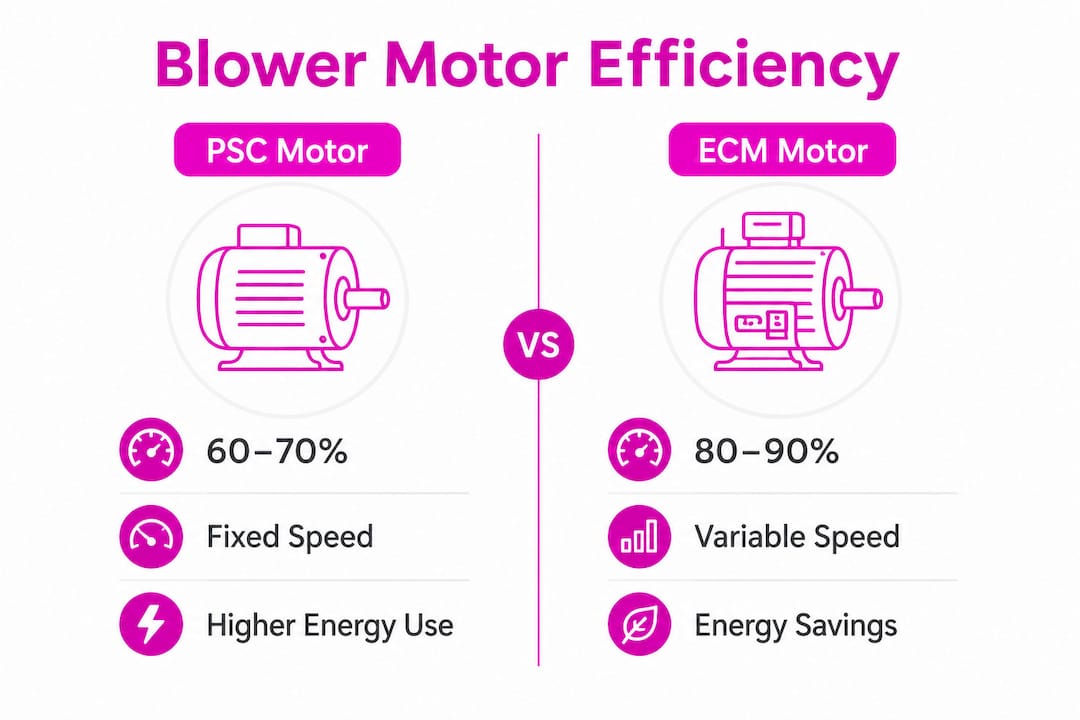
ECM motors work differently. They adjust their speed to match actual heating demand, achieving 80–90% efficiency. That variable speed capability is what makes the blower efficiency impact so significant in modern systems.
| Feature | PSC motor | ECM motor |
|---|---|---|
| Efficiency range | 60–70% | 80–90% |
| Speed control | Fixed (1,075 RPM) | Variable, demand-matched |
| Fan-only power draw | 500+ watts | 80–150 watts |
| Energy savings vs. PSC | Baseline | 15–30% at full load |
| Low-speed savings | Baseline | Up to 85% |
| Rebate eligibility | Typically no | Yes, for qualifying furnaces |
Upgrading from PSC to ECM reduces energy use by 15–30% at full heating load and up to 85% during low-speed continuous operation. That translates to annual electricity savings of $50–$200 depending on runtime and local rates.
The physics behind this are straightforward. Fan affinity laws state that power consumption scales with the cube of blower speed. Reducing fan speed by just 20% cuts power consumption by nearly 50%. Fixed-speed PSC motors cannot take advantage of this relationship at all.
ECM motors running at low continuous speeds also improve air mixing between rooms, enhance filter performance, and help heat recovery ventilators (HRVs) function more effectively. The system consumes roughly 80–150 watts in fan-only mode compared to 500+ watts for a PSC motor doing the same job.
For homeowners considering a furnace upgrade for efficiency, ECM motors are now standard on two-stage and modulating furnaces. They are not optional add-ons. They are what makes those furnaces deliver their advertised performance.
What degrades blower efficiency and how do you fix it?
Blower efficiency does not stay constant over time. Several common issues chip away at performance, and most of them are preventable with basic maintenance.
Dust and debris buildup
Dust accumulation on blower blades increases drag, forces the motor to draw more power, and accelerates wear. This is the most overlooked factor in blower efficiency. A dirty blower can lose a significant portion of its rated airflow capacity without triggering any obvious warning signs. The furnace still runs, but it works harder for worse results.
Incorrect blower sizing
Oversizing a blower by more than 10–15% pushes the system away from its Best Efficiency Point (BEP). At BEP, the blower moves the most air for the least energy. Oversized systems with large safety margins waste energy and produce uneven heating. Undersized blowers cannot move enough air to distribute heat properly. Both sizing errors cost money.
Ductwork design flaws
Leaky, undersized, or poorly routed ductwork forces the blower to work against resistance it was never designed to handle. Even a high-efficiency ECM motor cannot overcome a duct system with major leaks or sharp bends that restrict airflow. Duct sealing and proper design are prerequisites for getting full value from any blower upgrade.
Follow these steps to maintain blower efficiency:
- Inspect and clean blower blades annually. Remove dust buildup before it causes measurable drag and motor strain.
- Replace air filters on schedule. A clogged filter is the fastest way to restrict airflow and force the blower to overwork.
- Check duct connections for leaks. Seal any gaps with mastic sealant or metal tape rated for HVAC use.
- Verify blower sizing with an HVAC technician. Confirm the blower matches your home’s actual load, not an oversized estimate.
- Listen for unusual noises. Rattling, squealing, or grinding sounds signal bearing wear or blade damage that reduces efficiency immediately.
Pro Tip: Schedule a blower inspection every fall before heating season starts. Catching dust buildup and minor wear in september costs far less than an emergency repair in january.
The lack of regular blower maintenance is one of the most direct causes of rising energy bills in homes with otherwise functional heating systems.
What are the real benefits of upgrading your blower system?
Improving blower efficiency in your heating system pays off in several measurable ways, not just on the energy bill.
Energy cost savings are the most immediate benefit. ECM blowers save $50–$200 annually compared to PSC motors, with the higher end of that range applying to homes in colder climates with longer heating seasons. Over five years, that adds up to a meaningful return on the upgrade cost.
Rebate eligibility adds to the financial case. Top-tier furnace rebates in 2026 typically require an ECM blower as a condition of qualification. Homeowners who install qualifying two-stage or modulating furnaces with ECM motors can access utility and manufacturer rebates that offset a significant portion of the installation cost.
Additional benefits of upgrading to a high-efficiency blower include:
- Quieter operation: ECM motors run at lower speeds during partial-load conditions, producing noticeably less noise than fixed-speed PSC motors at full blast.
- Better humidity control: Continuous low-speed circulation keeps air moving through the system, which improves dehumidification in summer and prevents dry air pockets in winter.
- Longer equipment life: Lower operating temperatures and reduced strain on the motor extend the lifespan of the blower and connected components.
- Heat pump compatibility: ECM motors are the standard for heat pump systems in winter, where variable-speed airflow is critical to extracting maximum efficiency from the refrigerant cycle.
Variable speed systems save 25–35% energy versus fixed-speed blowers by matching motor speed to actual thermal demand. That figure reflects real-world residential heating and cooling conditions, not laboratory benchmarks. The savings are consistent and repeatable across different climates and home sizes.
Key Takeaways
Blower efficiency controls how well your heating system distributes warmth, and upgrading from a PSC to an ECM motor delivers the most direct improvement in both comfort and energy costs.
| Point | Details |
|---|---|
| Blower drives heat distribution | A furnace generates heat, but the blower determines whether that heat reaches every room. |
| ECM motors outperform PSC | ECM motors achieve 80–90% efficiency versus 60–70% for PSC, saving $50–$200 annually. |
| Dust is the top efficiency killer | Annual blower cleaning prevents drag buildup that forces motors to draw excess power. |
| Correct sizing is non-negotiable | Oversizing by more than 10–15% pushes the blower off its Best Efficiency Point and wastes energy. |
| Rebates favor ECM upgrades | Most 2026 furnace rebates require an ECM blower, making upgrades financially accessible. |
What most homeowners get wrong about blower efficiency
After years of working with heating systems, the pattern I see most often is this: a homeowner replaces a perfectly functional furnace because rooms feel cold, only to discover the real problem was a dirty, undersized, or worn-out blower. The furnace was fine. The heat distribution was not.
The importance of blower efficiency gets buried under marketing for high-AFUE furnaces and heat pumps. Those upgrades matter, but they cannot fix a system where the blower cannot move air effectively. A 96% AFUE furnace paired with a failing PSC blower will underperform a 80% AFUE furnace with a well-maintained ECM motor in terms of actual room comfort.
My honest advice: before you spend money on a new furnace, have a technician evaluate your blower. Check the motor type, measure the airflow, and inspect the blades. If you have a PSC motor and your system is more than 10 years old, the blower upgrade alone may solve the comfort problems you have been chasing. The HVAC upgrades that lower bills fastest are almost always the ones that address airflow first.
Maintenance is the other piece most homeowners skip until something breaks. A blower cleaned and inspected every fall runs more efficiently, lasts longer, and costs less to operate. That is not complicated advice. It is just the kind of habit that separates homes with consistent comfort from homes with chronic heating complaints.
— Blake
Hometsair can assess and upgrade your blower system
Your heating system’s blower does more work than most homeowners realize, and small inefficiencies compound into real costs over a heating season.

Hometsair’s NATE-certified technicians serve Long Island homeowners with same-day blower inspections, motor replacements, and full system efficiency evaluations. Whether you need a PSC-to-ECM motor upgrade, a blower cleaning, or a complete HVAC service in Bayville, the team brings the tools and expertise to fix it on the first visit. Hometsair reports a 90% first-visit fix rate and charges zero overtime fees, so you get reliable service without surprise costs. If your heating feels uneven or your bills have been climbing, a blower assessment is the right first step.
FAQ
What is blower efficiency in an HVAC system?
Blower efficiency is the measure of how effectively a blower motor moves heated air through your ductwork relative to the electricity it consumes. Higher efficiency means more airflow for less energy.
How does a dirty blower affect heating performance?
Dust buildup on blower blades increases drag and forces the motor to draw more power, reducing airflow and increasing energy consumption. Annual cleaning prevents this degradation.
What is the difference between PSC and ECM blower motors?
PSC motors run at a fixed speed with 60–70% efficiency, while ECM motors adjust speed to match heating demand and achieve 80–90% efficiency. ECM motors save $50–$200 annually in electricity costs.
Can a blower upgrade fix uneven heating in my home?
Yes. Uneven heating is frequently caused by insufficient or inconsistent airflow, not furnace output. Upgrading to an ECM motor or cleaning a degraded blower often resolves room-to-room temperature differences.
Do I need an ECM blower to qualify for furnace rebates?
Most top-tier furnace rebates in 2026 require an ECM blower as a condition of eligibility. Two-stage and modulating furnaces also depend on ECM motors to deliver their rated performance.