
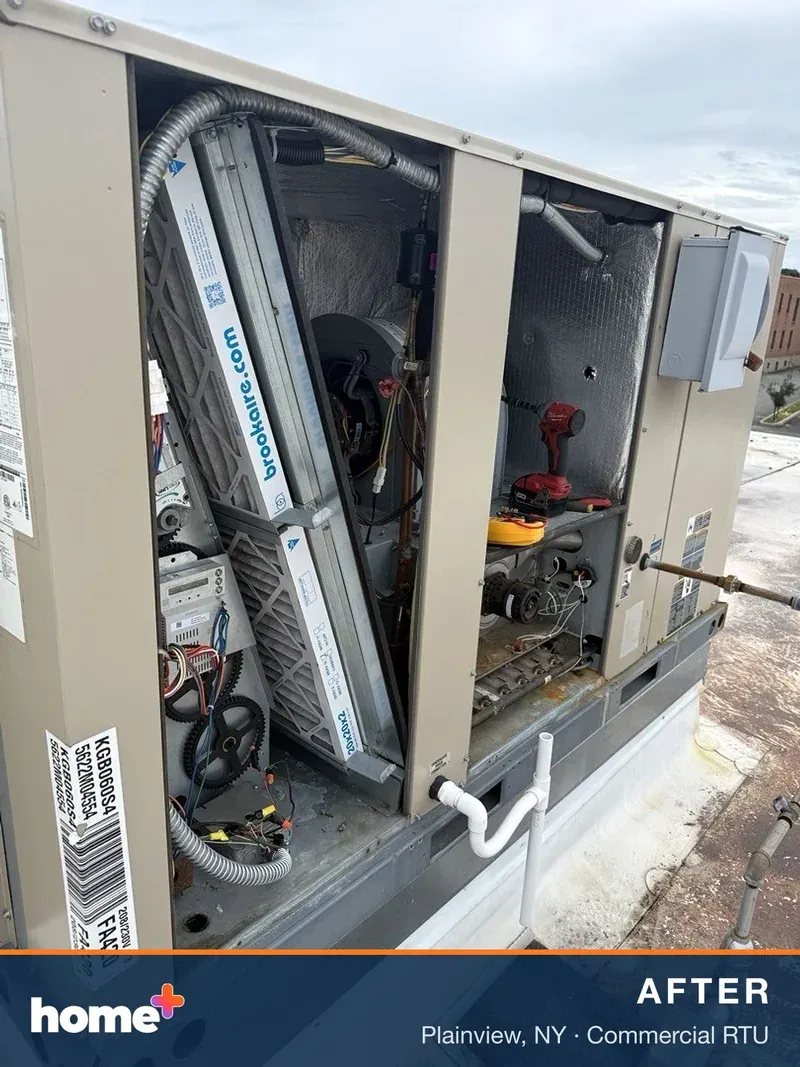
 Maintenance
Plainview, NY·Commercial rooftop units
Commercial Rooftop HVAC Inspection & Filter Change in Plainview
See the job
Retail and office HVAC is judged by two things: tenant comfort complaints and the operating cost that shows up on the bill.
Home+ works packaged rooftop units for strip malls, storefronts and office suites across Nassau County and Western Suffolk, documenting equipment condition, zone assignment, controls and lease responsibility before recommending work.
Multi-tenant calls resolve faster when we know which unit serves which space and who authorizes the work.
Property-level symptoms
The pattern across strip malls and office buildings is consistent: aging packaged equipment, unmapped zones and controls nobody has reviewed in years.
The same suite calls every season, which points to zoning, distribution or a unit sized for a different use than it serves now.
Unlabeled rooftop equipment turns every service call into a discovery exercise and delays repairs.
Failed economizers, stuck valves, dirty coils and simultaneous heating and cooling all inflate cost quietly.
Missing or wrong schedules keep units conditioning empty space overnight and on Sundays.
Packaged units with growing repair histories and constrained parts belong in a planned replacement schedule, not an emergency.
New walls, added glass, server rooms or a different tenant type invalidate the original zoning and airflow.
Multi-tenant scope
In a leased property, scope clarity is what prevents a dispute later. The written option should be explicit about boundaries, authorization and impact.
How the work runs
Document every unit, its nameplate and the suite it serves so future calls start with facts instead of guesswork.
Check capacity, airflow, static pressure, economizer function and schedules against how the spaces are actually used.
Separate immediate repairs, corrective work, scheduled maintenance and units that belong in a replacement plan.
Perform work in off-hours or weekend windows agreed with the property team, with notification handled up front.
Budgeting and tenant SLAs
Packaged rooftop equipment fails on the hottest and coldest days, which is exactly when lead times and premiums are worst. A documented roof inventory turns that into a budget line.
Knowing model, age, refrigerant and repair history per unit lets you sequence replacements across fiscal years.
Scheduled maintenance with documented visits supports tenant response expectations and keeps warranty conditions intact.
Correct schedules, sensors and economizer operation often recover comfort and cost without replacing equipment.
Qualifying equipment and controls projects may be eligible; confirm current program requirements and amounts in writing before purchase.
Request commercial service
Share the property, rooftop unit count, affected suites and who authorizes work. The commercial team will confirm scope fit and the next site-review step by phone.
Prefer to speak with dispatch?
(516) 259-1191Service area
Current coverage is centered on Nassau County. Dispatch confirms the address, equipment, roof access, project fit and current availability before scheduling.
Home+ focuses on residential and light-commercial HVAC. Equipment type, capacity, controls, fuel, roof access and site requirements must be reviewed so the team can confirm capability and the right next step.
Recent work
MaintenancePlainview, NY·Commercial rooftop units
See the job
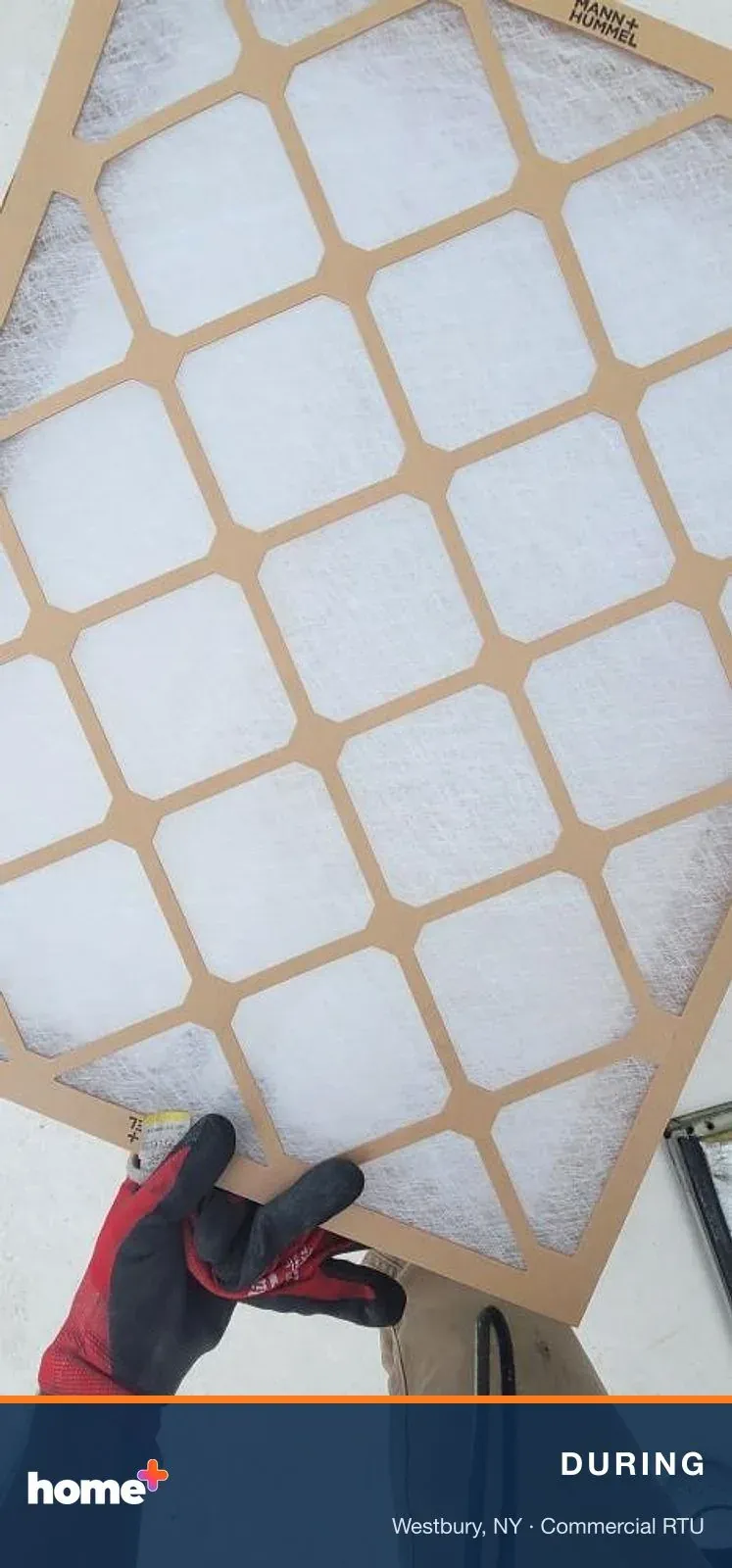 Maintenance
Westbury, NY·Commercial rooftop units
See the job
Photos enhanced for clarity.
Frequently asked questions
It depends on how the building is divided and metered, not on square footage alone. Most Long Island strip malls run one packaged rooftop unit per tenant space so each tenant controls and pays for its own comfort. Office buildings may use one unit per floor or per zone. The tenant layout, lease boundaries, existing curbs and duct drops determine the practical answer.
That is set by the lease, not by code. Triple-net leases commonly assign maintenance and sometimes replacement of the unit serving the demised premises to the tenant, while the roof itself stays with the landlord. Read the maintenance, repair, replacement and capital-expense clauses, and confirm in writing who approves and pays for each item before work is scheduled.
Usually zoning and air distribution. A single thermostat controlling a space with a sunlit glass front, an interior core and a server closet cannot satisfy all three. Measuring airflow per diffuser, checking static pressure, relocating or adding sensors, adding zone control, or correcting duct distribution addresses it more reliably than changing the setpoint.
The dependable items are scheduling, economizer operation, filter and coil condition, correct airflow, and repairing simultaneous heating and cooling. Occupied and unoccupied schedules matched to real store or office hours often produce the largest reduction without any equipment purchase. Savings depend on the building, rates and current condition, so we do not publish a guaranteed percentage.
Business incentives may be available for qualifying equipment, controls and efficiency projects, but eligibility, funding and requirements change. Review the current PSEG Long Island business program and obtain participation requirements and any estimated incentive in writing before purchase or installation.
Frequently, with planning. Rigging, roof access, electrical shutdown and duct work can often be scheduled before opening, after closing or on a weekend. The scope should state expected downtime per space, parking or sidewalk impacts, landlord notification and how tenants will be informed.
Compare repair, maintenance, replacement planning and recurring commercial coverage.